

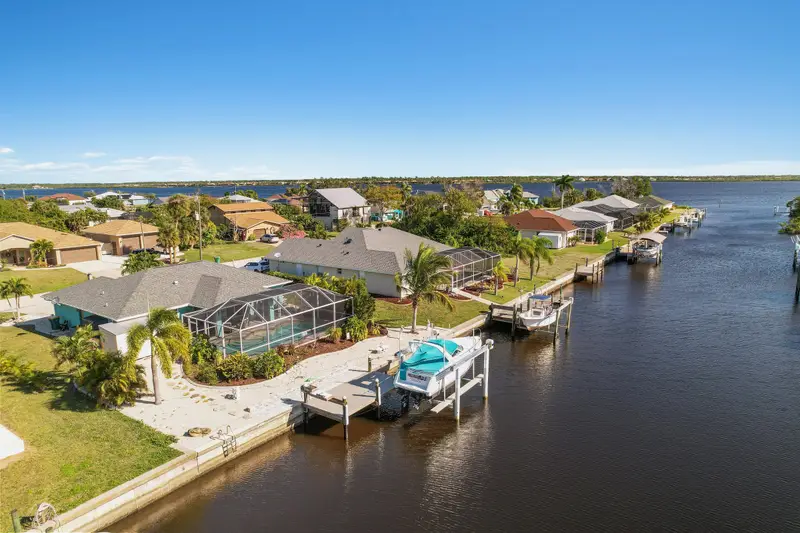
If you’ve spent any time looking at Cape Coral, you’ve probably heard the line: more than 400 miles of navigable waterways, more than any other city in the world. That’s true. But it’s also the most useless single sentence anybody can tell you about Cape Coral if you’re actually trying to buy a house here. Because those 400 miles aren’t 400 miles of the same thing. They’re three completely different products, sold for three completely different prices, and the difference between them is the single most important question you can ask about any Cape Coral waterfront listing.
Search Cape Coral homes
Browse Cape Coral homes for sale, gulf access homes for sale, or Cape Coral homes under $500,000. Compare direct gulf access homes and explore the Cape Coral guide.
I’m Brayden Milner. I’m a third-generation Realtor with Florida Future Realty, born and raised in Cape Coral. Real estate isn’t a career I chose out of a catalog. It’s the water I grew up swimming in. I have spent my entire life on these canals, and I’ve watched buyers from out of state pay six-figure premiums for a “Gulf access” home and only realize after closing that they can’t actually take a sailboat under the bridge at the end of their street. That conversation is brutal. I don’t want you to have it.
So here’s what this article is. It’s the canal walk-through I give every relocation buyer the first time we sit down. The three-tier hierarchy. What “direct” and “indirect” actually mean when the boat is in the water. The Chiquita Lock removal and what changed in 2025. Seawall economics, dock costs, and the questions you need to ask before you write an offer. By the end of this, you’ll be able to walk a Cape Coral listing and read the canal it sits on the same way I do.
Why Cape Coral Has 400+ Miles of Canals in the First Place
You can’t read this market without understanding that Cape Coral is, in the most literal sense possible, an engineered city. It was founded in 1957 by Leonard and Jack Rosen, two brothers who bought roughly 103 square miles of raw swamp and pine flatwoods in northwest Lee County. The land had no roads, no utilities, almost no structures, and very little dry ground. The Rosens did not develop the land the conventional way. They platted the entire 103 square miles into a uniform grid of residential lots before any infrastructure existed, and then they dredged hundreds of miles of canals through the limestone substrate to give those interior lots waterfront access.
The fill dirt from the canals raised the adjacent lots above natural grade. The canal-lot grid that defines the city today is a direct, physical result of that single dredge-and-fill decision in the 1960s. Cape Coral didn’t grow into a canal city. Cape Coral is a canal city by design. (We cover the founding story in more detail in Cape Coral 101: A Local’s Honest Overview.)
Two facts come out of that history that matter for everything below:
- The canal grid is fixed. The plat was drawn in the late 1950s and can’t be redrawn. The canals you see today are the canals that will exist tomorrow.
- The canals were built in phases over decades, in different parts of the city, with different purposes. The southern quadrants got salt water canals connected to the Caloosahatchee River. The northern quadrants got freshwater canals that never connect to open water at all.
That single fact, that not every “canal lot” is built for the same use, is where the three-tier hierarchy comes from.
The Three-Tier Canal Hierarchy (This Is the Whole Game)
Every canal lot in Cape Coral falls into one of three categories. The price difference between them, on otherwise comparable houses, can be $200,000 or more. So this is not an academic distinction.
Tier 1: Direct Gulf Access (Premium)
Direct Gulf access means exactly what it sounds like, and the line I use on tour videos is the cleanest definition you’ll find: “no bridges, no locks, nothing intruding your way to get out to the Gulf.” A direct-access lot puts you on a canal that runs without obstruction to the Caloosahatchee River, which dumps you into San Carlos Bay, which connects you to Fort Myers Beach, Sanibel, Captiva, Boca Grande, and the open Gulf. Straight shot.
That’s the thing buyers are paying for. No tide-timing your departure. No waiting for a lock. No measuring the height of your T-top against the bottom of a fixed bridge. You back out of your slip, you idle to the end of the canal, and you’re in open water. For a serious boater, especially anyone with a center console over 25 feet, a flybridge, or a sailboat, this is the only tier that actually works.
Direct access concentrates in a few specific areas of the city:
- Southeast Cape: The Yacht Club basin and the older direct-access canal reaches that feed into the Bimini Basin and out to the Caloosahatchee. This is the oldest direct-access inventory in the city, dating to the 1960s and 1970s.
- Southwest Cape: Cape Harbour, Tarpon Point, and the canal reaches that historically required the Chiquita Lock until its removal (see the next section). Newer construction. Higher price ceiling. Generally fewer bridges to deal with even within the SW canal network.
- Pockets of NE/NW connected through the Northwest Spreader: Less common, more constrained, and not the same product as SE or SW direct access.
The price impact is real, and I’m not going to pin a fake-precise citywide number to it in print, because medians move every quarter with mix and inventory, and a stale number does you no favors. What holds up every time I pull current comps: direct Gulf-access single-family homes carry a premium over freshwater canal homes that regularly runs into six figures on otherwise comparable houses, and freshwater in turn tends to price above true off-water inventory with no canal at all. Two houses of the same size and finish quality on different tiers will not appraise the same and will not sell for the same number, full stop. If you want the actual current medians for the specific canal or neighborhood you’re looking at, ask me directly and I’ll pull the live comps instead of handing you a number that’s already stale by the time you read it.
Tier 2: Indirect Gulf Access (the “Sailboats Need Not Apply” Tier)
Indirect access is where buyers get confused the fastest, because the MLS field still says “Gulf access” and the listing agent will absolutely use those two words to describe the property. Technically, that’s accurate. The canal does eventually connect to the Caloosahatchee. You can get a boat from your dock to open water. What the listing doesn’t always say is how, and at what cost in time and vessel size.
Indirect access usually means one of two things, and sometimes both:
- Fixed bridges between you and the river. Cape Coral has dozens of vehicular bridges crossing its canal network. Vertical clearance runs roughly 6 to 10 feet above mean high water, and nearly half of the canal bridges in the city’s inventory come in under 8 feet. If your boat plus your T-top plus your antennas is taller than that clearance, you cannot get under the bridge. A sailboat with a 35-foot mast doesn’t even qualify for the conversation. This is where the old phrase comes from: sailboats need not apply.
- A lock between you and the river. Historically, the Chiquita Lock in Southwest Cape was the most famous example. The Northwest Spreader had a single structure of its own — the Ceitus boat lift and barrier, a barrier with a boat lift rather than a true lock — and it was removed in 2008; boats in the NW spreader canals have exited toward Matlacha Pass without any lock since then.
What “indirect” actually feels like in practice: you fire up the boat, idle to the end of your canal, idle through whatever bridges sit between you and the next major waterway, possibly wait at a lock cycle for 15 to 30 minutes each direction, and only then reach the river. Plenty of people boat happily off an indirect-access lot for decades. Center consoles in the 22 to 24 foot range, bay boats, jon boats, pontoons. The boat just has to fit under the lowest fixed bridge in your path.
The price discount for indirect versus direct is meaningful, often noticeably lighter than a comparable direct-access home on the same kind of street. For a buyer whose boat fits and who doesn’t mind the idle, indirect can be the smartest value play in the whole city. For a buyer who’s already shopping for a flybridge or a sailboat, indirect is a non-starter even if the house itself is beautiful.
Tier 3: Freshwater Canals (Kayak Water)
Freshwater canals are the tier most out-of-state buyers don’t even know exist before they start shopping Cape Coral. These are the canals that run through Northeast and parts of Northwest Cape, and they are a completely closed system. They do not connect to the Caloosahatchee. They do not connect to the Gulf. They are landlocked freshwater bodies, fed by rain and stormwater, and they don’t go anywhere.
That doesn’t mean they’re not nice. Plenty of freshwater lots are gorgeous: wide canal views, fishing for bass and tilapia and the occasional tarpon that wandered into the system years ago, a kayak or paddleboard tied to a small dock for sunset paddles. People build beautiful homes on freshwater canals and love them.
What freshwater is not is a boating property. You will not be running a 26-foot Pursuit out to Sanibel from a freshwater lot. You will not be docking a 30-foot sailboat there. You will not be hopping over to Fort Myers Beach for dinner. The water doesn’t connect to those places, and there’s no fix for that. The plat is the plat.
This is why I push so hard on the question early. If you tell me you want to keep a 28-foot boat at your dock and I show you a freshwater lot, I’ve already wasted your day. The product doesn’t do the job. Freshwater is the most affordable waterfront tier in Cape Coral, and that affordability is real and earned. It’s also the tier where I see the most buyer-side regret when somebody buys without understanding what they bought.
The Chiquita Lock Removal: What Changed in 2023 to 2025
The biggest single shift in the canal hierarchy in the last decade is the removal of the Chiquita Lock in Southwest Cape Coral. For decades, the Chiquita Lock sat at the southwestern edge of the Cape Coral canal system, controlling the connection between a large network of SW canals and the Caloosahatchee River through the Spreader system. If you owned a home on one of those canals, your boat trip out to the Gulf required cycling through the lock in each direction. The cycle alone added 20 to 30 minutes per leg, and the lock physically constrained vessel size.
Functionally, the Chiquita Lock was the dividing line between direct and indirect access for an enormous slice of SW Cape inventory. Plenty of houses that look on a map like they should be direct-access were, until recently, indirect-access because of the lock. After the lock was removed, those canals re-rated. The same physical house on the same physical lot became a different product overnight, because the path to the Gulf no longer required a lock cycle.
The City of Cape Coral has published the official project records and timeline on the lock removal program; the city’s water resources pages are the authoritative source if you want the engineering and regulatory history (see capecoral.gov). The piece you need to know as a buyer or seller is this: certain SW Cape addresses that historically traded at indirect-access prices now trade at direct-access prices, and if you’re pulling comps from 2019 you may be looking at the wrong tier.
The other piece, which gets less attention but matters at the listing level: any agent who’s pricing SW Cape inventory using pre-removal comps is, structurally, mispricing the listing. We had to retrain ourselves on which addresses sit where in the hierarchy after the cutover. Some addresses that I would have called indirect three years ago, I now call direct. That’s not a marketing slide. That’s the boat actually getting to the river without a lock cycle.
Bridge Clearances and Sailboat Access Lots
Inside the direct-access tier, there’s a further layer that matters mostly to sailors and to anybody with a tall power boat: bridge clearance.
“Direct access” technically means no locks and no fixed bridges between your dock and the Caloosahatchee. In practice, even some direct-access canals have a low fixed bridge or two between certain interior lots and the river. The clearance under those bridges, at mean high water, runs roughly 6 to 10 feet on most canals, and even the tallest canal bridges top out well under 15 feet — the city’s bridge inventory maxes out just under 12 feet of clearance. The Cape Coral Bridge and the Midpoint Bridge over the Caloosahatchee itself are much higher; those are the bridges you cross in your car, not the canal bridges. Inside the canals, every bridge is a potential ceiling on your vessel.
For a sailboat, the bridge math is the whole equation. A mast that’s 35 feet above the water needs canal clearance well above that, plus tide cushion, plus rigging safety margin. Sailboat-access lots are the rarest segment of the Cape Coral waterfront market. They cluster in a small number of canals in Southeast Cape with unobstructed access to the river, no fixed bridges in the path, and water depth in the canal that supports a deeper keel. They trade at the top of the price band for that reason. If you’re shopping a sailboat-access listing, expect to pay for what you’re getting, and expect very limited inventory at any given time.
The practical rule I give buyers: if your boat is over 30 feet, or has a hardtop, or carries a tall T-top with electronics, get the exact canal path mapped before you write an offer. Don’t trust the listing description. Pull up the canal on satellite, identify every bridge between the dock and the river, and verify the clearance under each one at mean high water. If you skip that step, the boat you’re planning to buy might not fit the home you’re about to buy.
Seawall Economics (the Number People Miss)
Here’s the part of the canal conversation that buyers from out of state almost never see coming: the seawall is part of the house.
Every canal lot in Cape Coral is held back from the canal by a concrete seawall. The seawall protects the lot from erosion, retains the fill that the Rosens dredged up in the 1960s, and holds the line between your back yard and the water. Seawalls are structural. They are not optional to maintain. And they have a finite life.
Typical replacement cost for a concrete panel seawall runs in the $650 to $900 per linear foot range in current market conditions, with the broader market spanning roughly $400 to $1,200 per linear foot depending on site and spec. A standard Cape Coral canal lot has 80 to 100 feet of water frontage. Do the math: a full seawall replacement on a typical lot runs roughly $52,000 to $90,000 at today’s panel pricing. On a corner lot with longer water frontage or a wider canal-facing layout, it can run more. That’s not a deferred maintenance line item you discover in year five and address casually. That’s an infrastructure cost that can push six figures, and it lives on every waterfront house in the city.
Seawall lifespan depends on construction era and method. Most Cape Coral seawalls run 30 to 50 years before they need significant work or full replacement, with older 1960s and 1970s walls in Southeast Cape now reaching or exceeding that envelope. Signs of failure include cracking, leaning, tieback corrosion at the cap, and visible voids behind the wall where backfill has washed out. None of those issues are cosmetic. Each one is structural.
A seawall inspection during due diligence runs roughly $500 to $800 and is one of the highest-leverage inspections you can pay for on a waterfront purchase. Skipping it because the wall “looks fine from the deck” is, in my opinion, the single most expensive mistake buyers make on Cape Coral canal homes. A failing seawall is a $100K negotiating point, or a $100K post-close surprise.
The same logic applies to docks and lifts. A standard residential dock runs in the $25,000 to $40,000 range to build new. Boat lifts vary widely by capacity. Saltwater accelerates wear on every metal component, every cable, every bolt. Waterfront lifestyle in Cape Coral is the upside. The maintenance carry on the wall, the dock, and the lift is the cost of admission. Build the number into your purchase math before you write the offer, not after.
How Canal Tier Stacks Against Flood Zones and Insurance
Canal tier doesn’t exist in isolation. The same Gulf-access waterfront that gives you boating access also gives you exposure to storm surge, which means most direct-access lots in Cape Coral sit in FEMA flood zones AE (the 1% annual chance zone) rather than in the lower-risk Zone X band. That has direct insurance consequences. Flood insurance on a Zone AE waterfront home runs meaningfully higher than on a Zone X freshwater home, sometimes by thousands of dollars per year. I cover the mechanics in detail in Cape Coral flood zones and the carrier-side dynamics in The Cape Coral Insurance Landscape: Wind, Flood, and Citizens 2026.
The honest tradeoff: the canal that gives you the boat ride to Sanibel is the same canal that pushed surge water into Yacht Club homes during Hurricane Ian. There’s no clean way to have the lifestyle without the exposure. That’s the cost of living in paradise, and it’s a real cost. Anyone who tells you otherwise is selling you something.
The good news is that current building code, post-Ian construction, elevation, impact glass, and modern carrier underwriting can take a lot of the financial sting out of the equation. A new-build Gulf-access home with current-code elevation, impact windows, and a hip roof can sit in Zone AE and still carry insurance premiums that are meaningfully lower than buyers expect. The 1972 ground-level Yacht Club home with original openings and an aging roof is a different conversation. Same canal. Different risk profile. Different premium.
The Three Questions to Ask Before You Buy Any Cape Coral Waterfront Listing
If you remember nothing else from this article, remember these three. I ask them on every waterfront showing. They cut through the marketing language faster than anything else I know.
- Direct, indirect, or freshwater? Force the agent to give you a one-word answer. “Gulf access” is not an answer. If the answer is indirect, the next question is what’s between this dock and the river. Bridges, a lock, both? If the answer is freshwater, the answer is the boat conversation is done.
- What’s the lowest fixed bridge between this dock and the Caloosahatchee, and what’s the clearance at mean high water? If you’re a boater, this is the number that decides whether the boat you own (or the boat you want) actually works at this address.
- How old is the seawall, and when was the last marine inspection? If the answers are “no idea” and “never,” you need a seawall inspection in your due diligence period and you need to be prepared for the report to come back with real numbers. The seawall is the largest single infrastructure component on a waterfront lot. Don’t buy one blind.
Add a fourth if you’re shopping in Northeast or Northwest Cape: are city utilities in and paid, or is the property on well and septic with assessments pending? That’s a separate conversation we cover in the quadrant-by-quadrant neighborhoods breakdown, but it’s the next-most-common surprise in NE/NW waterfront purchases.
Why the Canal Tier Drives Resale Liquidity Too
One last thing worth saying, because most buyers don’t think about it on the way in. The canal tier you buy on shapes the resale audience you’ll have when you go to sell.
Direct Gulf-access homes have the deepest buyer pool in the city. Boat owners, second-home shoppers, cash offers from the Northeast and the Midwest, and out-of-state buyers all converge on direct access. Even in a buyer’s market, the direct-access tier moves. Cape Coral isn’t the only place in Florida with waterfront, but it’s one of the few places where direct Gulf-access homes with no HOA still trade at meaningfully lower numbers than comparable inventory in Naples or Sarasota. That price gap is the structural reason the demand stays.
Indirect-access homes have a narrower buyer pool, mostly local boaters and value-shoppers, but the pool is real and the discount versus direct often justifies the tradeoff for the right buyer.
Freshwater canal homes compete with off-water single-family homes more than with the Gulf-access tiers. The buyer pool wants a water view without needing the boat. That’s a real market. It’s a different market.
None of these tiers are wrong. All three serve a specific buyer. The mistake is buying for one use case and ending up on the wrong tier for that use case. That’s the entire point of this article.
Frequently Asked Questions
Does every canal in Cape Coral connect to the Gulf?
No. Cape Coral’s canal system is split into three tiers. Direct Gulf-access canals connect to the Caloosahatchee River and out to the Gulf with no locks and no fixed bridges in the path. Indirect Gulf-access canals eventually reach the river but require navigating under fixed bridges (roughly 6 to 10 feet of clearance, with nearly half of the city’s canal bridges under 8 feet) or, historically, through a lock. Freshwater canals in Northeast and parts of Northwest Cape do not connect to the Gulf at all; they are landlocked stormwater systems used for fishing, kayaking, and water views.
What does “direct Gulf access” mean in Cape Coral?
Direct Gulf access means a canal with no locks and no fixed bridges between the home’s dock and the Caloosahatchee River. From the river, you have a straight shot through San Carlos Bay to Fort Myers Beach, Sanibel, Captiva, and the open Gulf. Direct access is the highest tier of Cape Coral’s waterfront hierarchy and commands a meaningful price premium over indirect or freshwater inventory because it works for any vessel size, including sailboats and large power boats with hardtops.
Can a sailboat fit in a Cape Coral canal?
Only if the canal qualifies as direct Gulf access with no fixed bridges and adequate water depth in the canal itself. Sailboat-access lots are rare in Cape Coral and concentrate primarily in specific reaches of Southeast Cape with unobstructed paths to the Caloosahatchee River. If you’re shopping for a sailboat-compatible property, get the exact path mapped before you write an offer and verify bridge clearance under any structure between the dock and the river.
What happened with the Chiquita Lock in Cape Coral?
The Chiquita Lock in Southwest Cape Coral was removed in the 2023 to 2025 window. Before removal, the lock controlled the connection between a large network of SW canals and the Caloosahatchee River and added 20 to 30 minutes of transit time each direction for boats traveling to the Gulf. Its removal re-rated many SW Cape canal addresses from indirect-access to direct-access status, with corresponding effects on property values, comp analysis, and buyer demand. Refer to the City of Cape Coral’s water resources records for the official project history and timeline.
How much does it cost to replace a seawall in Cape Coral?
Seawall replacement for a concrete panel wall currently runs roughly $650 to $900 per linear foot in Cape Coral, with the broader market spanning roughly $400 to $1,200 per linear foot depending on site and spec. A standard 80 to 100 foot canal lot translates to a roughly $52,000 to $90,000 full replacement cost at today’s panel pricing, with corner lots and wider frontage configurations running higher. Seawalls have a 30 to 50 year functional lifespan depending on construction era, soil conditions, and tieback condition. A pre-purchase marine inspection costs $500 to $800 and is one of the highest-leverage diligence items on any waterfront contract.
Are freshwater canal homes a bad investment in Cape Coral?
No. Freshwater canal homes serve a real and growing buyer pool: waterfront views and lower carry costs without the maintenance and insurance load of Gulf-access property. They are the most affordable tier of Cape Coral’s waterfront inventory and they appreciate alongside the broader Cape Coral market. The mistake to avoid is buying a freshwater home expecting to keep a boat that needs Gulf access; the canal does not connect to open water and there is no fix for that.
Do I need flood insurance on a Cape Coral canal home?
If the home sits in FEMA Flood Zone AE and you have a federally backed mortgage, your lender will require flood insurance. Most direct Gulf-access waterfront homes in Cape Coral sit in Zone AE because of storm-surge exposure. Even on lots that fall outside the mandatory-purchase zones, flood insurance is something I recommend buyers seriously consider. Roughly 40% of National Flood Insurance Program claims come from properties in lower-risk zones. Read the full breakdown in our Cape Coral Flood Zones guide.
The Bottom Line
The Cape Coral canal system is one of the most distinctive residential infrastructures in the United States. It is also one of the most misunderstood by out-of-state buyers, because the language the market uses (“Gulf access,” “waterfront,” “canal lot”) covers up a three-tier reality that has six-figure price consequences and direct lifestyle implications for the boat you can keep and the trips you can take.
Direct Gulf access is the premium tier and the only tier that works for serious boats, sailboats, and frequent open-water use. Indirect Gulf access is the value tier for boaters whose vessels fit under the bridges. Freshwater is the affordability tier for buyers who want the water view without the boat. The Chiquita Lock removal in 2023 to 2025 re-rated a large slice of SW Cape inventory upward, and any comp analysis using pre-removal data needs to be re-checked. The seawall is part of the house. The bridge clearance is part of the boat’s purchase decision. The flood zone is part of the insurance bill. All of it fits together.
If you’re trying to figure out which tier matches your use case, or you’re sitting on a listing and don’t know which tier you’re actually buying, that’s exactly the conversation I’m built for. I grew up on these canals. I know the bridge clearances by canal name. I know which SW addresses re-rated after the Chiquita Lock came out and which didn’t. If you guys want a real walk-through of a specific property or a tour of the three tiers in person, that’s a 15 to 30 minute conversation and it will save you the kind of mistake that only shows up after closing.
Reach out and let’s talk about your Cape Coral waterfront search. Whether you’re a year out or actively writing offers, I’ll give you the same straight read I give every buyer who sits down with me.
Go deeper
- Freshwater Canals in Cape Coral — the landlocked side of the system: where they are, what they cost relative to Gulf access, and what you can do on them.
- Boat Time to the Gulf — why “direct access” isn’t the same as “fast,” how bridge clearances decide it, and what the Chiquita Lock removal changed.
- Living in Cape Coral — the four quadrants, flood insurance, schools, and cost of living in one honest overview.
Search live listings: gulf access · direct gulf access · canal homes.