

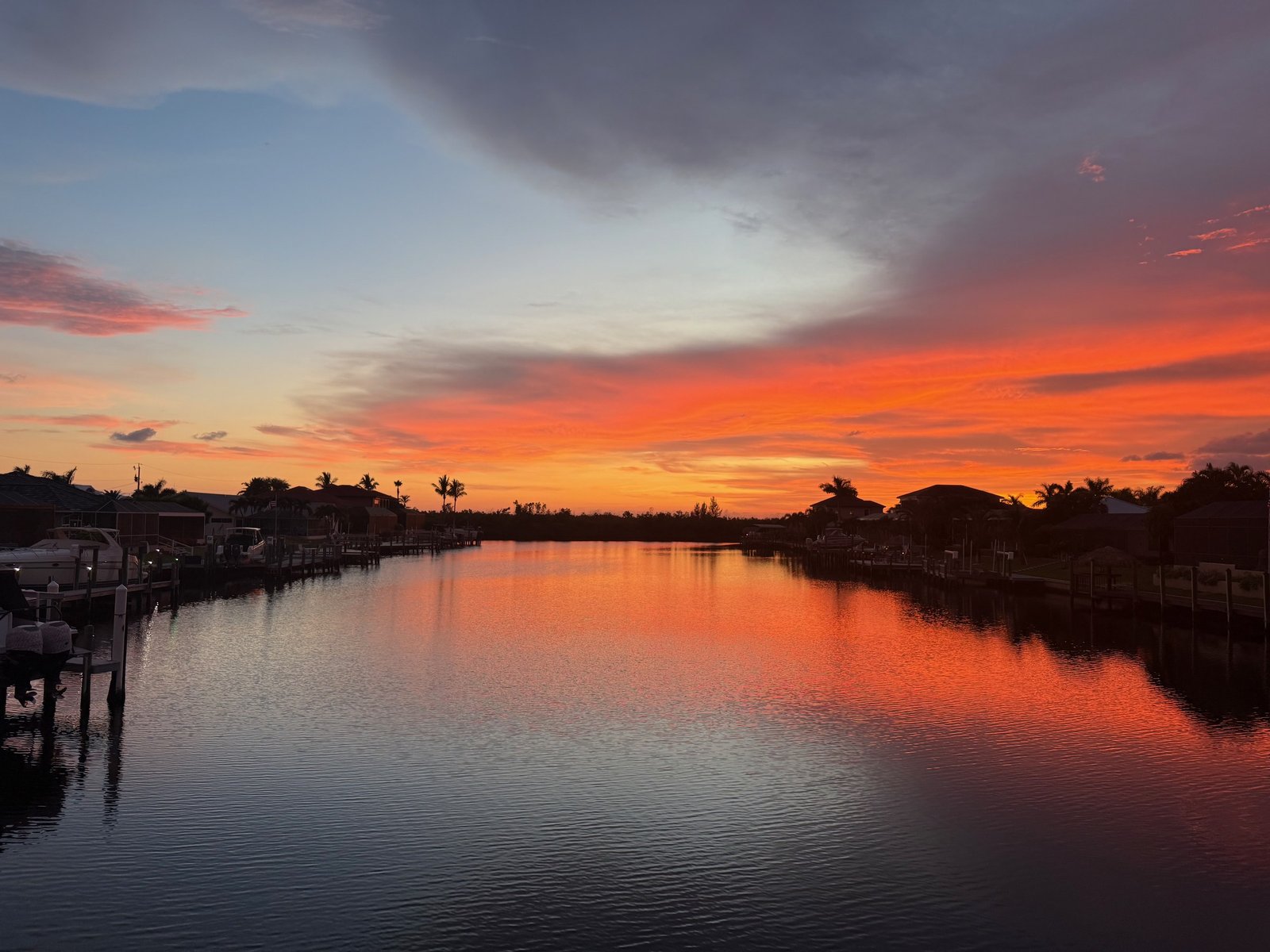
Hurricanes are the question every out-of-state buyer asks, and the question I almost never get a straight answer to from other agents. You either get the sales-side hand-wave (“we hardly ever get hit”) or doom-side overreaction shaped by whatever was on national news for the last 72 hours. Neither is honest. Hurricanes are real, they’re part of living here, and the gap between national coverage and lived experience in Cape Coral is wider than most people realize until they’ve been through a cycle or two.
I’m Brayden Milner, a third-generation Realtor with Florida Future Realty, born and raised in Cape Coral. Hurricanes aren’t abstract for me. I stood in a powerless house with my family for two weeks after Hurricane Ian. This is the conversation I have with every relocation buyer, and it’s the one I’m going to have with you guys here: the 95/5 split, the actual storm history (Charley, Wilma, Irma, Ian, Helene, Milton), why Ian was the 100-year storm, the structural advantages most national coverage skips, the seven prep pillars, and the question buyers should be asking instead of “is it safe.”
The 95/5 Split: The Honest Frame
Here’s the line I use with every relocation buyer the first time we sit down, and the line I want you guys to take seriously. Southwest Florida is paradise 95% of the year. The other 5% is hurricane season at its worst, and that 5% is real. But it’s not the kind of risk that should keep you from moving here, because the math doesn’t support panic.
Hurricane season runs June 1 through November 30, with peak impact roughly mid-August through mid-October. Within that window, the vast majority of named storms form and dissipate without coming near us, recurve into the open Atlantic, or track elsewhere. The chance that a given year produces a major-impact landfall on Cape Coral specifically is small, and the historical record bears that out. (You can pull the Atlantic hurricane database from NOAA if you want to look at the data yourself.) Long-time locals, my family included, talk about “only 3 or 4 major hurricanes in my whole life.” That’s the actual frequency. Not annual. The honest read: this is the cost of living in paradise. The other 5%, when it shows up, demands respect: you prep, you stay alert, you evacuate if you’re in Zone A or B and they call it, and you have a plan.
What Actually Happened: The Storm History You Guys Need to Know
Talking about hurricane risk in the abstract is useless. The only way you guys build a real mental model is to walk through the storms that mattered.
Hurricane Charley (August 2004)
Charley made landfall as a Category 4 with the eye over Punta Gorda. For Cape Coral, Charley was primarily a wind event. We took roof, screen, and tree damage but weren’t in the worst surge zone. Catastrophic damage was north of us, in Charlotte and DeSoto counties.
Hurricane Wilma (October 2005)
Wilma crossed Florida west to east. Cape Coral got wind impact. The 2004 to 2005 seasons triggered the second round of Florida Building Code tightening, which is why homes built after that period are structurally stronger.
Hurricane Irma (September 2017)
Irma was the first storm in a long time to put SWFL squarely in the cone. It made its first Florida landfall as a Category 4 near Cudjoe Key in the Lower Keys, then came ashore a second time near Marco Island as a Category 3 before tracking north through SWFL. Irma caused wind damage and inland flooding, but storm surge in Cape Coral was much smaller than Ian would produce five years later. The lasting impact was normalized roof replacement: a substantial share of SWFL roofs in service today were installed 2017 to 2019 as post-Irma replacements. A post-Irma roof is now a positive insurance signal.
Hurricane Ian (September 28, 2022)
Ian was the big one. No other honest way to put it. Ian made landfall at Cayo Costa, just north of Captiva, as a high-end Category 4 with sustained winds around 150 mph, then came ashore a second time near Punta Gorda. Fort Myers Beach took the peak storm surge at 10 to 15 feet, eastern Sanibel saw 9 to 13 feet, and Pine Island, the southern Cape Coral waterfront, and the communities at the mouth of the Caloosahatchee took 6 to 9 feet. The Yacht Club area in SE Cape was destroyed. Properties in FEMA Zone X dry for 30+ years took 2 to 4 feet of water. This is why I frame Ian as the 100-year storm: a statistical outlier that broke the historical model.
Inside Cape Coral, the main flooding was concentrated south of Cape Coral Parkway, southeast near the Yacht Club basin, and east of Del Prado Boulevard. North of those lines, plenty of homes took zero water and only experienced wind. The catastrophic flooding hit specific surge corridors with specific addresses. The rest of the city took wind, lost power, and got back to work. Most of Cape Coral was dark for roughly one to two weeks, with full restoration taking 11-plus days and the hardest-hit pockets out longer, and that’s why every local family I know has a generator now. Federal damage assessments are published by FEMA.
Hurricanes Helene and Milton (September to October 2024)
Two more storms hit Florida in 2024 in the same six-week window. Helene came through in late September as a Category 4 that landed in Florida’s Big Bend region; SWFL got tropical-storm-grade winds, and even with landfall 300-plus miles away, Helene still pushed 3 to 5 feet of surge into coastal Lee County. Milton came in October as a Category 3, landing near Siesta Key; surge here was far less than Ian’s, but Caloosahatchee-adjacent areas still saw 4 to 6 feet. Helene and Milton did re-traumatize the insurance market. On the flood-map side, though, the change buyers need to know about came earlier: Cape Coral’s current FEMA Flood Insurance Rate Map took effect in November 2022, moving some NW Cape areas that never flooded during Ian from Zone X into higher-risk designations, and no newer FEMA remap has followed the 2024 storms. That’s a real consequence even when physical damage was limited, because flood zone determines your insurance bill. I cover the zone mechanics in our Cape Coral flood zones guide; the short version is that buyers in NW Cape need to verify current FEMA zone designations rather than rely on lived experience.
Why Ian Was the “100-Year Storm” and Why the Rest Don’t Read Like Ian
The framing I keep coming back to: only one time in Cape Coral history have we had really, really bad flooding. That was Hurricane Ian, 2022. Milton and Helene, interior Cape Coral fared very well, though coastal and riverfront areas still took several feet of surge. Charley, Wilma, Irma were wind events. What made Ian different was the combination of a high-end Cat 4 strike on our coast, slow forward speed, a track that pushed the dirty side directly into Fort Myers Beach, Sanibel, Pine Island, and the southern Cape waterfront, and peak surge timed with high tide. Those factors stacked. That’s the 100-year-storm dynamic, and you guys need to understand why: every once in a long while, the variables align. Ian is the high-water mark in the historical record, and the rest of the storms in living memory don’t read like Ian. The frame is informed, not afraid.
CBS Construction: The Structural Advantage Most Out-of-State Buyers Don’t Understand
Here’s a fact that doesn’t make national hurricane coverage but matters enormously when you live here: 90 to 99% of Cape Coral’s housing stock is concrete block construction, or CBS. The walls are literal concrete blocks, filled and reinforced with steel rebar and concrete, then finished with stucco. This is not the wood-frame construction you guys are picturing from footage of storm damage in places like the Florida Panhandle, the Carolinas, or coastal Texas.
What CBS does in a hurricane: it doesn’t blow apart. The walls stay put. Roofs can fail (we’ll get to that), screen enclosures shred, and water can come in through openings, but the load-bearing walls of a CBS house are not going anywhere in a Category 4. Frame (wood) construction is rare in SWFL and is flagged by insurance carriers as a higher-risk profile. I cover the full housing-stock picture in our Cape Coral housing stock guide. The other major structural advantage is the 2002 Florida Building Code update, tightened again after the 2004 to 2005 seasons and again after Ian. Post-2002 construction in Cape Coral generally includes:
- Tied-down roofs. Hurricane straps and clips at every roof-to-wall connection. The roof is mechanically anchored to the walls in a way that resists wind uplift.
- Hip roof geometry where possible. Hip roofs perform better in wind than gable roofs and qualify for a meaningful insurance credit on the wind-mitigation report.
- Impact glass or shutter systems. New construction in Cape Coral’s $325K+ tier routinely ships with impact-rated windows and doors as standard.
- Elevated finished-floor heights. New construction must sit at least 1 foot above the parcel’s FEMA base flood elevation, which runs 7 to 10 feet in Cape Coral’s AE zones, and many builders go higher; finished floors around 11 feet are common. That extra margin kept many post-Ian new builds dry while older neighbors got water.
The line I use on tours is “great peace of mind for any hurricanes or storms,” because that’s literally what these features deliver. A CBS house with a post-Ian roof, impact glass, and 11 feet of elevation is structurally different from a 1970s ground-level Yacht Club home with original openings and an aging shingle roof, even on the same canal. Different risk profile, different insurance bill, different resale story.
Post-Ian Rebuilding: The Cape Today Is Structurally Stronger Than the Cape Before Ian
National news showed up for the destruction and left before the rebuild. If you guys are shopping the worst-hit areas (Yacht Club, southern waterfront, the surge corridors) now, rebuilt and newly constructed homes follow the latest Florida Building Code: finished floors at least 1 foot above base flood elevation (often around 11 feet), metal or reinforced roofs, full impact glazing, current wind-load standards. Premiums on properly built new CBS homes with impact windows and metal or tile roofs routinely come in under $3,000 a year, many under $1,500. Compare that to a 1970s direct Gulf-access home with original openings and a 2014 shingle roof, which can run $8,000 to $12,000 bucks a year for flood alone in Zone AE. Same canal, different premium. I cover the full carrier landscape in our Cape Coral insurance landscape guide.
The Seven Hurricane Prep Pillars (What Locals Actually Do)
Locals don’t improvise hurricane prep. There’s a routine, and most families run through it on autopilot once the cone starts including us. Here’s the framework I teach relocation buyers, organized around seven pillars. You guys can build your own version, but every functional Cape Coral prep plan covers all seven.
- Storm surge awareness. Know your evacuation zone (A, B, C, D, or E). Coastal and low-lying areas, Zones A and B, are the primary evacuation concern. Interior Cape Coral is generally less evac-sensitive. Look it up before the cone shows up, not during.
- Wind and construction readiness. Know what your house is built to. CBS or frame? Roof age and type? Tied-down? Hip or gable? Impact glass or shutters? A wind-mitigation inspection documents all of this and is one of the most important pieces of paper you can have.
- Shutters or impact glass. Kevlar fabric shutters, traditional bolt-in metal panels, impact-rated windows and doors, roll-down shutters, and accordion shutters all qualify for some level of insurance discount. Impact windows are most convenient because they’re always deployed. Whatever you have, know how to deploy it.
- Advance preparation. Water (one gallon per person per day, minimum seven days), non-perishable food, batteries, flashlights, battery banks, cash, documents in a waterproof folder, fuel for the generator and vehicles, medications, pet supplies. One-evening shopping trip, one-afternoon staging job, once per season.
- After-storm self-sufficiency. Plan to be without power for up to two weeks. After Ian, most of the Cape was dark for roughly one to two weeks, with the hardest-hit pockets out longer, and that’s the modern baseline. A generator, stored fuel, and food and water for two weeks is the working assumption. Don’t plan around restored services.
- Insurance and financial planning. Have your homeowners policy, flood policy, declarations pages, wind-mitigation report, elevation certificate, and agent contact information in one place, digital and paper. After a storm, the carriers that move fastest are the ones with policyholders who can produce documentation.
- Emotional and community resilience. Know your neighbors. Have a check-in plan with family. Don’t panic-watch national news for 72 hours straight. The local network around you is the actual emergency response. Build it before you need it.
None of this is exotic. It’s a routine, and it’s the cost of living in paradise. You learn it once, run it on autopilot every August through October, and the rest of the year you live on the water and forget about it.
Power Outages: The Quiet Part Out-of-State Buyers Don’t See Coming
Wind, rain, and surge get all the coverage. What defines the actual experience of a major hurricane is the power outage. After Ian, most of Cape Coral was without electricity for roughly one to two weeks, with full restoration taking 11-plus days and the hardest-hit pockets out longer. That can mean two weeks of no AC in subtropical heat, no refrigeration, no internet, no functional gas pumps, no traffic signals, limited cell coverage. It’s the single hardest piece of recovery for people who haven’t been through one before, and you guys need to plan for it as the modern baseline.
This is why the generator question gets serious so fast in Cape Coral. Options range from a portable gas generator to a whole-house standby on natural gas or propane. Neither is a luxury here. Stored fuel is the other piece: locals who learned from Ian keep 15 to 30 gallons of treated gasoline on hand during peak season, rotated through vehicles, because the gas stations with working pumps after a major storm run out within 24 to 48 hours. Stored bottled water at one gallon per person per day for seven days is the standard, with bathtubs filled before the storm for non-potable uses. Self-sufficiency for two weeks is the planning floor.
How My Family Handles It (Preparation, Not Panic)
I grew up watching my mom and grandparents prep for storms. Real estate is the water I grew up swimming in, and hurricanes are part of what came with it. Here’s the rhythm I want you guys to picture. Five days out, watch the cone. Three days out, if the cone still includes us, stage: water topped off, generators tested, fuel staged, documents in the waterproof folder, dock prepped, projectiles brought inside. Two days out, shutters or impact glass deployed, vehicles fueled. The night before landfall, the household is ready and the freezer is at maximum cold. We watch the storm come in, lose power in the eyewall, then run the after-storm routine: check neighbors, clear debris, assess, wait. None of this is heroic. The families that handle hurricanes best run the same checklist every season. That’s the cost of living in paradise. We pay it.
What Out-of-State Buyers Misunderstand (and What to Look for Instead)
The biggest misunderstanding, by a wide margin, is that national coverage of Florida hurricanes doesn’t differentiate between locations. A Category 4 in the Panhandle ends up in national news indistinguishable from a Category 4 in the Keys, even though the actual impact on Cape Coral can range from “nothing” to “10 days without power.” If you guys are absorbing national coverage, you’re building an exaggerated mental model. The second misunderstanding is that “in a flood zone” means “going to flood.” It doesn’t. Most of Cape Coral is in some FEMA designation because we’re a coastal canal city. The question is “what zone, what elevation, what construction, what insurance.” A new-build CBS home in Zone AE with 11 feet of elevation, impact glass, and a metal roof is a different risk profile from a 1972 ground-level home in Zone AE. Same zone, different products. The third misunderstanding is treating Ian as the baseline rather than the outlier. Ian was the 100-year storm.
So what should you look for on any specific property? Five variables, in order:
- Flood zone designation on the current FEMA map. Zone AE, X500, X, or another. Drives flood insurance bill and lender requirement.
- Construction type. CBS or frame. CBS is the baseline; frame is the red flag.
- Roof age and type. Post-Irma (2017+) is acceptable for most admitted carriers, post-Ian (2022+) is ideal, pre-2017 is increasingly a deal-killer. Metal and concrete tile outperform shingle.
- Shutter and impact-glass status. Impact windows are the gold standard. A wind-mitigation report converts whatever you have into a documented insurance discount.
- Finished-floor elevation relative to base flood elevation. New construction sits at least 1 foot above the parcel’s base flood elevation, and many builders go higher, to around 11 feet. An elevation certificate documents this and can lower your premium.
The zone, the walls, the roof, the openings, the elevation. Those five things combined tell you 90% of what you need to know about how a specific property will perform in a major storm and what your insurance bill will look like every year between storms. I cover the full relocation buyer process in our moving to Cape Coral 2026 guide and in Cape Coral 101: A Local’s Honest Overview.
The Honest Acknowledgment: This Is Real, and It’s Worth It
I’m not going to close this article by telling you guys hurricanes don’t matter. They do. Ian was a brutal experience for thousands of families, and recovery for the worst-hit neighborhoods is still ongoing in pockets four years later. Pretending otherwise would be the same dishonesty I criticize other agents for. What I will tell you is that the other 95% is genuinely paradise, and the trade is one millions of us make consciously and would make again. The waterfront lifestyle, canal access, no state income tax, year-round outdoor weather, boating, fishing, sunsets, the community that knows how to take care of itself when things get hard. The structural advantages (CBS construction, post-2002 building codes, post-Ian rebuilds, modern insurance landscape) mean the next hurricane cycle will be met with a stronger housing stock than any previous cycle. The frame is informed acceptance.
Frequently Asked Questions
Does Cape Coral flood every time a hurricane comes through?
No. Only one time in modern Cape Coral history has there been really, really bad flooding, and that was Hurricane Ian in September 2022. Milton and Helene in 2024 left interior Cape Coral largely unscathed, but coastal and Caloosahatchee-riverfront areas still saw several feet of surge, roughly 3 to 5 feet from Helene and 4 to 6 feet from Milton. Most hurricanes that affect SWFL produce wind damage and power outages, not widespread flooding in Cape Coral proper. Ian was the statistical outlier, not the rule.
How long was Cape Coral without power after Hurricane Ian?
Most of Cape Coral was without electricity for roughly one to two weeks after Ian, with full restoration taking 11-plus days and the hardest-hit pockets out longer. That’s the worst-case scenario in living memory and is why most local families now own or have priced out a generator. Self-sufficiency for up to two weeks is the standard planning assumption for any major hurricane impact.
Are Cape Coral homes built to survive hurricanes?
The vast majority are. 90 to 99% of Cape Coral housing stock is concrete block (CBS) construction with structural walls that don’t blow apart in a hurricane. Post-2002 construction includes tied-down roofs, hip-roof geometry where possible, and impact glass or shutters. New construction post-Ian is built with finished floors at least 1 foot above the parcel’s base flood elevation (often around 11 feet), with full impact glazing and current wind-load standards. Frame (wood) construction is rare and flagged by insurance carriers as higher-risk.
What was so different about Hurricane Ian compared to other Cape Coral storms?
Ian was a high-end Category 4 making landfall at Cayo Costa, just north of Captiva, with slow forward speed, a track that pushed the dirty side directly into the southern Cape Coral waterfront, and peak surge timed with high tide. Those variables stacked to produce 10 to 15 feet of storm surge at Fort Myers Beach and 6 to 9 feet along the Cape Coral waterfront, in areas that had been dry for 30+ years. That’s what made Ian the 100-year storm. Charley, Wilma, Irma, Helene, and Milton were primarily wind events for Cape Coral, not catastrophic surge events.
Did flood zones change after Ian and the 2024 storms?
The current map dates to November 17, 2022, just after Ian, when FEMA’s updated Flood Insurance Rate Map took effect and reclassified some NW Cape areas that never flooded during Ian from Zone X into higher-risk designations. No newer FEMA remap has occurred since; Helene and Milton in 2024 did not trigger another round of remapping. Buyers should still verify the current FEMA zone designation rather than rely on lived experience. See our Cape Coral flood zones guide.
Should I be worried about hurricanes if I’m buying in Cape Coral?
You guys should be informed, not worried. Hurricane risk is real, but the actual history shows long stretches between major-impact events, a resilient CBS housing stock, modernized codes, and a local population that knows how to prepare. The variables that matter for any specific property are flood zone, construction type, roof age, impact-window status, and elevation. Get a wind-mitigation report and an elevation certificate as part of due diligence.
How much hurricane prep do locals actually do each year?
The standard routine is a once-per-season equipment and supply check (water, food, batteries, fuel, generator test, document folder) plus a 24-to-72-hour staging window when a system enters the cone. Locals run through the same checklist every year as a routine cost of living in SWFL.
The Bottom Line
Hurricane risk in Cape Coral is real, manageable, and bounded, you guys. The 95/5 split is the honest frame. Ian (2022) was the 100-year outlier; Charley, Wilma, Irma, Helene, and Milton produced wind and outages rather than catastrophic surge. The structural picture (concrete block construction, tied-down roofs, post-2002 building code, post-Ian rebuilds) gives modern Cape Coral homes a meaningful resilience advantage. The seven prep pillars are a routine, and self-sufficiency for two weeks is the planning floor. Honest evaluation reduces to five variables: flood zone, construction type, roof age, impact protection, and finished-floor elevation. Get those right, carry the right insurance, build the prep routine into your annual rhythm, and hurricane risk becomes a known, managed cost. This is the cost of living in paradise. It’s real. It’s worth it.
Reach out and let’s talk about your Cape Coral search and what hurricane resilience looks like on a specific property. Whether you’re a year out or writing offers, I’ll give you the honest answer right here in paradise.