

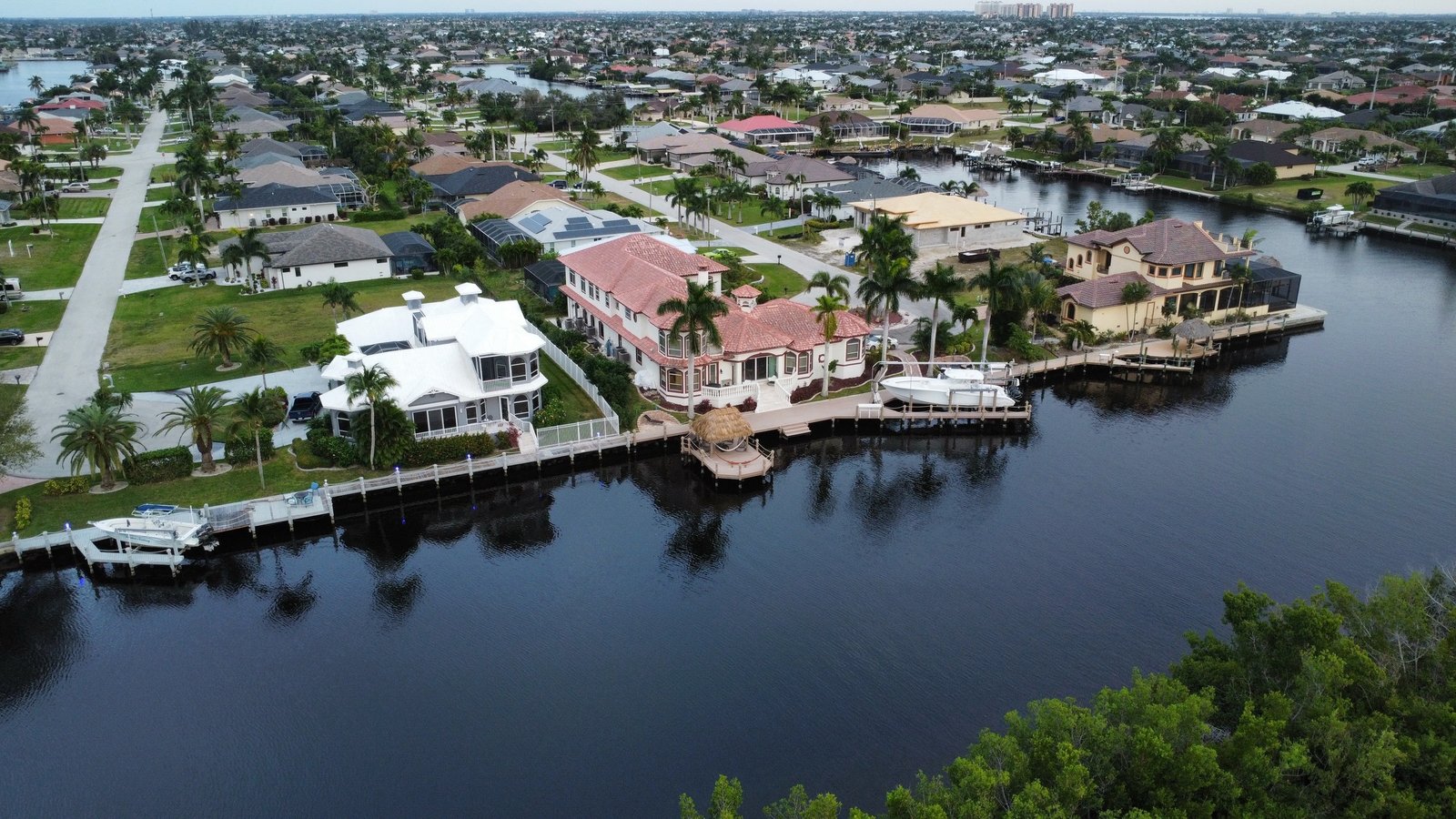
If you’ve spent a weekend on Zillow looking at Cape Coral, you’ve noticed something weird. Two houses on what looks like the same street, same bed/bath count, similar square footage, can be priced $150,000 apart. The listing copy doesn’t explain why. One says “updated.” One says “well-maintained.” Both have pools. Both are CBS. Same canal, even.
The thing actually driving that $150K gap, nine times out of ten, isn’t the kitchen or the staging photos. It’s the build era. Cape Coral has four very different construction eras stacked on top of each other in the same grid, and what era a house was built in tells you almost everything about the roof, the windows, the plumbing, the electrical panel, the insurance bill, and the work you’re about to inherit on day one.
I’m Brayden Milner. Third-generation Realtor with Florida Future Realty, born and raised in Cape Coral. Real estate isn’t a career I picked. It’s the water I grew up swimming in. This article is the build-era walkthrough I give every buyer the first time we sit down. Four eras, the seven-rung builder price ladder, the pool math, the pentad on off-water lots, and the eight things I read on any listing before I tell a buyer if it’s worth a showing. By the end of this you’ll be able to look at a Cape Coral listing and price the gap yourself.
Why Build Era Drives Almost Every Number on a Cape Coral House
You can’t read this market without understanding one structural fact: Cape Coral was platted in 1957 by the Rosen brothers as one giant pre-cut grid of roughly 120 square miles in northwest Lee County, but it has been built out in waves. Not all at once. Different decades, different codes, different materials. So when you walk the same neighborhood today, you’re walking past four different generations of construction philosophy sitting next to each other on the same canal. (We cover the founding story in detail in Cape Coral 101: A Local’s Honest Overview.)
What ties all four eras together is one thing: concrete block. The overwhelming majority of the housing stock here is CBS, which stands for concrete block structure — it’s the standard building method across nearly every era of Cape Coral construction. Frame construction (wood-built houses) is genuinely rare in Cape Coral, and when you do see it on a listing it’s an insurance red flag the carrier will ding you on. Concrete block is the baseline. That’s the floor. Everything else (roof, windows, plumbing, electrical, elevation) varies by era.
The reason era matters so much in 2026 is that Florida tightened the building code dramatically after Hurricane Andrew in 1992, tightened it again after the 2004 storm season, and tightened it again after Ian in 2022. The Florida Building Code today is one of the strictest in the country. The FEMA building-code resources at fema.gov document the full evolution. A house built to the 2026 code is a structurally different product than a 1972 Rosen-era starter home, even if they sit on identical lots and have the same square footage on the tax roll. Insurance carriers know this. Lenders know this. You guys need to know it too.
The Four Construction Eras (This Is the Whole Game)
Era 1: 1960s and 1970s (Rosen Era)
The oldest housing stock in Cape Coral is the original Rosen-era inventory, built during and just after the city’s founding. These are the small concrete-block houses you see all over Southeast Cape, the older interior streets of Southwest Cape, and the early pockets of Northeast. Typical Rosen-era home: 1,200 to 1,600 square feet, single-car carport or a tucked one-car garage, low or flat roof, jalousie windows in the original spec. The original floor plans were 2BR/1BA or 3BR/1BA, but decades of additions and remodels mean the typical Rosen-era home actually on the market in 2026 is a 3BR/2BA.
What’s under the skin of a Rosen-era home tells the whole story. The concrete block shell is rock solid. But the systems inside that shell are old. Cast iron drain lines on some of the originals, which corrode from the inside out. Polybutylene supply lines on a smaller subset of post-1978 stock, which is a known insurance flag and a leak risk. Electrical panels were often 60-amp or 100-amp originals, well under what a modern house needs to run AC plus an EV charger plus a pool pump. Roofs on this generation were flat or low-slope tar-and-gravel; most have been replaced two or three times by now, but a few originals are still out there in 2026 (and they are nearly uninsurable in the admitted market).
The Rosen-era home was built before modern hurricane code existed. No tied-down trusses to today’s standard. No impact glass. No elevation requirement above base flood. These were cheap, fast, affordable Florida starter homes for the 1960s relocation market and they did their job. Today they’re either fully renovated (different price, different conversation) or a value play for buyers who understand what they’re buying and what they’re going to spend to bring it current.
Era 2: 1980s and 1990s (Expansion Era)
The 1980s and 1990s pushed development west into Southwest Cape and north into parts of Northeast and Northwest. The product changed at the same time. Footprints grew, though more modestly than you might expect: the median 1980s–90s build runs about 1,650 square feet heated (up from roughly 1,520 in the Rosen era), and the 1,800-to-2,400-square-foot homes represent the top quarter of the era’s stock rather than the standard. 3BR/2BA became the dominant layout, two-car garages standard, lanais and screen pool cages on a much larger share of homes. Roofs switched from flat tar-and-gravel to asphalt shingles early in the era and concrete tile by the mid-90s. Plumbing is mostly copper or PEX on the later builds. Electrical panels stepped up to 150-amp or 200-amp service.
What’s missing from 1980s and 1990s stock is impact protection. This is the pre-Andrew code era and the very early post-Andrew adjustment period. Original windows are single-pane, sometimes double-pane on the late-90s builds, but very rarely impact-rated. Most of these homes either have storm shutters (accordion, panel, or roll-down) added at some point or they’re naked. That matters for insurance, and it matters for what you’re going to spend in year one if you want great peace of mind for the next storm.
Era 3: 2000s (Post-Andrew Code Maturity)
The 2000s era is where the Florida Building Code starts looking like what we have today. Post-Andrew requirements ramped up through the late 90s and got codified into the modern statewide building code by 2002. Houses from roughly 2002 onward have meaningfully better hurricane engineering than anything before: hip roofs more common (more aerodynamic than gable in high wind), tied-down truss-to-wall connections to a real spec, impact glass becoming a buyer option mid-decade and standard on the upper tiers, and elevations getting more attention as flood-zone awareness improved.
The 2000s also gave us the modern lanai-and-pool package as the default for anything over 1,800 square feet: paver decking instead of broom-finish concrete, picture-window screen cages so you don’t lose the canal view, screened summer kitchens on the upper tiers, pool heaters as regular spec. Kitchens started showing the wood-cabinet-and-granite look still common today. This is the era where you start finding what I call honest middle-ground value: a 2005-built CBS home with a 2018-or-newer roof and impact windows added or original is close to a new build on insurance and carrying cost but trades at a meaningful discount to current new construction. For a buyer who doesn’t need the brand-new finish package, this is often the smartest tier in the city.
Era 4: 2010s, Post-Ian, and Current Code (the New Build Tier)
The current Florida Building Code era is where the structural engineering is essentially as good as it gets in residential construction in this country. Full impact glass on every window and every exterior door. Tied-down roof trusses with hurricane straps and clips that match a spec the inspector verifies. Metal roofs or architectural-grade shingles with high wind ratings. CBS construction with reinforced stem-wall foundations. Post-Ian rebuilds are commonly elevated to (or above) the base flood elevation required for their specific FEMA zone, and many new builds add extra freeboard above the minimum, which puts the finished floor meaningfully above where the pre-Ian housing stock sat.
Inside the modern build, you’re getting features that didn’t exist as a default 20 years ago. Soft-close cabinets all throughout the kitchen. PEX plumbing on a manifold system. 200-amp electrical with provisions for EV charging. Wired and Wi-Fi smart-home packages on the upper tiers. Spray-foam insulation in the attic on some specs. The energy bill on a current-code home is meaningfully lower than on a 1990s home of the same size.
The insurance number is what really separates this tier. A current-code CBS home with impact windows, a metal or current-shingle roof, and proper elevation can routinely insure for under $3,000 per year, with plenty of new builds coming in under $1,500 and the smallest builds reportedly as low as around $900. Compare that to a 1972 Rosen-era home with original openings and an aging roof, which can run $5,000 to $10,000 per year or be uninsurable in the admitted market entirely. That delta compounds over a 10-year hold and is one of the strongest financial arguments for new construction in this market. (Full carrier-side mechanics in the Cape Coral Insurance Landscape guide.)
The Seven-Rung Builder Price Ladder for New Construction
If you’re looking specifically at new construction in 2026, Cape Coral’s builder market sorts into roughly seven price rungs. Different builders own different rungs. Knowing which rung you’re shopping in and who builds there saves you a ton of time and gives you a real read on what’s standard, what’s an upgrade, and where the incentives live.
- Rung 1, starter resale at roughly $250K and under: Older Rosen-era stock, almost always needing roof, windows, and mechanical work to be insurable at a normal premium. CBS shell is solid. Everything else is a renovation project. Real for cash purchases and experienced rehabbers, hard when you need financing and a clean insurance binder.
- Rung 2, sub-$325K new construction: Entry-level new build, mostly off-water in Northeast Cape. Builders like Coaston Homes and Christopher Alan Homes operate this rung, with models running roughly $285K to $317K. CBS construction is standard. Impact windows may not be standard at this rung (verify on the spec sheet).
- Rung 3, $325K to $500K (the impact-windows inflection): This is the rung where impact windows become standard equipment instead of an upgrade. Sun Life Homes is a named builder in this rung with the Sunset Harbor starting around $350K. Insurance pricing drops noticeably at this level because the wind-mitigation features are built in from day one.
- Rung 4, $500K to $900K mid-market: Bigger lots, more customization, often canal-adjacent or canal-frontage on freshwater. Lauren Homes is a local family-owned name that anchors this rung. Pool and impact windows are expected as standard, not as upgrades.
- Rung 5, $800K to $1.2M luxury: Full luxury spec on Gulf-access or premium canal lots. Frey & Son Homes is a named builder in this rung with the Marsala spec model around $1.2M and a base build-on-your-lot starting under $800K. Boat dock and lift potential is part of the package conversation.
- Rung 6, $1.2M to $2M semi-custom and custom: Driftwood Coastal Craft Homes is a named operator in this rung. Feature-heavy spec: smart home, wine cellar, gas propane, premium finishes. These homes go on the best waterfront lots.
- Rung 7, $6M and above mansion tier: Caloosahatchee riverfront, deep-water access, ultra-custom builds. Limited inventory at any given time. Different buyer pool, mostly cash, mostly out-of-state or international.
National builders are also active. D.R. Horton’s Stonewater community in Northwest Cape is one of the more visible national-builder footprints, organized around a network of freshwater lakes with floor plans starting around 1,800 square feet. Stonewater is positioned as an entry-level master-planned alternative inside Cape Coral, with active listings in the mid-$300Ks as of mid-2026 and low HOA fees.
Builder incentives in 2025 and 2026 are real and they’re stackable. Rate buydowns into the 4-handle and 5-handle range, closing-cost credits of $10,000 to $20,000, free upgrade packages, and pool-package discounts can together represent $10,000 to $40,000 in value depending on the builder and rung. New construction represented roughly 34 percent of active Cape Coral housing inventory as of the March 2026 market update — more than double the new-construction share in neighboring Fort Myers (about 8 percent) or Naples (about 14 percent) — which means if you’re shopping resale in the $300K to $500K band you are structurally competing against a heavy volume of builder inventory on every showing.
Pool Economics (What the Listing Doesn’t Tell You)
Pools are part of the Cape Coral product, especially on anything over 1,800 square feet, and especially on anything marketed to vacation-rental investors. But pools come with a real carrying cost that buyers from out of state almost never see coming. Here’s the math I run with every buyer who’s looking at a pool home.
- Routine pool maintenance: approximately $3,000 to $5,000 per year. Chemicals, equipment servicing, seasonal adjustments, replacement filter cartridges, salt cell replacement on saltwater systems. Most owners hire it out at $120 to $180 per month for weekly service.
- Screen cage rescreen: $5,000 to $10,000 every 5 to 8 years on a typical lanai cage. The screen mesh itself is a wear item. The aluminum frame can last 20-plus years if it isn’t bent in a storm. Hurricane damage to screen enclosures is one of the most common Cape Coral insurance claims, period.
- Pool heater: heat pumps run roughly $4,000 to $6,000 to install new, gas heaters higher, solar systems variable. Operating cost varies wildly by how cold you want the pool in February.
- Pool resurfacing (Diamond Brite or similar): $5,000 to $10,000 every 10 to 15 years depending on water chemistry and use.
- Pool pump and equipment: figure on a $1,500 to $3,000 replacement event roughly every 8 to 12 years for the variable-speed pump and the filter system.
For a year-round resident who actually uses the pool, none of that is a deal-breaker. Pool homes are a Cape Coral lifestyle staple, the lanai is genuinely the most-used room of most of these houses, and the resale premium pool homes command in the buyer pool is real (especially because short-term rental investors essentially require a pool to hit normal occupancy numbers). For a place used 3 to 4 months per year without renting it out, the math gets harder. Run the numbers honestly before you assume a pool is upside.
The Pentad: Why Off-Water New Construction in NE Cape Is the Quiet Best Deal
The product the team’s video content keeps coming back to in Northeast Cape, especially in the sub-$400K new-construction tier, is what I call the pentad. Five structural cost advantages stacked on one house, none of which the buyer sees on the listing photos. They show up on the carrying-cost spreadsheet every single month.
- No HOA. Zero monthly community association fees. No board, no rules, no special assessments, no surprise reserve studies.
- No CDD. No Community Development District bond payment baked into the property tax bill. In a lot of master-planned Florida communities the CDD adds $1,500 to $3,000+ per year, indefinitely. Off-water Cape Coral has none of it.
- Own your land. Fee-simple lot ownership. Not a leasehold, not a co-op, not a manufactured-home rental pad. You own the dirt under the house and the dirt around it.
- No flood zone (Zone X or X500). Most off-water Northeast Cape lots sit in FEMA Zone X or X500, which means no mandatory flood insurance for a federally backed mortgage. (Full zone mechanics in the Cape Coral Flood Zones guide.)
- Low insurance. Current-code CBS construction with impact windows on a Zone X lot is the cheapest insurance profile in Cape Coral. Sub-$1,500 per year is common at this tier.
The pentad isn’t a marketing slogan. It’s the actual reason a $330K new-construction 3BR/2BA home in Northeast Cape can have a lower monthly carrying cost than a comparable $330K HOA townhouse in a master-planned community elsewhere in Southwest Florida, even before you account for the fact that you own a single-family detached home with a yard instead of sharing a wall. Over a 10-year hold, the difference between $0 in HOA/CDD fees and $300 per month in a comparable community is $36,000 of pure carrying-cost savings. That’s tons of value that doesn’t show up on Zillow.
One caveat. The pentad applies cleanly to off-water Northeast and Northwest Cape new construction. Above roughly $500K, especially on canal lots, you trade some of the pentad for waterfront access, and the calculus changes. Direct Gulf-access homes almost always sit in Zone AE rather than Zone X, which means mandatory flood insurance and a different cost profile (the full canal-tier breakdown lives in the Cape Coral Canal System guide). The pentad is the affordability-tier story. It’s not the luxury-tier story.
How to Actually Read a Cape Coral Listing
When I’m scanning a Cape Coral listing for a buyer, I’m not really reading the marketing copy. I’m reading eight specific data points that tell me everything I need to know about whether the house is going to be insurable at a normal premium, whether the carrying cost matches what the buyer expects, and where the negotiation room is. Here’s the checklist. Use it on every listing you’re seriously considering.
- Year built. Tells you which era you’re in. Tells you what the original code was. Tells you which questions to ask next.
- Roof age and material. The single most important insurance variable in 2026. Florida law (s. 627.7011, F.S.) bars a carrier from refusing a policy solely because of roof age while the roof is under 15 years old, and even a 15-plus-year roof can’t be refused on age alone if an inspection shows at least 5 years of useful life remaining — so what actually matters is roof condition and remaining life, not a hard cutoff year. Tile or metal beats shingle for lifespan. The listing should disclose the year. If it doesn’t, that’s a signal to ask.
- Window type. Impact-rated glass or non-impact? If non-impact, is there a shutter system, and what kind (accordion, roll-down, panel)? This drives the wind-mitigation credit and the premium. Impact windows trigger 20 to 45 percent wind-mitigation credits, which is real money.
- Electrical panel age and amperage. 100-amp panel from 1970 is a problem. 200-amp current panel is fine. Federal Pacific or Zinsco panels were never formally recalled, but they’re flagged by inspectors and insurers and may require replacement before close. The listing rarely says, the inspection always reveals.
- Plumbing material. Copper, PEX, or CPVC is fine. Polybutylene supply lines are an insurance flag and a leak risk and effectively require a re-pipe at some point. Cast iron drain lines on Rosen-era stock are a known issue.
- HVAC age. Most carriers want the AC system under 15 years old. The Florida heat means systems work harder here than in most of the country.
- Pool and lanai condition. Screen cage age (likely needs rescreen at 5 to 8 years), pool surface age, equipment age. None of this is structural. All of it is real money.
- Flood zone and elevation. Look up the zone on the FEMA Map Service Center at fema.gov before you write an offer. Get the elevation certificate from the seller if one exists. The flood policy on the same canal can vary $4,000 per year between two lots based on elevation alone.
This eight-point read takes me about three minutes per listing. The listing agent is generally not going to volunteer all eight, but most of it is recoverable from the MLS data, the property record at the Lee County Property Appraiser, and a quick check at capecoral.gov for permit history. The buyer who knows this checklist beats the buyer who’s just looking at staging photos every single time.
Era Versus Renovation: When Updated Beats Newer
One question I get constantly is whether to buy a Rosen-era home and renovate, or buy something newer that needs less work. The answer depends on the numbers, not the vibe. Here’s the framework.
The CBS shell on a 1970 Rosen-era home is structurally sound. Concrete block doesn’t age out. What ages out is everything inside it: roof, windows, electrical, plumbing, HVAC, kitchen, bathrooms, flooring. A full bring-to-current renovation on a Rosen-era home runs roughly $80,000 to $200,000+ depending on scope, with new roof ($15K to $25K), impact windows ($15K to $30K), re-pipe ($8K to $15K), panel upgrade ($3K to $6K), kitchen and bath remodel ($30K to $80K+), and flooring/paint/trim ($15K to $30K) all stacking up fast. Add a pool if it doesn’t have one and you’re looking at $50K to $80K more.
So the math is: a $200K Rosen-era home plus $150K in honest renovation puts you at $350K all-in for a fully updated 3BR/2BA on what’s probably a smaller lot in an older neighborhood. A $350K new-construction home in Northeast Cape gets you a brand-new 3BR/2BA, impact windows standard, current-code roof, modern systems, full pentad treatment, builder warranty. Same number, very different products. Which one wins depends on whether you want the older neighborhood with mature trees and proximity to the city’s older amenities (renovation wins), or whether you want the cheapest insurance and the lowest year-one capex (new construction wins).
The 2000s-era resale is often the quiet sweet spot. A 2005 to 2010 build with a 2018-or-newer roof, impact windows added or original, and current mechanicals trades at meaningful discount to current new construction, sits in a more established neighborhood, has had time for landscaping to mature, and has insurance pricing very close to a brand-new build. That’s a real value tier that doesn’t get the marketing love but checks more boxes than most buyers expect.
Frequently Asked Questions
What does CBS construction mean in Cape Coral?
CBS stands for concrete block structure. It means the load-bearing walls of the house are built with concrete blocks (typically 8-inch CMU) filled and reinforced with rebar and concrete, then finished with stucco on the exterior. The overwhelming majority of the Cape Coral housing stock is CBS, which is one of the city’s genuine structural advantages: concrete block is hurricane-resistant, fire-resistant, termite-resistant, and effectively maintenance-free for the wall structure itself. Frame (wood-built) homes do exist in Cape Coral but are rare and are flagged as higher-risk by most insurance carriers.
How old can a roof be in Cape Coral before I can’t insure the house?
Florida law draws the practical line at about 15 years, not a specific calendar year: under Fla. Stat. 627.7011(5), an insurer may not refuse to write or renew a policy solely because of roof age if the roof is less than 15 years old, and for a roof 15 years or older they can’t refuse on age alone if an inspection shows at least 5 years of remaining useful life. Carriers can still decline based on the roof’s actual condition or remaining life, so an aging roof will draw scrutiny. Tile and metal roofs have longer expected lifespans (20+ years for tile, 30+ for metal) and get more favorable treatment. If you’re buying a resale, get the roof permit history from the city’s permit records at capecoral.gov before you write an offer, and budget for a roof inspection in your due diligence period.
Are impact windows worth it, or are storm shutters enough?
Both qualify for wind-mitigation credits on the insurance side, but impact windows are more convenient (no deployment before each storm) and typically produce a larger discount than shutters. New construction at roughly $325K and above usually includes impact windows as standard. On older homes, the retrofit cost runs roughly $15,000 to $30,000 depending on opening count and size, and the insurance savings plus the convenience plus the resale premium usually justify it over a 5 to 10-year hold. A wind mitigation inspection documents whichever protection is in place and feeds the discount calculation.
What is “the pentad” in Cape Coral real estate?
The pentad is the five structural cost advantages that stack on most off-water new-construction homes in Cape Coral: no HOA, no CDD, own your land, no flood zone, low insurance. Together they create the lowest carrying-cost profile in single-family Florida real estate at the same price point. The pentad applies cleanly to off-water Northeast and Northwest Cape new construction below roughly $500K. Above that price point, especially on canal lots, the flood zone usually shifts from Zone X to Zone AE and the insurance and flood-policy math changes accordingly.
How much does it cost to own a pool home in Cape Coral?
Routine pool maintenance runs roughly $3,000 to $5,000 per year for chemicals, equipment service, and seasonal adjustments. Screen cage rescreens are typically $5,000 to $10,000 every 5 to 8 years. Pool resurfacing runs $5,000 to $10,000 every 10 to 15 years. Heat pumps for pool heating are roughly $4,000 to $6,000 installed. The pool pump and filter system run a $1,500 to $3,000 replacement event every 8 to 12 years. For year-round use and short-term rentals the pool pays for itself in lifestyle or occupancy. For a few months of use a year without renting it out, the math is tighter.
Should I buy a Rosen-era home and renovate, or buy new construction?
Run the numbers on both paths before you decide. A Rosen-era home from the 1960s or 1970s typically needs $80,000 to $200,000 in renovation to bring it fully current (roof, impact windows, re-pipe, panel upgrade, kitchen and bath remodel, flooring). Add a pool if it doesn’t have one for another $50,000 to $80,000. The CBS shell is sound, so you’re paying for systems and finishes, not structure. A new-construction home at a similar all-in number gets you current-code everything plus builder warranty plus the lowest insurance profile available. Renovation wins on neighborhood character and established trees; new construction wins on year-one capex and insurance pricing.
Why is new construction such a big share of Cape Coral home sales?
New construction represented roughly 34 percent of active Cape Coral housing inventory as of a March 2026 market update, which is a structural feature of the market rather than a temporary spike. The reason is supply: the Rosen-era plat from 1957 carved tens of thousands of residential lots across the city, many of which were never built on. Vacant infill lots still exist throughout Northeast and Northwest Cape, and as the Utility Expansion Project extends municipal water and sewer service into new sections, new construction follows. The new-construction share trend is tracked in Lee County MLS data published by Florida Realtors and the Royal Palm Coast Realtor Association.
Do all Cape Coral homes have pools?
No, but pools are common, especially on homes above 1,800 square feet and on waterfront properties. Off-water starter homes and many sub-$325K new builds in Northeast Cape do not include a pool as standard. For a short-term rental, a pool is effectively mandatory: the Cape Coral STR market assumes one, and pool-less properties face a meaningful occupancy penalty compared to pool homes. For year-round residents and seasonal owners, it’s a lifestyle and budget question, not a structural requirement.
The Bottom Line
Cape Coral’s housing stock is four construction eras stacked on the same grid. Rosen-era inventory is structurally sound CBS shell with aging systems inside. The 1980s and 1990s expansion-era stock added modern footprints and better mechanicals but predates impact-glass standards. The 2000s era brought current building code, hip roofs, and impact glass into the mainstream. The current code era is the gold standard for insurance pricing and structural resilience.
The seven-rung builder price ladder gives you a clean read on what’s standard at each new-construction tier, and the pentad (no HOA, no CDD, own your land, no flood zone, low insurance) is the quiet structural advantage that makes off-water Northeast Cape new construction one of the lowest-carrying-cost single-family products in Florida at its price point. The eight-point listing checklist (year built, roof age, windows, panel, plumbing, HVAC, pool/lanai condition, flood zone) is the read I do on every listing before I tell a buyer it’s worth showing.
If you’re trying to figure out which era and which builder matches your budget, your timeline, and your tolerance for renovation versus turnkey, that’s exactly the conversation I’m built for. I know which 2000s-era resales are quiet value plays and which Rosen-era streets are about to get a teardown wave. If you guys want a real walk-through of the inventory in your price range, that’s a 15 to 30 minute call.
Reach out and let’s talk about your Cape Coral search. Whether you’re shopping new construction, hunting for a value-tier 2000s build, or pricing out a Rosen-era renovation play, I’ll give you the same straight read I give every buyer who sits down with me.