

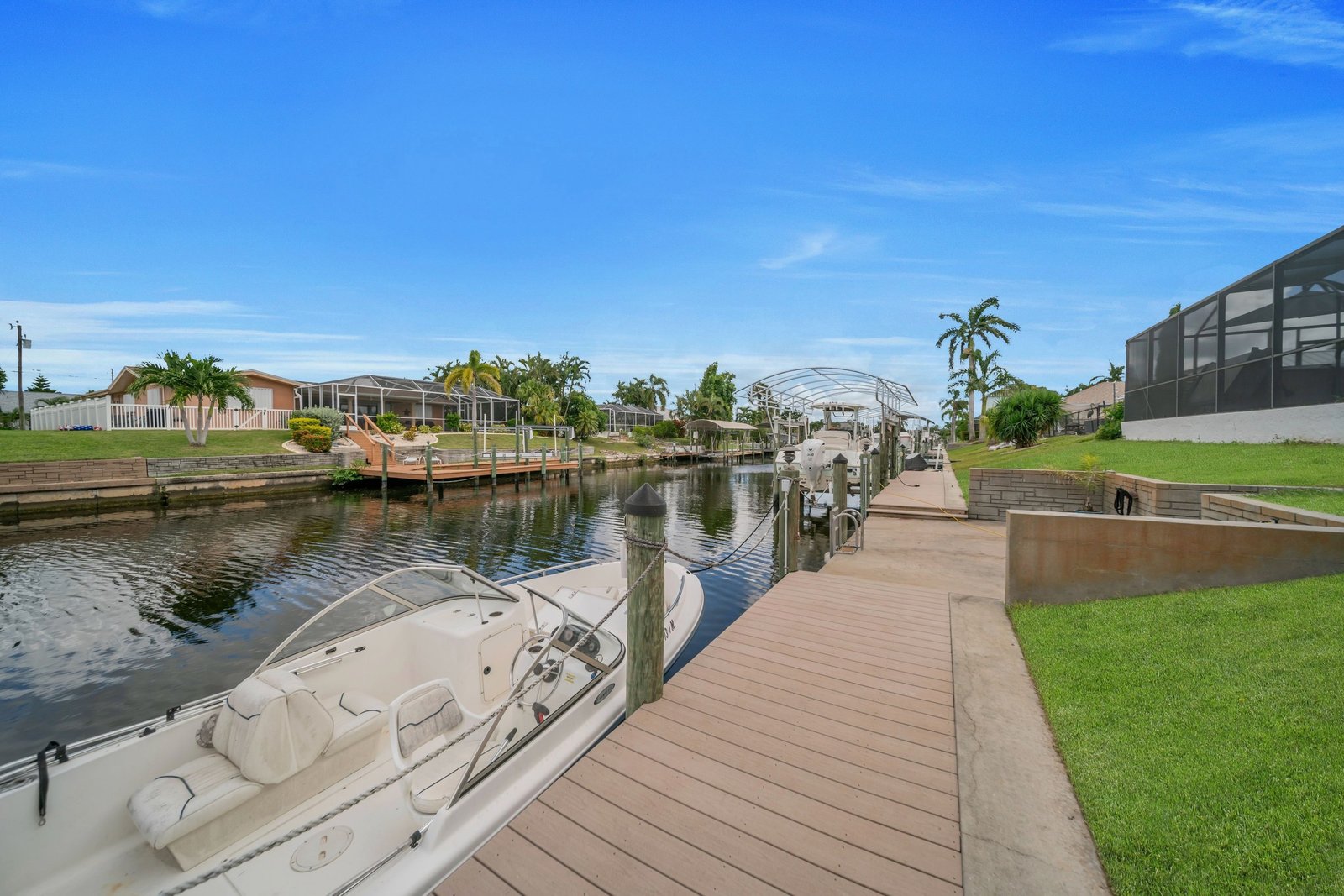
If you’re shopping Cape Coral and pulling listings yourself, you’ve probably noticed something that looks like a deal. A four-bedroom on a freshwater canal, $415,000, listing says the annual property tax bill is $2,750. That feels almost too low. So you flag it, tell your spouse, start mentally moving in.
Here’s the problem. That $2,750 is not your tax bill. It’s the seller’s tax bill. The seller has been homesteaded in that house since 2009, with the Save Our Homes cap holding their assessed value down for 16 years. The January 1 after you close, all of that resets. Your bill on that exact same house can jump to $5,500 to $6,800, sometimes higher. That’s a $3,000-plus annual swing nobody told you about, on a number that affects your DTI, your monthly escrow, and your real cost of ownership.
I’m Brayden Milner. I’m a third-generation Realtor with Florida Future Realty, born and raised in Cape Coral. Property tax in Florida gets oversimplified into a bumper sticker (“no state income tax, low property tax, paradise”) and then ambushes buyers in year one when the real bill arrives. This is the walk-through I do with every relocation client before we write an offer. By the end, you guys will read a Cape Coral listing’s tax line the way I do, know your real first-year burden, and know whether the lot you’re looking at has a Utilities Extension Project assessment hiding behind it.
The Florida Tax Framework in 60 Seconds
Florida is a low-tax state in the obvious ways. There’s no state income tax, and there’s no state-level estate tax. That low-tax reputation is earned, and it’s a real piece of why people from New York, New Jersey, Illinois, Michigan, and Ohio keep landing in Lee County.
Property tax is where the math gets more nuanced. Florida’s statewide effective property tax rate averages roughly 0.74% of market value, which is genuinely low by national standards. But “Florida average” hides a lot. Counties and cities set their own millage rates, special districts add layers on top, and the actual burden on a given home can land anywhere from well below 1% to well above 1.2% of market value.
In Lee County, where Cape Coral sits, the combined millage on a Cape Coral parcel totals 15.3806 mills across all taxing authorities for 2025. (A “mill” is $1 of tax per $1,000 of assessed value, so 15.3806 mills equals about 1.54% of assessed value before any exemptions.) The 2025 millage is the latest adopted figure; 2026 millage is typically adopted in September. The Lee County Property Appraiser’s office publishes the official millage breakdown and TRIM notices for every parcel; their site at leepa.org is where I send buyers to verify a specific property’s current assessment, exemption status, and tax history. The effective rate for a non-homesteaded buyer at full market value is roughly 1.54%.
That combined millage puts the effective rate at roughly 1.26 percent of assessed value on the median homesteaded Cape Coral home after exemptions, and closer to 1.33 percent of just value for a new buyer assessed at full market value. Higher than the 0.74% statewide average. Still low compared to New Jersey, where roughly 2.2% of market value is normal, or the priciest Illinois counties at 2% and up — even Texas runs around 1.6 to 1.7 percent effective. The honest read: Florida property tax is competitive, but it’s not the giveaway people sometimes assume.
The Millage Stack: Who Actually Gets Your Tax Dollar
The 15.4 mills you pay isn’t going to one place. It’s a stack of separate levies from different taxing authorities, each with its own line on your annual bill. The typical Cape Coral stack looks roughly like this:
- Lee County general government: roads, sheriff, courts, county administration.
- Lee County school district: the largest single millage component in most Florida counties.
- City of Cape Coral: municipal services, parks, code enforcement, city-level operations.
- Special districts: mosquito control, the West Coast Inland Navigation District, the South Florida Water Management District, and a handful of other authorities with their own taxing power.
- Non-ad-valorem assessments: the Cape Coral Fire Service Assessment (not part of the millage rate, not covered by homestead exemption) appears on a separate section of your tax bill.
You don’t pick and choose which of these you fund. They’re all on the bill, bundled into the millage rate that applies to your parcel. When somebody quotes you a Cape Coral tax number, the only way to know if it’s right is to pull the actual TRIM notice for that specific address. The same dollar amount of assessed value can carry a different total tax depending on which fire, water, and special improvement district the parcel falls inside.
The TRIM Notice and How to Read It
Every August, the Lee County Property Appraiser mails out the TRIM notice, which stands for Truth in Millage. It’s a single sheet of paper (or PDF, depending on how you’ve opted in) that lays out, for your specific parcel, three things:
- Your just (market) value, the appraiser’s estimate of what the property would sell for as of January 1 of that tax year.
- Your assessed value, which for a homesteaded property reflects the Save Our Homes cap and can be substantially lower than market value.
- The proposed millage from each taxing authority, the resulting tax line from each, and the total proposed tax bill.
The TRIM is not a bill. It’s a preview. If you disagree with the just value, you have a narrow window to file a petition with the Value Adjustment Board. Most homeowners never appeal, and most don’t need to. But the TRIM is your one annual look at how the appraiser sees your property, and it’s the document that tells you whether your assessment is in line with the market or has drifted out of step.
The actual tax bill arrives in November from the Lee County Tax Collector, a separate office from the Property Appraiser, at leetc.com. The early-payment discount schedule: 4% off in November, 3% in December, 2% in January, 1% in February, full amount due by March 31. If your taxes are escrowed, your servicer pays in November and pockets the 4% discount on your behalf.
The Homestead Exemption: $50K-Plus Off the Top
If a Cape Coral home is your primary, permanent residence, you qualify for the Florida homestead exemption. The exemption removes up to $50,722 (the 2025 maximum) from your assessed value before the millage is applied. The mechanics:
- The first $25,000 of homestead exemption applies to all taxing authorities (county, city, school, special districts).
- The second tier, $25,722 in 2025, applies to non-school millage only, so it shaves your county and city bill but doesn’t touch the school portion. Since 2025 this second tier is indexed to CPI, so the maximum adjusts each January 1.
On a typical Cape Coral parcel, the full $50,722 exemption is worth roughly $645 a year in tax savings at 2025 millage rates, depending on the millage stack on your specific address. That’s not life-changing money on day one, but the bigger value of homestead is what it unlocks: Save Our Homes.
To qualify, the property has to be your primary residence as of January 1 of the tax year, and you have to file with the Lee County Property Appraiser by March 1. Filing is a one-time event; once you’re on the books, the exemption renews automatically each year unless your residency changes. If you buy in May 2026, you can’t claim homestead for tax year 2026 because you weren’t the owner on January 1. You file in early 2027 for tax year 2027.
Save Our Homes: The 3% Cap That Quietly Builds You a Tax Moat
Save Our Homes is the constitutional provision that caps annual increases in the assessed value of a homesteaded property at the lesser of 3% or the change in the Consumer Price Index. The cap kicks in the year after you file. Year one of homestead, your assessed value is set. Year two, even if your home’s market value jumped 12%, your assessed value can only rise by 3% (or whatever CPI was, if lower).
The compounding effect is the whole game. If your homestead is in place for 10 years and the Cape Coral market appreciates at 6% a year while your assessment grows at 3%, your assessed value drags substantially behind market by year 10. That gap, the SOH differential, is your tax moat. Owners who’ve held homesteaded property in Cape Coral since the early 2010s now have assessed values sometimes 40% or more below current market value. Their tax bills look insanely low compared to what a brand-new buyer of the identical house would pay. That’s not a loophole, it’s exactly how Save Our Homes is designed to work.
The flip side: that benefit belongs to the owner, not the house. When the home sells, the SOH cap resets. The new owner starts over at current market-value assessment, and the moat has to be rebuilt from scratch. This is the single biggest reason listing tax bills mislead buyers.
Portability: How Floridians Carry Their SOH Savings to a New House
Here’s where Florida’s tax code gets surprisingly generous to in-state movers. If you’ve been homesteaded in another Florida property and you’re buying a new primary residence in Cape Coral, portability lets you transfer your accumulated Save Our Homes differential to the new house, up to a $500,000 cap on the transferred amount.
The math: portability moves the dollar gap between your old home’s market value and assessed value over to the new home, reducing the new property’s assessed value by that amount (up to the $500K cap) in your first homesteaded year. Hold a homestead for 15 years with a $180,000 differential, and you bring $180,000 of cap savings with you when you upsize, downsize, or relocate within Florida.
Timing matters. You have to establish the new homestead within three tax years of giving up the old one. If you sell in 2025 and don’t buy and homestead until 2029, you’ve lost the window. File Form DR-501T with the Lee County Property Appraiser along with your homestead application. Florida Realtors has a plain-English explainer at floridarealtors.org if you want to read up before your appointment.
For in-state movers, portability is almost always worth claiming. Buyers from out of state simply don’t have access to it, which is why a New Yorker buying in Cape Coral and a Naples-based Floridian buying the same house will land on meaningfully different first-year tax bills on identical properties.
The First-Year Reset: The Big Sticker Shock for Out-of-State Buyers
This is the section that, in my experience, saves the most pain. If you’re buying a Cape Coral home from a long-time homesteaded owner, your tax bill will not look anything like theirs once the reset hits. Three things happen, and the timing matters:
- Your closing-year bill still looks like the seller’s. Exemption and Save Our Homes status are locked in as of January 1 each year, so the November bill in the year you close still reflects the seller’s homestead and cap. Don’t let that first bill fool you.
- The reset lands the following January 1. That’s when the seller’s exemption comes off and the Save Our Homes cap evaporates. Whatever tax moat the seller built over years of holding the property doesn’t transfer with the house. The assessment resets to current just (market) value.
- Your own homestead can begin that same January 1. If you occupy the home as your primary residence by that January 1 and file by March 1, your exemption and your new Save Our Homes cap start in the same year the reset hits — so a compliant owner-occupant never pays a fully unexempted year.
So the sticker shock is real, but it arrives in your second-year bill, not at closing. Once the reassessment lands, your bill as a buyer purchasing from a long-time homesteaded seller is structurally going to be higher than what the listing shows. Sometimes substantially higher. The example from the top of this article is real: a $415,000 listing with a $2,750 tax bill (long-time homestead) can carry a $5,500 to $6,800 bill once it’s reassessed at just value — a number your own homestead exemption and fresh cap only partially soften at first.
For investors and second-home buyers who never qualify for homestead, that elevated bill isn’t a one-year problem. It’s the permanent number. Non-homesteaded property is subject to the 10% annual assessment cap (a separate provision from Save Our Homes), so the assessment can climb up to 10% a year on rental and second-home inventory. The effective tax burden runs roughly 10 to 20 percent higher than the homesteaded equivalent. That premium needs to live in your cash flow model from day one. (For how housing stock and ownership profile shape carrying costs, see the Cape Coral housing stock guide.)
Practical move for any buyer working off a listing: don’t trust the displayed tax line. Pull the Lee County Property Appraiser record, check the current just value (not the assessed value), apply the millage stack to that just value, and back out the exemption only if you’re certain you’ll qualify and only for the year you’ll qualify in. That’s your real first-year math. I do this exercise on every relocation buyer’s shortlist before we tour, because it’s faster to filter on the spreadsheet than to fall in love with a house whose carrying cost doesn’t work.
The “Low Tax Listing” Trap (and How to Spot It in 30 Seconds)
You guys can spot the seller-homestead trap in any MLS listing once you know what you’re looking for. The tell is the ratio between listing price and displayed annual tax bill. On a current-market non-homesteaded Cape Coral home, that ratio typically lands in the 1.1% to 1.4% of price range. A $500,000 home should be showing a tax line somewhere between $5,500 and $7,000.
If the listing price is $500,000 and the tax bill says $2,400, you’re looking at one of three things:
- A long-time homesteaded owner whose Save Our Homes moat has gotten huge. Most common.
- A property undervalued in a prior reassessment that hasn’t caught up to current market.
- Stale tax data in the MLS pulling a prior year’s bill against a current price.
None of those scenarios mean it’s a bad house. They mean the tax line in the listing is not the tax line you’ll be paying. Reverse the math: listing price multiplied by 1.1% to 1.4% is your honest first-year range as a non-homestead buyer. If you’ll homestead in year two, that number drops by roughly $645 from the exemption plus whatever Save Our Homes restraint compounds going forward.
UEP Assessments: The Tax Bill That Isn’t a Tax Bill
This is the part of the carrying-cost conversation that catches the most out-of-state buyers off guard, because it has nothing to do with millage and everything to do with infrastructure. The City of Cape Coral runs a multi-decade Utilities Extension Project (UEP) extending municipal water, sewer, and irrigation service into the northern and western parts of the city built out before utilities arrived. Those properties have operated on well water and septic. As the UEP rolls through, every affected lot gets assessed for the cost of the new infrastructure.
The assessment numbers are real. North 1 East, the current active phase, carries a total assessment of $32,288 per lot, broken down as:
- Water: $8,221
- Sewer: $9,607
- Irrigation: $7,710
- CFEC (Capital Facility Expansion Charge, a capacity charge the owner pays toward plant expansion): $6,750
That $32,288 is just the infrastructure assessment. On top of that, budget for standard utility connection fees (meter and tap fees) plus roughly $2,000 to $2,500 in plumbing and permit costs to physically tie the house into the new lines, including septic tank pump-out and abandonment. Connection fee schedules change with each contract, so get the current numbers directly from Cape Coral Utilities Billing or at capecoral.gov before you build them into an offer.
Older infill UEP assessments in earlier phases have historically run $20,000 to $35,000 per lot, depending on phase and scope. So when one neighbor says “the assessment was twenty grand” and another says “I paid thirty-two,” they’re both probably telling the truth, just for different phases.
UEP Payment Options and Timing
Lot owners can pay the UEP assessment as a lump sum (cheapest total cost, biggest cash hit) or finance it over 20, 25, or 30 years through the city. A 30-year financed assessment runs roughly $2,400 to $2,500 a year added to your tax bill, at up to the city’s maximum allowed rate of roughly 6.25% to 6.5% interest depending on the contract. That’s another ~$200 a month on top of your regular escrow, and it stays there for the life of the loan unless you pay it off early.
A few important wrinkles:
- The 180-day connection window is not optional. Once you receive the Notice of Availability from the city, you have 180 days to connect the property to the new utility lines. This is a legal requirement, not a recommendation.
- A grant of up to $2,000 is available for income-eligible homeowners, administered through the Cape Coral Housing Development Corporation — it offsets connection costs, not the assessment itself.
- Hardship deferral is available for income-qualified residents, with applications running through the City of Cape Coral.
- The farthest-out parcels, still in the city’s design or study phase, don’t have a confirmed assessment date yet. Lots in those areas are still on well and septic and will be for the foreseeable future, with no published year for when that changes. That can be a feature or a bug depending on your timeline — check capecoral.gov/uep for the current phase map before you assume a lot is exempt long-term.
Southeast and Southwest Cape are largely utility-complete, with UEP either fully paid or rolled into the tax base years ago. Most active UEP exposure today sits in NE and NW. If you’re shopping a quadrant breakdown of where utilities are in versus pending, the Cape Coral neighborhoods guide goes block-by-block, and the transportation and infrastructure context is in our infrastructure breakdown.
The Question You Have to Ask Before Closing on Any NE or NW Lot
Single sentence, every time: “Is the utility assessment paid, financed, or pending?”
That question tells you whether the assessment is the seller’s already-handled problem, a known liability you’re inheriting on a financed schedule, or an open exposure about to land in your mailbox. There’s no good answer after closing. There’s only the correct timing, which is before you write the offer.
If the answer is “paid,” ask for documentation. If “financed,” ask the city’s Utilities Billing office for the exact remaining balance and annual payment so you can model it. If “pending,” decide whether you’re willing to absorb a five-figure infrastructure bill in the first one to three years of ownership, and if you are, negotiate the purchase price with that liability in mind. Plenty of NE and NW lots are still great buys even with a pending assessment. They’re just not the price the sticker says, once you add the assessment carry.
How Non-Homestead Properties Change the Math
If the Cape Coral property is going to be a rental, a short-term rental, or a second home you don’t claim as your primary residence, your tax math is fundamentally different from a homestead buyer’s:
- No $50K homestead exemption. The full assessed value gets hit by the full millage stack.
- No 3% Save Our Homes cap. Your assessment can climb up to 10% per year under Florida’s non-homestead cap, which is a substantially looser constraint.
- Effective tax burden runs roughly 10 to 20 percent higher than the comparable owner-occupied home. Model this from the start.
- UEP assessments hit harder in absolute terms on lower-priced lots. A $32,288 assessment on a vacant lot purchased for $45,000 changes the return profile completely.
For short-term rental operators, there’s also a separate filing called Tangible Personal Property (TPP) tax that covers furnishings, appliances, and equipment inside the rental. Owner-occupied homeowners never deal with it. If you furnish a property and run it as a rental, you’ll file an initial TPP return with the Lee County Property Appraiser. The first $25,000 of TPP value is exempt, and many small short-term rentals fall under that threshold — after that first return, the filing requirement is waived for any year your value stays at or under $25,000, and it only resumes if the value climbs above that. Multiple rentals or a high-end furnished property and TPP becomes a real line item.
None of this makes Cape Coral a bad investment market. The numbers still pencil for plenty of investors. What it means is the carrying cost on an investor-owned property is different enough from an owner-occupied one that the spreadsheet has to be built from scratch.
Where Property Tax Sits Inside the Total Cost of Ownership
Property tax is one leg of a four-leg stool in Cape Coral, and any honest cost-of-ownership conversation has to put all four legs on the table:
- Property tax + special assessments, the subject of this article.
- Homeowner’s insurance, covered in the Cape Coral insurance landscape guide, which can run $1,800 to $5,000+ a year depending on construction year, roof age, and wind mitigation.
- Flood insurance, mandatory in FEMA Zone AE with a federally backed mortgage and a good idea even in Zone X (almost one-third of NFIP flood insurance claims come from outside high-risk flood areas, covered in detail in the Cape Coral flood zones guide).
- Waterfront-specific maintenance carry, particularly seawalls, docks, and lifts, which we walk through in the Cape Coral canal system breakdown.
Add it all up and a Cape Coral waterfront home’s all-in carrying cost beyond mortgage principal and interest can run $12,000 to $20,000 a year. On an inland Zone X home with newer construction, that number drops closer to $7,000 to $10,000. “Is it expensive to own a house in Cape Coral?” depends almost entirely on which segment of the market you’re in.
That’s the cost of living in paradise. Not a bumper sticker, an honest line item, and you’d rather know the real number before you sign than after.
Frequently Asked Questions
What is the effective property tax rate in Cape Coral?
Cape Coral’s combined millage totals 15.3806 mills for 2025, which translates to roughly 1.26 percent of assessed value for the median homesteaded Cape Coral home (about 1.33 percent of just value for a new buyer assessed at full market value). That’s higher than Florida’s statewide average of 0.74% but still meaningfully lower than property tax burdens in states like Texas, Illinois, or New Jersey. Non-homesteaded properties (rentals and second homes) face an effective burden roughly 10 to 20 percent higher than the homesteaded equivalent because they lose the homestead exemption and the Save Our Homes cap.
How does the Florida homestead exemption work in Cape Coral?
The homestead exemption removes up to $50,722 (the 2025 maximum) from your assessed value if the Cape Coral home is your primary, permanent residence as of January 1 of the tax year. The first $25,000 applies to all taxing authorities; the second tier — $25,722 in 2025, CPI-indexed each January 1 — applies to non-school millage only. On a typical Cape Coral home, the full exemption saves roughly $645 per year in property tax at current millage. File with the Lee County Property Appraiser by March 1. Once on file, it renews automatically each year unless your residency status changes.
What is Save Our Homes and how much will it actually save me?
Save Our Homes is a Florida constitutional cap that limits annual increases in the assessed value of a homesteaded property to the lesser of 3% or the change in the Consumer Price Index. The cap compounds year over year, so a homeowner who holds the property for 10 or 15 years in a strongly appreciating market can end up with an assessed value 30% to 50% below current market value. The dollar savings depend on how long you hold and how fast the market appreciates, but for long-term Cape Coral owners, Save Our Homes is often worth far more than the homestead exemption itself.
Can I transfer my Florida Save Our Homes cap to a new Cape Coral home?
Yes, through portability. If you’ve been homesteaded in another Florida property and you’re moving to a new primary residence in Cape Coral, you can transfer up to $500,000 of your accumulated Save Our Homes differential to the new home. You have three tax years from giving up the old homestead to establish the new one and claim portability. File Form DR-501T with the Lee County Property Appraiser alongside your standard homestead application. Out-of-state buyers don’t have access to portability because they have no prior Florida homestead to port.
Why is the tax bill on this Cape Coral listing so low?
In most cases, the displayed tax bill reflects a long-time homesteaded seller whose Save Our Homes cap has held their assessed value well below current market value over a decade or more. Your closing-year bill still reflects the seller’s status, but on the January 1 after closing the seller’s homestead exemption and SOH cap come off and the property is reassessed to current market value, so the bill that follows can be substantially higher than the listing shows. That same January 1 is when your own homestead can begin if you occupy and file on time. As a rough rule, multiply the listing price by 1.1% to 1.4% to estimate your honest post-reset tax range as a non-homestead buyer in Cape Coral. Always verify against the Lee County Property Appraiser’s current parcel record before writing an offer.
What is a UEP assessment and how do I know if a property has one?
UEP stands for Utilities Extension Project, the City of Cape Coral’s ongoing project to extend municipal water, sewer, and irrigation service into areas built before utilities existed. Properties in active UEP phases are assessed for their share of the infrastructure cost. The current North 1 East phase carries a total assessment of $32,288 per lot, plus standard connection fees and roughly $2,000 to $2,500 in plumbing and permit costs to physically tie the house in (including septic pump-out and abandonment). Older infill phases have run $20,000 to $35,000 per lot. Always ask whether the assessment is paid, financed, or pending before writing an offer on any NE or NW Cape lot, and verify directly with the City of Cape Coral Utilities Billing office.
Are there parts of Cape Coral with no pending UEP assessment?
Yes. Most of southeast and southwest Cape Coral was built out with utilities already in place and carries no UEP exposure today. The active assessment exposure sits primarily in northeast and northwest quadrants. The farthest-out parcels, still in the city’s design or study phase, don’t have a confirmed assessment date published yet. Lots in those areas are still on well water and septic and will be for the foreseeable future, which can be either an advantage (no near-term assessment liability) or a drawback (well and septic maintenance and water quality variability) depending on your priorities. Confirm the current phase status for a specific parcel at capecoral.gov/uep before you rely on it.
Do investors and second-home buyers in Cape Coral pay higher property tax?
Yes. Non-homestead property in Florida (rentals, second homes, vacant land) doesn’t qualify for the homestead exemption or the 3% Save Our Homes cap. Instead, non-homesteaded assessments are subject to a looser 10% annual increase cap. The result is that an investor-owned or second-home Cape Coral property typically carries an effective tax burden 10 to 20 percent higher than an equivalent owner-occupied home, and the gap widens over time as Save Our Homes compounds for nearby homesteaded owners. Build this premium into your cash flow model from day one.
The Bottom Line
Cape Coral property tax is competitive by national standards, with the combined millage working out to roughly 1.26 percent of assessed value on the median homesteaded home. Florida’s no state income tax, the homestead exemption (up to $50,722 for 2025), and the Save Our Homes 3% cap together make long-term Cape Coral ownership one of the more tax-friendly profiles in any coastal U.S. market. Portability lets in-state movers carry their SOH savings to a new Florida home, up to $500,000 transferred.
The catches are real and predictable. The seller’s tax bill on a listing isn’t your tax bill, because the reset that lands the January after closing wipes out the seller’s homestead exemption and SOH cap on every sale. Investors and second-home buyers never qualify for either and pay a structural premium. And UEP assessments in NE and NW Cape can add five-figure liabilities that have nothing to do with millage but everything to do with carrying cost. Spot the trap, verify the parcel with the Lee County Property Appraiser, ask the assessment question before you write the offer, and the math works in your favor.
If you’re trying to model the real first-year carry on a specific Cape Coral listing, or figure out whether a NE or NW lot has a UEP exposure you can live with, that’s the conversation I do for buyers before we even tour. I’ll pull the Property Appraiser record, apply the current millage, calculate year-one and year-two bills, and check assessment status with the city. It takes me 15 minutes per address and it’s the difference between buying a house with eyes open and buying one with a surprise waiting in November.
One note before you run with any of this: I’m a Realtor, not a CPA or a tax attorney. Everything above is the general framework I walk buyers through, not a substitute for advice from an accountant on your specific return or a filing from the Lee County Property Appraiser and Tax Collector on your specific parcel — confirm the final numbers with them before you make a closing decision.
Reach out and let’s talk through the real numbers on the Cape Coral homes you’re looking at. Whether you’re a year out or actively writing offers, I’ll give you the same straight tax read I give every buyer who sits down with me.