

Cape Coral Waterfront Homes
We don’t write our reviews. Our clients do. Read them on Google, Zillow, and Realtor.com.
Cape Coral Waterfront Homes: what this search actually is.
1,818 active Cape Coral listings with water frontage, direct gulf, gulf canal, or freshwater canal, or lake, in our live MLS mirror, as of October 21, 2026.
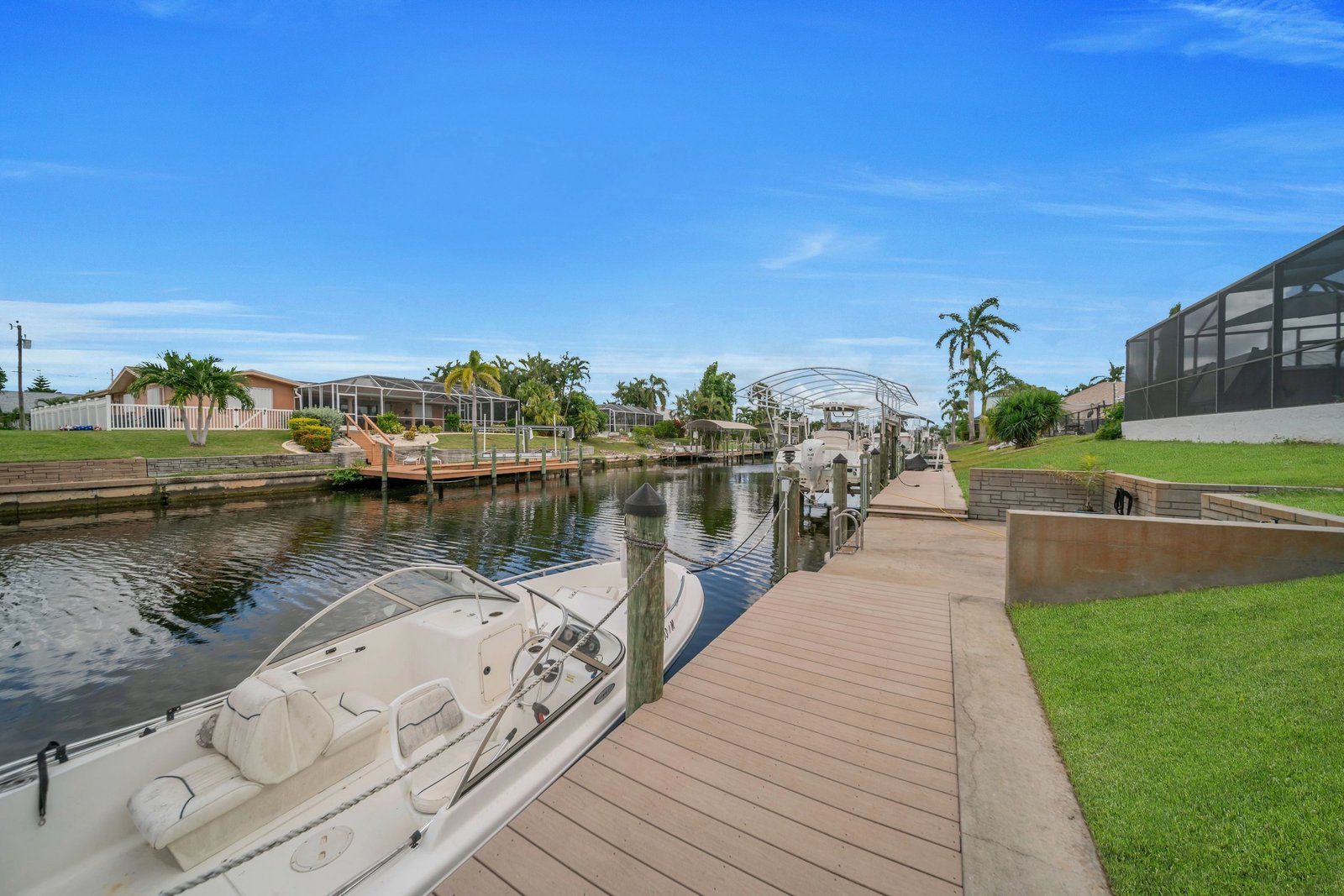
Cape Coral has more residential canal frontage than anywhere else, so "waterfront" here covers a real range. This page pulls every active listing with water on the lot: direct gulf access with no fixed bridges, gulf-access canals that pass under a bridge first, freshwater canals with no route to open water, and the handful of lake-front lots scattered through the older sections of the city.
Those four types are not the same product. A direct gulf-access lot is a boat lot, priced like one. A freshwater canal lot gets you a view, a dock for a kayak or a small jon boat, and a lower price tag. If you already know which one you want, use the filters on the full search below to narrow it down by canal type, price, and bedroom count, this page is the starting point, not the whole story.
We check the actual route to the Gulf on every canal listing we send a client, not just the MLS water-type field, because that field gets it wrong often enough to matter. If a specific address matters to you, send it to us and we'll walk the route before you make an offer.
What “Cape Coral Waterfront” Actually Covers
Cape Coral was platted in the late 1950s around more than 400 miles of dredged canals, more canal frontage than any other city in the world. That single fact is why a “waterfront homes” search here turns up so many different kinds of properties instead of one clean category. Before you scroll the listings below, it helps to know what you’re actually comparing.
Three Canal Types, Not One Search
The MLS calls all of it “waterfront,” but the water itself falls into three distinct systems. Direct gulf-access canals, sometimes called sailboat water locally, run to the Caloosahatchee River with no fixed bridges in the way, so a boat can leave the dock and reach the river, San Carlos Bay, and the open Gulf without restriction. Indirect gulf-access canals get there too, but only after passing under a fixed bridge, which caps boat height and rules out sailboats. Freshwater canals don’t connect to the Gulf at all, they’re landlocked, good for a kayak, paddleboard, or small jon boat, but not a boat that needs open water. A lot marketed as “waterfront” could be any of the three, and the difference in what you can actually do from the dock is not small. See the full breakdown in our canal system guide.
The Trade-Off Buyers Actually Face
Direct gulf access carries the largest premium of any water type in this city, and freshwater canal frontage costs meaningfully less because it’s a view and a small-boat dock rather than a route out. That gap narrowed in one specific way in June 2025, when the Chiquita Lock, which used to gate several Southwest Cape routes and add real transit time to every trip, was permanently removed. Some addresses that were indirect access for decades are now direct access, without a bridge or lock between the dock and the river. If a specific canal’s real-world boat time to the Gulf matters more to you than its MLS water-type label (and it should, that field gets it wrong often enough to matter), we’ve mapped it out at boat time to the Gulf.
Flood Zone Is a Cost Question, Not a Location Question
Nearly every interior residential canal in Cape Coral, direct, indirect, or freshwater, sits in FEMA Zone AE, X500, or X. Direct gulf-access lots run almost universally AE; freshwater canal lots more often land in X or X500. That zone assignment drives whether a federally backed mortgage requires flood insurance and roughly what that policy costs, it does not tell you whether the home floods. FEMA has redrawn Cape Coral’s flood maps twice in the last few years, after Hurricane Ian and again after the 2024 storms, and describes them as living documents that should be checked per-parcel rather than assumed from a prior sale. We check the flood zone on every canal listing before a client gets attached to it, the full detail on what each zone actually requires is at Cape Coral flood zones.
Where Pricing Stands Right Now
Cape Coral, FL · active listings in our live IDX search feed, default map view · updated October 21, 2026
That’s the live snapshot, not a number we typed in, canal-tier pricing moves with the market, so treat anything printed in an article as a photograph of one week, not a current quote.
Mapping It Before You Tour It
Because “waterfront” splits into three access types across four quadrants, the fastest way to narrow a search is visually rather than by scrolling addresses. Our interactive waterway map plots every canal and bridge by access type and clearance, and if a freshwater lot is genuinely what you’re after, lower cost, still a dock, no Gulf run required, the case for it, and where the best freshwater pockets sit, is laid out at freshwater canals.
Current listings below update live from our MLS feed and include all four water types, direct gulf, bridge-limited gulf, freshwater canal, and lake, so you can see exactly what’s active before you narrow by access type, price, or bedroom count.
Active listings matching this search in Cape Coral, counted October 21, 2026. Houses, condos and townhouses only. The 1,037 vacant lots also listed here are excluded, because counting dirt alongside houses pulls the median below what a house actually costs. Price per sq ft is the median of 200 mid-market listings with a stated living area. Source: our own MLS mirror, not a third-party estimate.
Updated 0 seconds ago, refreshed every 60 seconds
Cape Coral waterfront listings right now.
Live snapshot of active Cape Coral listings with water frontage, newest first.
 $830,000
4203 Pelican BLVD
Listing courtesy of RE/MAX Trend
 $519,900
4815 Sorrento CT
Listing courtesy of Starlink Realty, Inc
 $377,990
2300 NE 13th AVE
Listing courtesy of Coaston Realty LLC
 $995,000
1707 NW 34th AVE
Listing courtesy of The Agency Northwest Florida
 $319,990
1501 NW 24th TER
Listing courtesy of Coaston Realty LLC
 $875,000
5214 Willow CT
Listing courtesy of Beycome of Florida LLC
Updated 0 seconds ago, refreshed every 60 seconds
Read more, or start over.
What buyers ask us about this search.
Does "waterfront" on this page mean my boat can reach the Gulf?
Not automatically. This page includes direct gulf access, bridge-limited gulf access, freshwater canals, and lake frontage together, because all four are technically waterfront. Only direct and bridge-limited gulf-access canals actually connect to open water, and bridge-limited routes cap your boat by the fixed bridge clearance. If reaching the Gulf is the point, use the gulf-access-only search or ask us to check the specific address.
Is a freshwater canal lot worth less than a gulf-access lot?
Generally, yes, and it is not close. Direct gulf access carries the biggest premium in Cape Coral's canal system. Freshwater canal lots and lake lots cost less because they do not offer boat access to open water, they offer a water view and, in most cases, a dock for something small like a kayak or jon boat.
Do all these waterfront homes need flood insurance?
Most will, but it depends on the FEMA flood zone, not just whether the lot touches water. Homes in Zone AE typically need flood insurance if there is a mortgage. Some canal-front homes sit in Zone X or X500 and do not carry that requirement. We pull the flood zone on every listing before a client gets attached to it.
Book a 15–30 minute intro call.
We’ll walk through what’s relevant to where you are now and what you’re trying to do. No pitch. No pressure. Just a real conversation with someone who grew up in this market.
Pick a time, or leave a note.
Real conversation. No pressure. No call-center handoff.
Send Us a Message
We usually respond the same business day.