

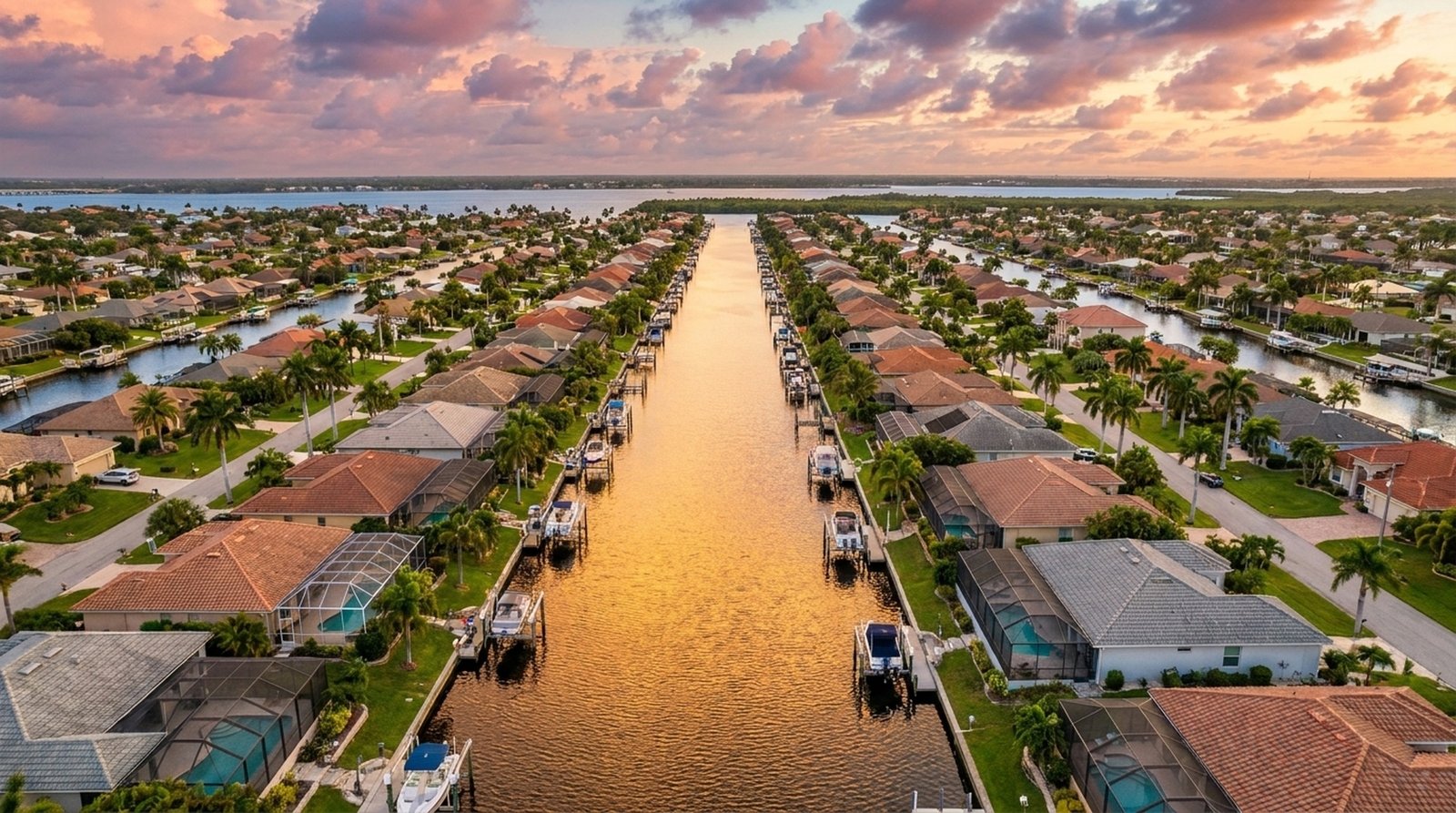
I bought my first house at 22 with way less than 20% down. The 20% myth is the single biggest reason first-time buyers in Cape Coral stay renting one more year, and one more year after that. Here’s the math, in honest dollars, on what 5% down actually gets you in this city in 2026.
I’m Brayden Milner. I’m a third-generation Realtor with Florida Future Realty, born and raised right here in Cape Coral. Real estate isn’t a career I chose out of a catalog. It’s the water I grew up swimming in. I closed on my first home at age 22 with conventional financing, low down payment, and roughly $35K off list on an on-market deal. The full story lives in how I bought my first house at 22. The takeaway: you do not need 20% down to own a home in Cape Coral. 3% to 5% is the usual floor on conventional, 3.5% on FHA, and 0% on VA and USDA for buyers who qualify.
This article covers the down-payment matrix across the four mainstream loan types, the full monthly cost stack on $300K, $400K, and $500K Cape Coral houses at 5% down, the PMI reality, the AE flood-zone curveball, the HOA-free advantage, total cash-to-close, the Florida first-time-buyer programs, and the line every renter in this city should memorize: marry the house, date the rate.
The 20% Myth (and Where It Came From)
The “20% down” rule is real, and it’s also a holdover. It exists because on a conventional loan, putting 20% down is the only way to avoid private mortgage insurance entirely. That’s the kernel of truth everyone repeats. What gets dropped is that putting less than 20% down is completely normal, supported by Fannie Mae and Freddie Mac guidelines, and the math often pencils out fine.
If you wait until you have 20% down on a $400,000 Cape Coral home, that’s $80,000 saved. At $1,500/month (aggressive for most renters), that’s 53 months. Four and a half years. In four and a half years, the home you wanted could be priced very differently, and you will have paid roughly $80,000 in rent over the same window with zero equity to show for it. That math is the single most expensive mistake I watch first-time buyers make.
Fannie Mae’s consumer-facing guidance (see singlefamily.fanniemae.com) lays out HomeReady at 3% down for qualified first-time buyers. Freddie Mac’s Home Possible program (see sf.freddiemac.com) matches that floor. The Consumer Financial Protection Bureau’s homebuyer hub (see consumerfinance.gov) is the cleanest neutral resource without a salesperson on the other side of the table. The Federal Housing Administration runs the FHA loan program (see fha.gov). Read these before you write your first offer.
The Down Payment Matrix: Four Loan Types, Four Floors
There are four mainstream loan products that cover the vast majority of first-time-buyer closings in Cape Coral. Each one has a different minimum down payment, a different mortgage-insurance structure, and a different buyer fit. We cover the full mortgage process in depth in the Cape Coral mortgage process guide. Here is the short version of who each program fits.
Conventional 5% Down (3% for First-Time Buyers)
Conventional is the workhorse loan in Cape Coral. Standard floor is 5% down for repeat buyers, 3% for qualified first-time buyers under HomeReady or Home Possible. Credit typically 620 to 680 minimum, best pricing above 740. PMI is required below 20% but drops off automatically at 78% LTV. The 2026 conforming loan limit for a one-unit home in Lee County is $832,750 (FHFA, 2026 county loan limits), which covers almost every single-family home a first-time buyer is shopping. Best fit: average first-time Cape Coral buyer with decent credit and 5% down. By far the most common loan I see at the closing table.
FHA 3.5% Down
FHA is the federally backed program under HUD (see hud.gov) for buyers with lower credit or a smaller cushion. Floor is 3.5% down with a 580 credit score (most Lee County lenders set overlays at 600 or 620). FHA carries an upfront MIP of 1.75% rolled into the loan plus a monthly MIP of roughly 0.55% annualized, permanent for life on most modern originations unless the buyer refinances into conventional. The 2026 FHA loan limit for a one-unit home in Lee County is $541,287 (HUD, 2026 FHA forward mortgage limits). FHA appraisals are stricter than conventional and can flag conditions on older 1970s Cape Coral homes with deferred maintenance. Best fit: first-time buyers with credit 580 to 680 and purchase prices under the Lee County FHA cap.
VA Loans (0% Down for Veterans)
If you served, this is the single best loan product in the country for buyers who qualify. Zero down. No monthly mortgage insurance, ever. Competitive rates. A one-time VA funding fee rolled into the loan. Here is the purchase-loan chart from va.gov (rates effective April 7, 2023; checked October 20, 2026). First use: down payment less than 5% is 2.15%, 5% or more is 1.5%, 10% or more is 1.25%. After first use: less than 5% is 3.3%, 5% or more is 1.5%, 10% or more is 1.25%. You won’t pay the fee if you get VA compensation for a service-connected disability, plus a few other cases VA lists. VA also says that if you have full entitlement, you don’t have a loan limit, as long as you can afford the loan and the appraisal supports the price (VA loan limits page). Your lender still decides how much you can borrow. If you have eligibility, use it.
USDA Loans (0% Down for Rural Areas)
USDA Rural Development loans require 0% down and lower rates than most programs, with a smaller upfront guarantee fee plus an annual fee that functions like a low PMI. The catch is the eligibility map. It depends on the exact address. Parts of Cape Coral may qualify, so check the USDA eligibility map for the address before falling in love with this program. Income limits also apply.
5% Conventional on a $300K Cape Coral House: Full Math
Let’s run the actual numbers. $300K is on the lower side for a single-family home in Cape Coral in 2026. For comparison, the middle asking price of our current Cape Coral single-family listings is about $375K (our MLS feed, as of October 20, 2026), so $300K sits in the entry-level offwater band.
- Purchase price: $300,000
- Down payment (5%): $15,000
- Loan amount: $285,000
- Estimated monthly P&I: ~$1,835/month (calculated at 6.68%, 30-year fixed, per the local mid-May 2026 market snapshot below)
- PMI (estimated): $100 to $200/month, scaled by credit score
- Property taxes: ~$285/month (property tax rates are set in mills, and 1 mill is 0.1% of taxable value. Your bill compared to the price you paid is usually lower than the mill rate sounds, because the homestead exemption and the Save Our Homes cap lower and limit your taxable value if you live in the home. The first year is usually higher than later years. Ask for the tax estimate for the exact address)
- Homeowners insurance (X-zone, modern construction): ~$350/month
- Flood insurance (if AE-zone): $250 to $580+/month for a typical AE-zone home ($3,000 to $7,000+/year); severely-exposed pre-FIRM or below-BFE properties can run $500 to $1,000+/month
Total monthly on a $300K X-zone Cape Coral house at 5% down: roughly $2,570 to $2,670/month all-in (calculated off the local 6.68% rate snapshot above). If the same house sits in a typical AE flood zone, you’re closer to $2,820 to $3,250; severely-exposed pre-FIRM AE properties can push the all-in past $3,600. That’s a working-professional, first-time-buyer payment on a real Cape Coral house with no HOA, owning the land you stand on, building equity from month one. The same payment in a Lee County rental gets you zero equity and a landlord who can raise the rent every year.
Same Math on $400K and $500K Cape Coral Houses
Same assumptions: 5% down conventional, current rate environment, X-zone insurance baseline, AE-zone flood add-on shown separately.
$400K Cape Coral House (Median-Ballpark Offwater or Lower-End Freshwater)
- Down payment (5%): $20,000 / Loan: $380,000
- Monthly P&I: ~$2,447/month (calculated at 6.68%, 30-year fixed, per the local mid-May 2026 snapshot)
- PMI: $150 to $260/month / Taxes: ~$380/month / Insurance (X-zone): ~$400/month
- Flood (AE-zone add): $250 to $580+/month typical AE; severe-exposure properties run $500 to $1,000+/month
- X-zone total: ~$3,375 to $3,490/month / AE-zone total (typical AE): ~$3,625 to $4,070/month
$500K Cape Coral House (Mid-Range Freshwater or Entry Gulf-Access)
- Down payment (5%): $25,000 / Loan: $475,000
- Monthly P&I: ~$3,059/month (calculated at 6.68%, 30-year fixed, per the local mid-May 2026 snapshot)
- PMI: $190 to $325/month / Taxes: ~$475/month / Insurance (X-zone): ~$450/month
- Flood (AE-zone add): $250 to $580+/month typical AE; severe-exposure properties run $500 to $1,000+/month
- X-zone total: ~$4,175 to $4,310/month / AE-zone total (typical AE): ~$4,425 to $4,890/month
The honest read on the table: at every price point, the PMI line is the smallest component of your monthly. The big variables are P&I (driven by the rate environment), insurance (driven by zone, construction year, roof age), and flood (driven by zone and elevation). PMI is the line everyone obsesses over. It’s almost never the line that actually moves your monthly the most. We cover the carrier and premium dynamics in the Cape Coral insurance landscape guide and the tax mechanics in the Cape Coral property taxes guide.
PMI Reality: Not the Boogeyman
PMI exists because when you put less than 20% down on a conventional loan, the lender is taking on more default risk. It’s a small monthly premium that protects the lender (not you) against that risk. On a 5% down conventional loan in Cape Coral, PMI typically runs $100 to $325 per month depending on loan size, credit score, and PMI provider. Higher credit equals lower PMI.
The part that doesn’t get said enough: PMI is temporary. By federal law (the Homeowners Protection Act), PMI must be automatically cancelled by your servicer when the loan balance reaches 78% of the original purchase price. You can request manual removal at 80% LTV. On a $300K house with 5% down, you typically hit 80% LTV in 10 to 11 years through scheduled amortization alone, faster if the home appreciates and you order a new appraisal, faster still if you make extra principal payments. The refinance path also works: if rates drop or the home appreciates significantly, you refinance into a new loan at less than 80% LTV and PMI disappears in the process. Plenty of Cape Coral buyers who closed in 2020 and 2021 at low down payments refinanced PMI off within a couple of years on appreciation alone.
The right framing: PMI is the modest, temporary cost of getting into the market earlier and locking your purchase price. The alternative (waiting four-plus years for 20% while rent goes to a landlord) is almost always more expensive in total cost.
The Flood-Zone Curveball
Here’s the Cape Coral wrinkle out-of-state first-time buyers do not see coming until the lender pulls the flood determination. If the house sits in FEMA Flood Zone AE (the 1% annual chance zone) and you have a federally backed mortgage, your lender will require flood insurance. That’s not optional. Full zone breakdown lives in the Cape Coral flood zones guide; the budget implication for a 5% down buyer is direct.
Most direct-Gulf-access waterfront homes in Cape Coral sit in Zone AE because of storm-surge exposure. Plenty of freshwater and offwater homes sit in Zone X (low/moderate risk, no mandatory purchase) or Zone X500. The zone determines whether your monthly includes a flood line of $0 or a flood line of $500 to $1,000/month on older waterfront construction. This is the single biggest reason a $400K freshwater offwater home in NE Cape can carry a meaningfully lower monthly than a $400K AE-zone home in SE Cape. Same price, different insurance bill. Ask the listing agent for the FEMA zone before you write the offer, or pull it yourself on the FEMA Flood Map Service Center.
The reframe: if AE-zone flood pushes a house outside your budget, you don’t abandon Cape Coral. You shift to a comparable home in a lower-risk zone, often a few miles inland, and the math works again. The cost of living in paradise is real. It is also navigable when you know which lever to pull.
The HOA-Free Advantage (Most of Cape Coral)
One of the structural cost advantages of buying in Cape Coral versus most Florida master-planned communities is that the overwhelming majority of single-family residential neighborhoods here have no HOA. No monthly dues. No architectural review boards. No special assessment to repaint the clubhouse you don’t use.
For a first-time buyer at 5% down, this matters two ways. Every dollar of HOA dues that doesn’t exist on your monthly is a dollar going to mortgage, savings, or actual life. More importantly for qualification: HOA dues count against your debt-to-income ratio. A $300/month HOA can reduce your maximum approved purchase price by $40,000 to $50,000 depending on rate and other debts. Buying HOA-free in Cape Coral mechanically increases the price ceiling your lender will approve on the same income. The tradeoff: without an HOA, there’s no enforcement mechanism for neighbor behavior beyond city code. Most Cape Coral buyers see this as an acceptable or preferable trade.
Cash to Close: The Number Beyond the Down Payment
The down payment is one bucket. Total cash-to-close is what you actually fund at the table. For a first-time Cape Coral buyer at 5% down, plan for total cash to close in the 7% to 9% of purchase price range. The components:
- Down payment: 5% of price ($15K on $300K, $20K on $400K, $25K on $500K)
- Closing costs: typically $5K to $10K. Lender origination, title insurance, settlement, recording fees, and lender prepaids. Full stack in the Cape Coral closing costs guide
- Escrow setup: lender typically collects 2 to 3 months of tax and homeowners insurance up front. On a $400K home, ~$1,500 to $2,500 extra at the table
- Pre-paid first-year insurance: lender requires the homeowners policy paid in full for year one before funding
Rough totals at 5% down: $22K to $27K on a $300K home, $31K to $37K on a $400K, $35K to $45K on a $500K. Seller-paid closing-cost concessions can reduce that meaningfully in a buyer’s market like Cape Coral in 2026, where sellers sometimes contribute toward your closing costs as part of the negotiation. Gift funds from family are also allowed on conventional and FHA loans with proper documentation; a $10,000 gift letter from a parent toward your down payment is legal, common, and standard.
Florida First-Time Buyer Programs
Florida Housing Finance Corporation runs several first-time-buyer assistance programs that pair with conventional, FHA, VA, or USDA loans and add down-payment assistance, closing-cost assistance, or below-market rates for eligible buyers.
- Florida Hometown Heroes Housing Program. Down-payment and closing-cost assistance for full-time Florida workforce members: teachers, law enforcement, firefighters, healthcare workers, military, and a wide list of additional essential-service professions. Benefit levels change periodically; check directly with Florida Housing Finance Corporation for current rules.
- Florida HFA Preferred / HFA Advantage. Conventional loan products with reduced PMI and optional down-payment assistance grants for income-qualified buyers.
Not every Cape Coral lender originates these programs. If you’re a teacher, nurse, paramedic, or first responder shopping in Cape Coral, ask your loan officer specifically about Hometown Heroes, and if they don’t originate it, ask for a referral to one who does. The savings can be material.
Marry the House, Date the Rate
This is the line I want every first-time buyer in Cape Coral to internalize before they get hung up on the rate environment. Marry the house. Date the rate.
Mortgage rates are temporary. Our local market snapshot for mid-May 2026 shows 30-year fixed conforming at about 6.68% (local CSV snapshot, week of 2026-05-18). The rate will be a different number in three years, in five, in ten. You refinance the rate. You pay extra principal. You buy the rate down at the closing table with discount points or seller-funded buydowns. Rates move. They have always moved. The purchase price, by contrast, is permanent. The day you close on a Cape Coral home at $375,000, that’s your basis forever. Every dollar of appreciation from that day forward is yours. The homestead exemption locks once you file. Save Our Homes caps your annual assessment increases at 3%, which compounds dramatically over a decade-plus hold. You’re not paying rent. You’re paying yourself, in equity, in tax-cap protection, in a fixed housing cost no landlord can raise.
If you wait for the perfect rate, you’ll miss the bottom. If you wait for the perfect price, you’ll miss the cycle. The buyers I see succeed are the ones who buy the right house at the right price with the right loan they can afford today, and refinance the rate when it makes sense. Not the other way around.
Frequently Asked Questions
How much do you need down to buy a house in Cape Coral?
Depends on loan type. Conventional requires 3% down for qualified first-time buyers under Fannie Mae HomeReady or Freddie Mac Home Possible, with 5% as the standard repeat-buyer floor. FHA requires 3.5% with a 580+ credit score. VA loans require 0% for eligible veterans. USDA requires 0% on eligible properties, but eligibility depends on the address, so check the USDA eligibility map. At 5% down, plan for about 7% to 9% of the price in total cash to close. That is the down payment plus closing costs, escrow setup, and prepaid insurance, before any seller concessions. With 3% down, the down payment part is smaller.
Is 5% down enough to buy a house in Cape Coral?
Yes. 5% down conventional is the most common first-time-buyer loan I see at the Cape Coral closing table and is fully supported by Fannie Mae and Freddie Mac. On a $300,000 home, that’s $15,000 down plus roughly $7,000 to $12,000 in closing costs and escrow setup, for a total cash to close in the $22,000 to $27,000 range before seller concessions. The trade is private mortgage insurance, which typically runs $100 to $325 per month and drops off automatically at 78% LTV by federal law. The math frequently pencils out better than waiting four-plus years to save 20% down.
What is PMI and how much does it cost on a Cape Coral mortgage?
PMI (private mortgage insurance) is required on any conventional loan with less than 20% down. It protects the lender, not the borrower, against default risk. On a 5% down conventional loan in Cape Coral, PMI typically runs $100 to $325 per month depending on loan size, credit score, and provider. Higher credit equals lower PMI. By federal law under the Homeowners Protection Act, PMI must be automatically cancelled when your loan balance reaches 78% of the original purchase price. PMI does not exist on VA loans. On FHA, the equivalent monthly MIP is permanent on most modern originations unless you refinance into conventional.
Can I get rid of PMI on a Cape Coral conventional loan?
Yes, three paths. Automatic cancellation by federal law at 78% LTV through scheduled amortization. Borrower-requested removal at 80% LTV based on original purchase price, or at current appraised value with a new appraisal (typically at borrower expense). Or refinance into a new conventional loan at less than 80% LTV. Plenty of Cape Coral buyers who closed in 2020 and 2021 at low down payments rode the 2020-2022 price run-up into 20%+ equity and refinanced PMI off within a couple of years.
How much income do I need to qualify for a $300,000 house in Cape Coral?
Depends on other debts and the rate environment, but rough math: at 5% down with the mid-May 2026 local 6.68% rate snapshot, total monthly housing on a $300K X-zone home typically lands $2,570 to $2,670. To keep housing under 36% of gross monthly income (a conservative rule), you’d want gross monthly income $7,150 to $7,425, roughly $86,000 to $89,000 annually. Lenders will go higher on the DTI math if your other debts are low. Get a pre-approval (not a pre-qualification) before assuming. The pre-approval is the only number that counts when you write an offer.
Do first-time buyers in Florida get any special programs?
Yes. Florida Housing Finance Corporation operates several. Florida Hometown Heroes is the most widely known: down-payment and closing-cost assistance for full-time Florida workforce members including teachers, law enforcement, firefighters, healthcare workers, and military. Florida HFA Preferred and HFA Advantage are conventional products with reduced PMI and optional down-payment assistance for income-qualified buyers. Not every Cape Coral lender originates these; if you qualify by profession or income, ask your loan officer specifically and request a referral if needed. Federal first-time-buyer programs (HomeReady, Home Possible) are originated by virtually every lender.
The Bottom Line
The 20% down rule is a holdover that costs first-time Cape Coral buyers years of equity. Conventional 5% is the workhorse loan here. FHA 3.5% covers lower credit. VA gets you in at 0% if you served. USDA at 0% if the property qualifies. PMI is a temporary, modest cost. The flood-zone curveball is real and budget-defining, which is why you ask for the FEMA zone before you write the offer. The HOA-free advantage adds margin to your DTI on most Cape Coral single-family homes. Total cash-to-close lands 7% to 9% of purchase price. Florida Hometown Heroes and the HFA programs can knock that down for eligible buyers. The rate is the part you refinance later. The purchase price is the part you marry today.
If you guys are renting in Cape Coral right now and the only thing standing between you and a contract is the 20% myth, that’s the conversation I’m built for. I’m a third-generation Realtor who closed his own first house at 22 with low money down. I know the lenders, I know the programs, and I know which houses on which streets in which zones actually pencil for a first-time buyer at 5% down without surprise insurance bills six months in. We shop with real numbers.
Reach out and let’s talk about your Cape Coral first-time-buyer plan. Whether you’re 90 days from closing or 18 months from a down payment, we’ll give you the same straight read I give every buyer who sits down with me.