

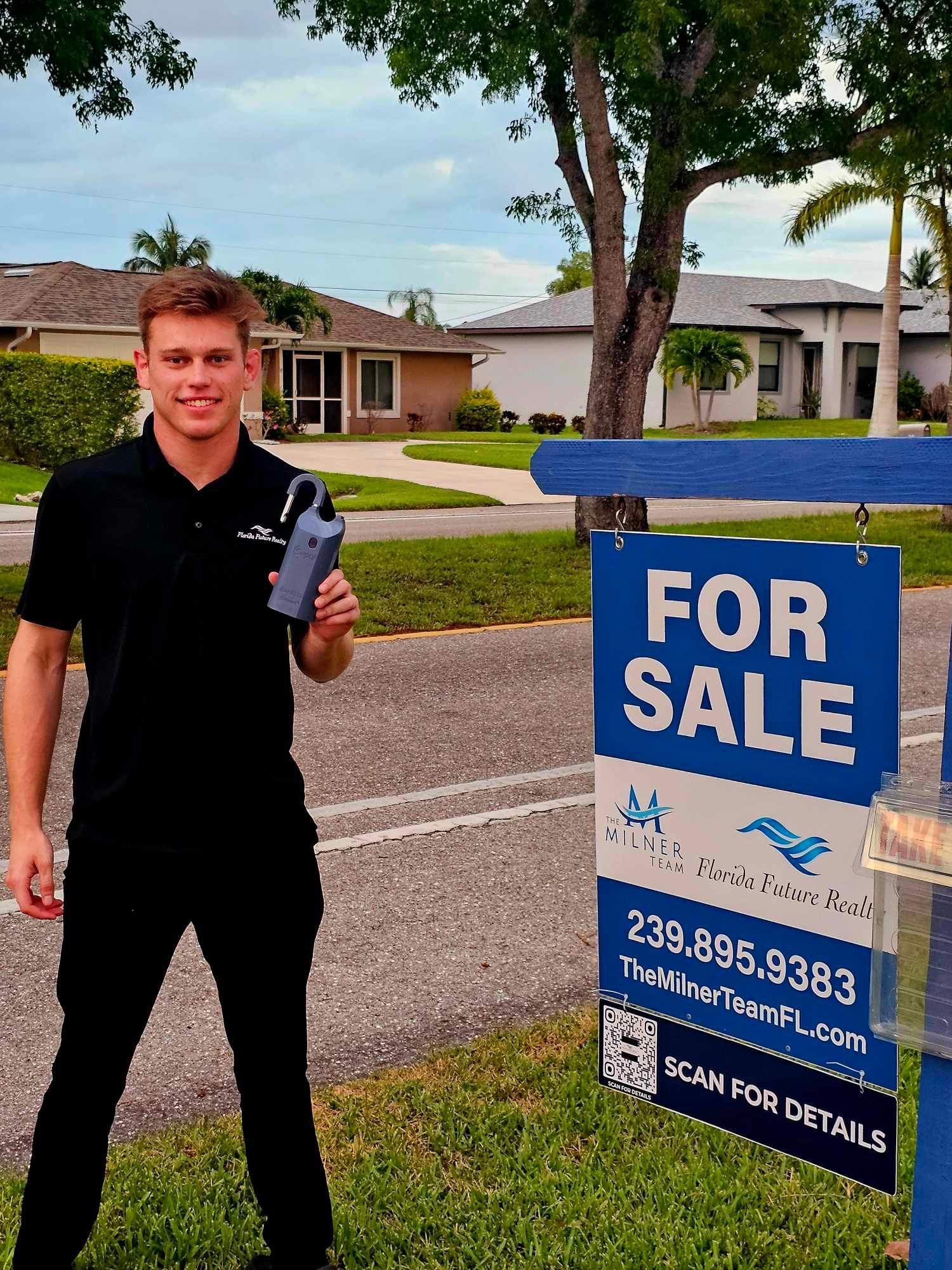
I closed on my first house at 22. I’m a third-generation Cape Coral native, my family has been selling and living on these canals long enough that I grew up thinking everybody understood seawalls, flood zones, and the difference between Gulf-access and freshwater before they understood a car payment. So you’d think buying my own first place would have been easy. It wasn’t. I made real mistakes, I learned things the expensive way, and the whole reason I’m writing this is so you can skip the parts that cost me sleep.
This isn’t a “look how smart I was” story. It’s the opposite. I want to walk you through what actually happened, the deal structure, the financing problem I almost didn’t solve (I weighed the low-down-payment route and ended up somewhere else), the Cape Coral market I bought into, and the playbook I’d hand my own little brother if he came to me tomorrow. If you’re working toward a first purchase in Southwest Florida, especially on self-employment income, this is for you.
The short version: I overpaid for my inspection, underestimated insurance, and almost lost the deal because I didn’t understand how Cape Coral flood zones affect financing. All three mistakes get their own section below, with what each one taught me.
The house
It’s a 3-bed, 2-bath in the NW quadrant of Cape Coral, a dry lot, no pool, no canal. Nothing flashy. I closed on it in late March 2025, at age 22, for around $270,000.
It was never the prettiest listing on the market. And that was the point.
Why this deal was even available
The win started before I ever wrote an offer. I read the situation.
The sellers were motivated. The home had been sitting on the market a long time, high days-on-market is a flashing signal that the price, the condition, or the presentation isn’t matching the market. The listing photos were shot on a cell phone, which tells you the seller wasn’t getting premium marketing attention. And the house genuinely needed work, which scares off a lot of buyers who want move-in-ready.
Every one of those is a reason most buyers scroll past. To me, they added up to a seller with a specific problem to solve, and a property the market had quietly written off. That’s exactly the kind of setup where an aggressive, comp-supported offer can land.
So I ran the comparable sales, built an offer the data could defend, and brought it in low but credible. They accepted more readily than I expected.
The financing problem
I’m a real estate agent, and like most self-employed people I maximize my write-offs. Great for taxes, rough for mortgage qualifying. A traditional W-2, tax-return-based mortgage was off the table because my returns don’t show the income a bank wants to see.
So I went with a bank-statement loan, a non-QM (non-qualified mortgage) product that underwrites you off your actual deposits instead of your tax returns. It’s a common path for self-employed buyers. The trade-off: the non-QM product carried a higher rate than a conventional or FHA loan would have, not because self-employment itself is a risk factor, but because bank-statement underwriting doesn’t document income the way those programs require, so it’s priced differently. Nothing about the house drove it. My plan from day one was to pay extra principal and refinance when rates improve.
I did weigh a low-down-payment FHA route early on. The self-employment math pushed me toward the bank-statement loan instead. That was the consideration, not the path I ended up taking.
The three mistakes I promised you
Mistake #1: I overpaid for the inspection
I booked the first inspector my lender’s checklist reminded me I needed, paid for a full package, general inspection plus add-ons, without getting a second quote. Later I learned what experienced buyers do on every deal: shop two or three inspectors, compare what each package actually includes, and negotiate the bundle. I paid for a well inspection and a septic test on a house that had neither, city water, city sewer, dry lot, because the package I bought included everything and I didn’t ask what applied.
The lesson isn’t “cheap out on the inspection”, on a house that needs work, the inspection is the last place to save money. The lesson is: get more than one quote, ask exactly what’s included, and skip add-ons that don’t apply to your property. A dry-lot house on city water and sewer won’t need a septic test or a well inspection, but it can still benefit from add-ons specific to its condition, age, or construction, so ask what actually applies to the house you’re buying.
Mistake #2: I underestimated insurance
I budgeted my monthly payment off principal, interest, and taxes, and penciled in an insurance number that turned out to be optimistic. Southwest Florida homeowner’s insurance is its own animal: the age of the roof, wind mitigation features, and distance from the coast all move the premium, and my first real quotes came back significantly higher than the number I’d budgeted, by a wide enough margin to change my qualifying math. I’d been planning around a figure I’d estimated loosely; the quotes I later saw through agent referrals came in meaningfully lower than what I paid.
What I’d do differently: get an actual quote from an insurance agent before making the offer, not after going under contract, and ask early about a wind mitigation inspection, which can bring the premium down. If you’re buying in Cape Coral, price the insurance on a specific house before you fall in love with it. Ask about the roof age early, it’s one of the bigger rating factors for most carriers, alongside wind-mitigation features, construction type, and distance from the coast.
Mistake #3: I didn’t understand how flood zones affect financing
I grew up around canals, so I assumed I understood flood zones. What I didn’t understand was how they interact with a mortgage. If the lender’s flood determination puts the structure in a special flood hazard area, flood insurance stops being optional, it becomes a lender requirement, and the cost lands inside your qualifying math. That surprise hit late in my process and nearly blew up my numbers at the eleventh hour.
It worked out, my house turned out to be in Zone X, outside the special flood hazard area, and the lender’s final determination confirmed no flood insurance requirement. But that confirmation didn’t arrive until days before closing, after I’d already nearly restructured the numbers. I lost sleep I didn’t need to lose. The fix is simple and free: check the flood zone on any house before you offer, and ask your lender up front whether flood insurance will be required and roughly what it would add. In Cape Coral, two houses a block apart can sit in different zones. Never assume.
The part nobody talks about: the down payment
On paper, this looks like a sizable down payment, the kind of cash most 22-year-olds don’t have sitting around. And here’s the honest truth: I didn’t either.
I only brought a fraction of it as fresh cash. The bulk of my “down payment” came from money I earned on the deal itself, my own buyer-agent commission, plus a bonus I negotiated into the transaction, along with my deposits. A seller credit, given in exchange for me accepting the home as-is, covered most of the closing costs.
Stack all that together and the out-of-pocket cash I actually wrote a check for was a small slice of the total. That’s not a loophole. That’s structure. I identified where value could be captured in the deal and I captured it, legitimately, in writing, on the settlement statement.
What buying my first house at 22 taught me
Here’s why I tell this story, and the honest caveat: I was the buying agent in my own transaction, so the commission, the bonus, and the way I structured them into the settlement were available to me specifically because of my license and my relationship with the brokerage. Most buyers can’t capture their own agent’s commission; what they can capture is seller credits, inspection credits, and other deal structure that a skilled agent negotiates on their behalf. The repeatable piece isn’t the commission rebate, it’s knowing where value hides in a transaction and being able to bring it to the table in writing. Lender treatment of agent commission and seller credits toward funds to close varies by loan program, confirm how yours handles it with your lender before you count on that structure.
The repeatable play isn’t “I got a discount.” It’s:
- Spot the motivated-seller setup. Long days on market, weak photos, a home that needs work, a seller with a specific problem. Those are signals, not red flags.
- Make the offer the data can defend. Comp it hard, then go in aggressively but credibly.
- Structure the deal so value gets captured at the table, credits, commission, as-is concessions, while genuinely solving the seller’s problem.
- Solve their problem and yours at the same time. The best deals are win-wins. Everybody walks away happy.
That’s the whole game. The sticker price is the headline. The structure is where the money is.
If you’re trying to buy your first place in Cape Coral, self-employed, first-time, or just tired of getting outbid, this is the kind of thinking we bring to every client. Get in touch with The Milner Team or reach out through my site, and I’ll walk you through the same playbook, on your numbers.
Brayden Milner, The Milner Team, born and raised in Cape Coral.