

I’ll be the agent who tells you when FSBO actually makes sense. It’s not never. But it’s not most of the time either. The pitch is everywhere: list it yourself, save the commission, pocket six figures. The math looks clean on a napkin. It almost never looks clean once the contract hits the table.
I’m Brayden Milner. I’m a third-generation Realtor with Florida Future Realty, born and raised in Cape Coral. Real estate isn’t a career I chose out of a catalog. It’s the water I grew up swimming in. My job in this article isn’t to talk you out of FSBO. It’s to walk you through the narrow set of scenarios where for-sale-by-owner is genuinely the right call, the wider set of scenarios where it costs you more than the commission you’re trying to save, and the Cape-Coral-specific traps (seawalls, flood zones, dock permits, canal-tier pricing) that turn a clean FSBO into an expensive one.
The data point most FSBO blogs leave out: NAR’s annual Profile of Home Buyers and Sellers shows FSBO homes selling for materially less than agent-assisted homes. In the 2025 edition (sales from July 2024 to June 2025), the national FSBO median was $360,000 versus $425,000 for agent-assisted sales, a $65,000 gap (see NAR’s Profile of Home Buyers and Sellers). That gap is the argument against treating FSBO as a default. Let me be precise about when the data flips.
The Narrow Set of Scenarios Where FSBO Actually Works
I want to name the use cases up front so nobody thinks I’m anti-FSBO on principle. I’m not. There are real, defensible, even smart reasons to sell without representation. There are just fewer of them than the YouTube videos suggest.
You Already Have the Buyer (Family, Friend, Neighbor, Tenant)
This is the cleanest FSBO scenario in the world. Your son wants the house. Your neighbor’s kid is ready to buy. Your tenant finally got their financing together. The buyer is already identified, the price is already roughly negotiated, and the only real work left is the legal and procedural infrastructure to close the deal. You don’t need MLS exposure, a buyer-agent network, or a listing campaign. You need a contract, a title company, and a clean disclosure package. FSBO fits the job.
An Off-Market Private Deal With an Investor
A local investor approaches you. Cash. AS IS. 10-day inspection. They’ve done this 40 times. You know the price you’ll accept. FSBO can work here, though I’d strongly recommend a real estate attorney on the seller side at minimum to review the contract and coordinate closing. The risk in this scenario isn’t deal complexity, it’s deal asymmetry. The investor has done this many times. You probably haven’t. Get representation in some form even if it’s not a full-service listing agent.
A Hyper-Hot Pricing Pocket Where Anything Sells Fast
This was the 2021-2022 Cape Coral market and it isn’t this market. During the COVID frenzy, freshly listed homes drew multiple offers in days, and the market itself did most of the work an agent normally does. The current Cape Coral market is the opposite. Buyers have a lot of choice today (our MLS mirror showed 2,690 active Cape Coral single-family listings on Oct. 20, 2026). This is not a market where the listing sells itself. Constants over outliers: don’t price your FSBO strategy on a market that ended years ago.
You Are a Licensed Real Estate Professional Yourself
If you hold an active Florida real estate license, you have the contract knowledge, disclosure familiarity, MLS access (through your brokerage), and negotiation experience to run your own listing. Technically that isn’t FSBO in the pure sense, but I include it because it’s the only category of “self-listed seller” that consistently doesn’t lose money on the transaction.
If your situation matches one of the four above, FSBO is a legitimate path. If not, the rest of this article is for you.
The Wider Set of Scenarios Where FSBO Costs You Money
The scenarios where FSBO costs sellers more than the commission they were trying to save almost always share a common feature: the seller underestimates one specific piece of the transaction. Pricing, contract law, buyer-pool reach, negotiation. The piece changes; the outcome looks the same: the home sells for less, takes longer to sell, or both.
You Need MLS Exposure to Reach the Real Buyer Pool
Roughly 9 in 10 home buyers work with a real estate agent (88% of buyers nationally in NAR’s 2025 Profile of Home Buyers and Sellers). Those buyers see homes through their agent, and their agent searches the MLS. If your listing isn’t on the MLS, those buyers structurally don’t see your house. You’re left fishing in a much smaller pond: drive-by traffic, Zillow FSBO views, Facebook Marketplace, your personal network. Smaller pond, fewer offers, less competition, lower clearing price. The math is mechanical, not opinion.
You’re Not Comfortable With Florida Contract Law
Florida uses the FAR/BAR contract as the standard residential purchase agreement, with several variants (AS IS, financing, cash). Each has different default rights, timelines, and consequences for missed deadlines. A buyer walking during inspection in day 1-15 of an AS IS contract has very different rights than one walking on day 25, and the difference can cost you the earnest money or the deal. If you don’t know the difference between the standard contract and the AS IS variant, any buyer’s agent on the other side will work that gap.
You Can’t Handle the Showing Logistics
A well-presented Cape Coral listing gets meaningful showing volume during the first 10-14 days. That means coordinating times, screening the buyers who walk through your home, handling unexpected requests, and being present (or absent) in a way that doesn’t sabotage the showing. Agents have lockboxes, showing services, screening protocols, and the experience to handle the random calls. FSBO sellers don’t, by default. The seller who answers every Zillow inquiry, schedules unscreened showings, and ends up in their own kitchen during a tour they’re trying to host is putting the listing at a disadvantage on day one.
You Have No Negotiation Experience
Real estate negotiation is not the same as buying a car or negotiating salary. It involves counter-offer math, inspection-credit math, contingency-removal math, financing-contingency mechanics, appraisal-shortfall negotiation, and a half-dozen other inflection points where the dollars at stake routinely exceed what the seller would have paid in commission. A buyer’s agent who’s done 300 transactions sees your tells and knows where the pressure points sit. A FSBO seller on their first deal doesn’t. The gap shows up in the final number.
You Have No Buyer-Agent Network
Even on FSBO listings where the seller offers buyer-agent compensation, the network piece matters. A listing agent who works Cape Coral every day knows which buyer agents have active out-of-state relocators, which ones specialize in waterfront, which ones are sitting on a snowbird buyer who’s been looking for exactly your house since November. That distribution network is real value, not slide-deck value. FSBO sellers don’t have it.
What FSBO Actually Requires (the Operational Checklist)
If you’re still committed after reading the above, here’s the operational reality. I’m not trying to scare you off. I’m trying to make sure you go in with eyes open about the workload.
- FAR/BAR contract and variants. Know which form applies, what the default contingencies are, and the deadline math. floridarealtors.org is the authoritative source.
- Seller’s disclosure. Florida law requires sellers to disclose known material defects. Failure to disclose can produce post-closing liability that dwarfs commission savings. The form covers flood history, insurance claims, roof, seawall, permitted work, and more.
- Title coordination. Select a title company or real estate attorney for the title search, insurance, closing documents, and closing itself. The agent normally coordinates this; you’ll be doing it.
- Financing and appraisal. Track the loan-approval and appraisal timelines. An appraisal shortfall is a critical negotiation point that can blow up a deal if mishandled.
- Inspection negotiation. The inspector will find items. The buyer will request credits, repairs, or both. Your response shapes whether the deal closes at the original price, a lower price, or not at all.
- HOA, condo, municipal coordination. Estoppel letters, condo docs, special assessment balances, city utility transfer paperwork. None of it is hard. All of it has to be done.
- The closing. Final walk-through, closing disclosure, wire transfer, deed delivery, keys handed over. The title company runs it; you need to know what to expect.
That list isn’t impossible. People do it. The question is whether the time and risk you absorb is worth the commission you’re saving, and whether the sale price you achieve actually nets you more than a represented sale would have.
The “Save the Commission” Math (What the NAR Data Actually Says)
The pitch sounds like: “If I sell my $500,000 home myself, I save the 5-6% commission, which is $25,000-$30,000 straight to my pocket.” That math is correct as a maximum theoretical savings, and almost never correct as a real-world outcome.
The NAR Profile of Home Buyers and Sellers tracks median sale price of FSBO homes versus agent-assisted sales. In the 2025 edition the national FSBO median was $360,000 versus $425,000 for agent-assisted sales, an 18% gap in favor of agent-assisted homes (NAR, 2025 Profile of Home Buyers and Sellers).
The honest caveat: the FSBO median is influenced by mix. FSBO transactions tilt toward lower-value properties, in-family sales, and rural areas. So the headline gap overstates the apples-to-apples difference for a Cape Coral mid-market home. But the apples-to-apples gap, when researchers control for property type and location, is still real and is usually in the same order of magnitude as the commission you’re trying to save, or larger.
In practice: the seller who FSBOs to save 5-6% often ends up selling for less than they would have with an agent, plus carrying the home longer, plus eating the time and stress. The net outcome is often worse than the represented sale.
The Hidden FSBO Costs Nobody Lists
The commission savings show up on a spreadsheet. The costs that eat the savings often don’t, until they do. The ones I see hit FSBO sellers in Cape Coral:
- Extended days on market = extended carrying cost. Mortgage, insurance, taxes, utilities. Every extra month is another month of mortgage, insurance, taxes and utilities you didn’t budget for.
- Lost ground in offer review. A FSBO seller fielding three offers without negotiation experience often accepts the wrong one, or counters the right one in a way that loses the buyer.
- Fewer offers = less competition = lower clearing price. Even one extra offer in a multi-offer scenario can lift the final sale price. FSBO listings draw fewer offers.
- Inspection-negotiation losses. Whether you give back $3,000 or $15,000 in credits to keep a deal alive depends on negotiation experience. FSBO sellers consistently give back more.
- Appraisal-shortfall losses. If the appraisal comes in low, an experienced agent contests with comps and sometimes saves the original price. A FSBO seller usually drops the price.
- Mispricing on day one. A seller without full MLS sold-data access often prices off Zillow estimates or recent asking prices (which include phantom listings, see my expired-listing relaunch piece). Mispriced listings sit, age, and clear below where correct pricing would have sold.
Add it up and the “savings” turn negative for most sellers. Not always. But most.
Cape-Coral-Specific FSBO Challenges
Beyond the general traps, Cape Coral has local realities that make FSBO harder here than in a uniform suburban market. The ones I’d flag:
Waterfront Pricing Requires Comp Expertise
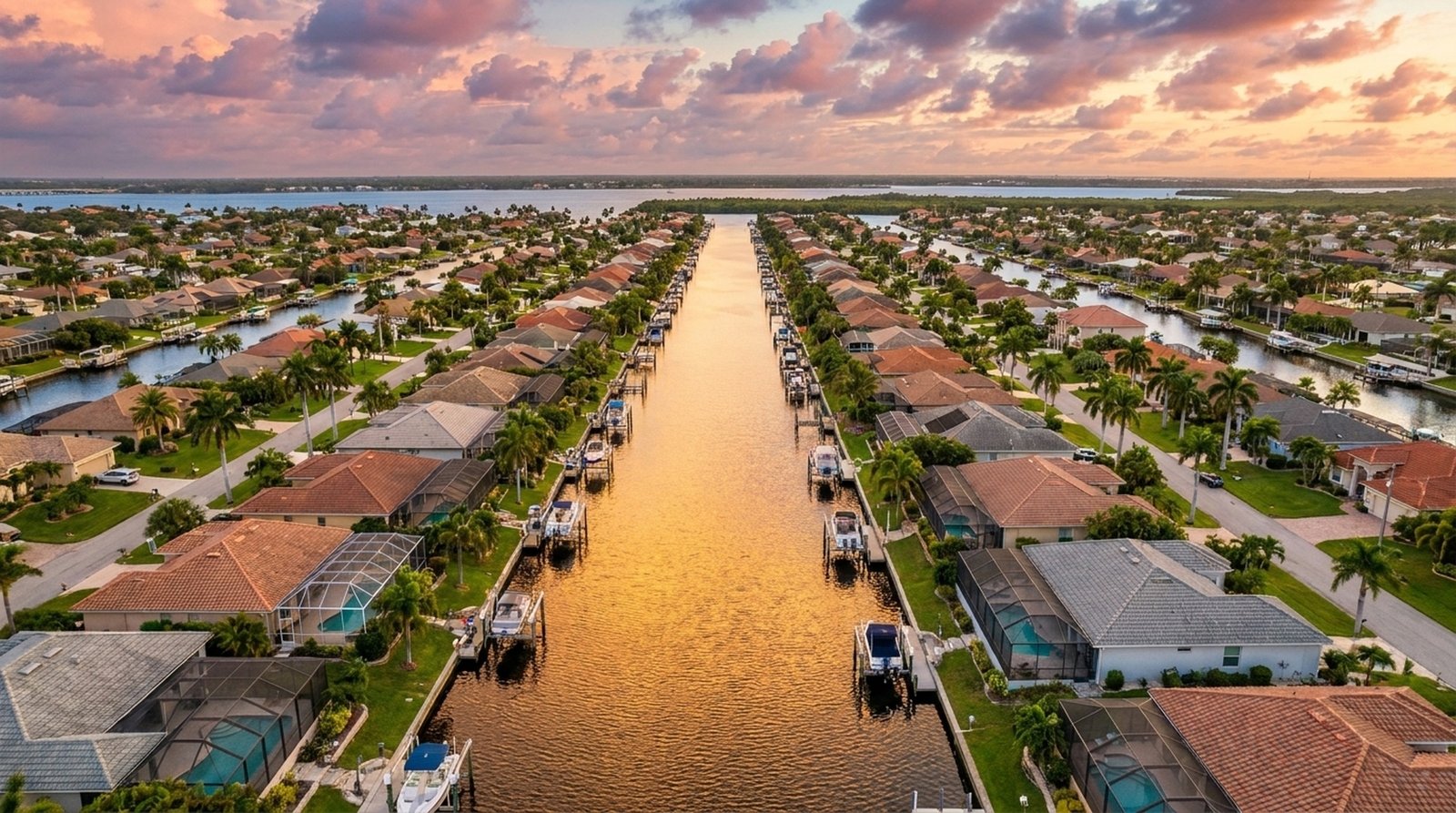
If you’re selling waterfront, you need to know whether your canal is direct Gulf access, indirect, or freshwater, and price accordingly. Two physically similar houses on different tiers don’t sell for similar numbers. I cover the hierarchy in the Cape Coral canal system breakdown: no bridges, no locks, straight shot to the river is the premium tier. Indirect discounts meaningfully. Freshwater discounts more. A FSBO seller pulling comps without that granularity will misprice the listing, and either direction loses money. Too low gives away equity. Too high lands you in phantom-listing territory where the home sits past 90 days.
Flood Zone and Insurance Disclosure
Cape Coral has meaningful flood-zone variation. Many direct Gulf-access homes sit in FEMA Zone AE, which carries mandatory flood insurance for any federally backed mortgage. Some homes carry prior flood claims from Hurricane Ian. Florida disclosure law requires sellers to disclose known material defects. A FSBO seller who doesn’t understand the disclosure obligations on flood history can create post-closing liability that buries any commission savings. My flood zones breakdown covers the mechanics; the FSBO-specific risk is not knowing what gets disclosed and what doesn’t.
Seawall, Dock, and Permit Coordination
On any Cape Coral canal lot, the seawall is part of the house. Replacement is a significant cost that varies with the contractor, the site, and the permitting, so get current written quotes before you price the home. Buyers and inspectors will ask about seawall condition, dock permits, lift permits, and whether work was done with proper city approvals. A FSBO seller who doesn’t have records ready, or doesn’t understand the permitting history of their own dock, will lose ground in the back-and-forth when those items come up. The cost of admission for selling waterfront is having the documentation in order.
The Cost of Living in Paradise Disclosure
Out-of-state buyers want the honest conversation: insurance, hurricane history, what Ian did and didn’t do to this specific address. The cost of living in paradise is real and buyers price it in. An experienced listing agent has had that conversation hundreds of times and knows how to frame the property’s situation honestly without tanking the deal. A FSBO seller often either avoids the conversation (which kills buyer trust) or volunteers too much (which kills the price). The middle path is a learned skill.
The Hybrid: Flat-Fee MLS
The middle option a lot of sellers consider is flat-fee MLS. You pay a discount brokerage a one-time flat fee (fees vary by provider) to list your home on the local MLS without full-service representation. You still handle showings, negotiation, contract, and closing. You’re buying MLS distribution and nothing else.
The honest case for it: it solves the biggest FSBO problem (MLS exposure and the buyer-agent network that comes with it) at a fraction of the cost of full representation. For a seller genuinely comfortable handling the operational work, flat-fee MLS captures most of the distribution value without paying for services they don’t need.
The honest case against: most sellers who use it aren’t, in fact, comfortable handling the operational work. They take the listing live, get the showings, then run into the same contract, negotiation, and inspection problems the pure FSBO seller faces. The MLS exposure helps; the lack of representation during the offer-through-closing phase still hurts. The net outcome often lands between pure FSBO and full representation, sometimes closer to the FSBO end than expected.
The thread in most FSBO problems is rarely that the seller was unintelligent or lazy. It’s that they were doing something for the first time against people who do it every day. That asymmetry is the structural argument for representation.
Frequently Asked Questions
Can I sell my house without a realtor in Florida?
Yes. Florida law allows homeowners to sell without representation (FSBO). You handle the listing, marketing, contract, disclosure forms, negotiation, and closing coordination yourself, though you can hire a real estate attorney to assist. The legal path is open. The question is whether the economic outcome of going it alone beats the outcome with representation, and NAR data consistently shows FSBO homes selling for less than agent-listed homes on a median basis.
How much do you save selling FSBO in Florida?
The theoretical maximum is the listing-side commission, typically 2.5-3% in Florida (with another 2.5-3% historically paid to the buyer’s agent, though those arrangements shifted with the 2024 NAR settlement). On a $500,000 sale, listing-side savings is roughly $12,500-$15,000. The real-world net outcome is usually negative because FSBO listings tend to sell for meaningfully less, take longer to sell, and concede more in inspection and appraisal. Run the math on your specific situation before assuming the savings are real.
Do I need a lawyer to sell FSBO in Florida?
Florida doesn’t legally require an attorney, but I strongly recommend one for FSBO. An attorney can review your contract, draft or review the seller’s disclosure, coordinate with the title company, and protect you from post-closing liability. Attorney fees vary, and they are usually small compared to the exposure of mishandling the contract on your own.
What is flat-fee MLS and is it worth it in Cape Coral?
Flat-fee MLS is a service where a discount brokerage lists your home on the MLS for a one-time flat fee (fees vary by provider), without full-service representation. You still handle showings, negotiation, contract, and closing. It works for sellers comfortable running the operational side who primarily want MLS exposure. It doesn’t fit sellers who want help on pricing, negotiation, inspection responses, or closing. In Cape Coral, canal-tier pricing nuance and disclosure complexity make full representation more valuable than in a uniform suburban market.
What is the seller’s disclosure I need to give a buyer in Florida?
Florida law requires sellers to disclose any known material defects affecting the property’s value that are not readily observable to the buyer. The standard Seller’s Real Property Disclosure used in FAR/BAR transactions covers structural, mechanical, environmental, and historical items: flood history, insurance claims, roof age, seawall condition, permitted versus unpermitted work. Failure to disclose can produce post-closing legal liability. Current forms live at floridarealtors.org.
Will I have to pay a buyer’s agent commission if I FSBO?
Not automatically, but most FSBO sellers offer some buyer-agent compensation because it expands the buyer pool. If you refuse, you’re effectively limiting the listing to unrepresented buyers, a small fraction of the pool. Following 2024 NAR settlement changes, sellers and buyer agents now negotiate compensation more explicitly per transaction, but the underlying reality (most buyers are represented) hasn’t changed.
What is the FAR/BAR contract?
FAR/BAR is the Florida Realtors/Florida Bar standard residential contract, the most commonly used purchase agreement form in Florida residential real estate. There are multiple variants including the standard form and the AS IS form, each with different default contingencies, inspection rights, and deadline mechanics. As a FSBO seller, you need to know which variant is being used and what the deadline math means for both sides. A real estate attorney or floridarealtors.org can walk you through them.
The Bottom Line
FSBO isn’t a scam and it isn’t a trap. It’s a legitimate option that fits a narrow set of sellers: those with a buyer already identified, those running a clean off-market deal with an experienced counterparty, and those who hold a Florida real estate license. Outside that set, the data is consistent. FSBO listings tend to sell for less, take longer to sell, concede more on inspection and appraisal, and produce a net outcome often worse than a represented sale even after accounting for commission saved.
In Cape Coral, the math gets harder because of local complexity. Canal-tier pricing, flood-zone disclosure, seawall and dock documentation, post-Ian insurance and damage history, snowbird buyer dynamics, and the Tale of Two Markets bifurcation all require enough local knowledge that pricing correctly is itself a meaningful piece of work. A seller who underestimates that complexity loses money before they get to the contract.
If you’re thinking about FSBO because the commission feels expensive, I get it. Run the actual math on your specific home and timing against what an experienced agent would realistically net you. In most cases, the represented sale produces a higher net. In some, it doesn’t, and FSBO is right. (Full path in the Cape Coral seller process guide, the operating framework in the 3-P framework, and the terms in the glossary.)
If you guys want a real conversation about whether FSBO fits your situation or whether representation makes more sense, that’s exactly the call I’m built for. I’ll give you the same straight read I give every seller who sits down with me, even if the right answer is FSBO. Reach out and let’s talk through your Cape Coral sale.