

Cape Coral Gulf Access Homes
We don’t write our reviews. Our clients do. Read them on Google, Zillow, and Realtor.com.
Cape Coral Gulf Access Homes: what this search actually is.
833 active Cape Coral listings with direct gulf access, no fixed bridges between the dock and open water, in our live MLS mirror, as of October 9, 2026.
This page is direct gulf access only: no fixed bridges between your dock and open water. The local MLS calls this "sailboat access," and it is the tier that matters most if you actually own a boat with any real mast height or a flybridge you don't want to duck under a bridge to clear.
Cape Coral's canal system splits into three tiers everyone lumps together as "waterfront." Direct means no fixed bridges in your route out. Bridge-limited (indirect) still reaches the Gulf, but under a fixed bridge first, usually 8-10 feet of clearance, fine for a powerboat, a hard stop for anything tall. Freshwater canals don't reach the Gulf at all. The Chiquita Lock, which used to bottleneck several southwest Cape Coral routes, was permanently removed in June 2025, one obstacle gone, but fixed bridges still decide direct versus bridge-limited, address by address.
We don't take the MLS water-type field at face value on a gulf-access listing. We check the actual route before a client makes an offer, and that's what our Waterway Map tool does. Type in any Cape Coral address and see the route to the Gulf yourself before you fall for the listing photos.
What you’re actually shopping for
A search for “Cape Coral gulf access homes” is usually a boat question more than a real-estate one. The thing you’re trying to pin down is whether a specific address lets you keep a boat at your own dock and reach open water, and the listing photos won’t answer it. The header above this page lays out how direct and bridge-limited access differ; what follows is the part that rarely makes it into a listing description, what gulf access actually costs to own, and where the homes that match your picture actually sit.
What gulf access costs to own
Flood insurance is the line item buyers underestimate
Direct gulf-access lots are almost universally in FEMA’s Zone AE, the 1% annual-chance floodplain. Any federally backed mortgage in AE requires flood insurance; cash buyers are not required to carry it, though most do. Base flood elevation in Cape Coral’s AE zones is 9 feet, and NFIP premiums in AE run roughly $3,000 to $7,000 a year, with older waterfront homes that carry claim history sometimes landing between $8,000 and $12,000. Freshwater canal lots generally sit in Zone X or X500, where coverage is not federally required and premiums run a fraction of the AE figure, so a freshwater listing and a gulf-access listing at the same asking price carry very different carrying costs.
Coverage also has ceilings worth knowing before you shop the high end: NFIP caps building coverage at $250,000 and contents at $100,000, so higher-value waterfront homes fill the gap through private carriers such as Neptune or Wright Flood. If a specific home’s premium looks off, an elevation certificate, about $500 to $800 from a licensed surveyor, documents the finished-floor height against that 9-foot base and can support a Letter of Map Amendment to reclassify the parcel. One caveat FEMA’s own data carries: roughly 40% of national flood claims come from low-to-moderate-risk zones, so an X or X500 rating lowers what you are required to spend without erasing the underlying risk.
The seawall behind the dock
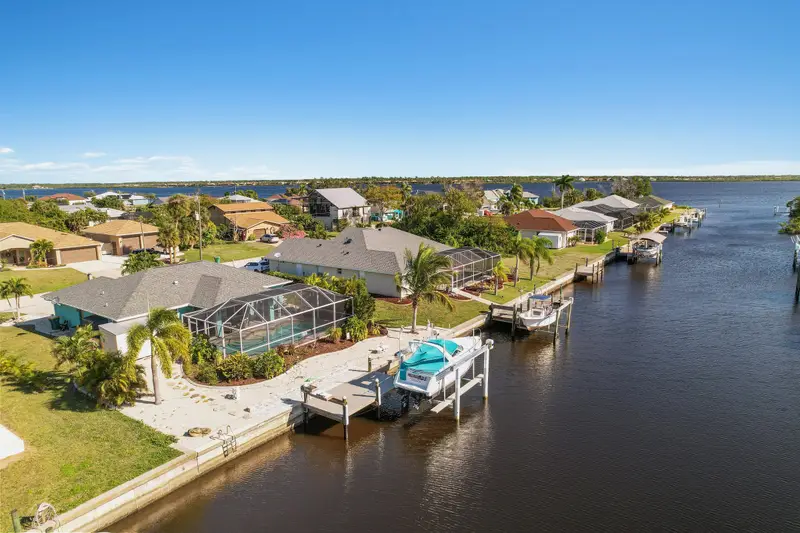
The dock photo hides a maintenance number. A gulf-access lot is only as sound as its seawall, and replacement in Cape Coral runs roughly $800 to $1,200 per linear foot; on a typical 80-to-100-foot waterfront lot that is a $64,000-to-$120,000 job, with a working lifespan of 30 to 50 years. Ask the age of the seawall on any home you are serious about, because it can move an offer as much as the kitchen does.
Where the direct-access inventory actually sits
Direct gulf-access homes cluster rather than spread evenly across the city. The concentrations are in southeast Cape Coral around the Yacht Club basin and Bimini Basin, and in southwest Cape Coral around Cape Harbour and Tarpon Point, with smaller pockets reachable via the Northwest Spreader. If your search keeps surfacing homes that don’t match what you pictured, it is often a bridge-limited or freshwater canal wearing the same “waterfront” label. The canal system layout for a given quadrant, or the breakdown on our freshwater canals page, resolves more of that confusion than another round of listing photos will.
Cape Coral, FL · active listings in our live IDX search feed, default map view · updated October 9, 2026
Two related questions come up once the access type is settled. How long the run to open water actually takes is separate from whether a route is direct, a canal can be direct access and still be a long ride out, and we break down realistic boat time to the Gulf from different parts of the city. And if the insurance math above reshaped your budget, our Cape Coral flood zones page walks each zone’s premium range in more depth.
Verify the route before you write an offer
Two addresses can carry the same MLS water-access code and behave differently the day you try to run a boat out. Flood maps compound the point: FEMA updated Cape Coral’s rate maps after Hurricane Ian in 2022 and again after the 2024 storms, and some parcels changed zones both times, so a zone quoted at a prior sale can be stale. Before committing to anything on this list, confirm the current per-parcel flood zone and the actual route to the river rather than trusting a field a listing was filled out with once.
The listings below update from the MLS feed and reflect direct gulf-access homes active in Cape Coral right now, newest first.
Direct vs. bridge-limited: why it actually matters
Two Cape Coral homes can sit on the same street, both labeled "gulf access," and be completely different products. Direct gulf access means your route to open water never passes under a fixed span, a sailboat, a boat with an arch, or anything with real height clears it without a second thought. Bridge-limited (indirect) gulf access still gets you out to the Gulf, but only under a fixed bridge first, and Cape Coral's fixed bridges typically run 8-10 feet of clearance at mean high water. That's fine for most center-console and bay boats. It's a hard stop for a sailboat or anything with a tall tower. The practical result: direct-access lots carry a real price premium over bridge-limited ones, and the only way to know which one a specific address is, is to check the route, not the listing description.
Active listings matching this search in Cape Coral, counted October 9, 2026. Houses, condos and townhouses only. The 285 vacant lots also listed here are excluded, because counting dirt alongside houses pulls the median below what a house actually costs. Price per sq ft is the median of 200 mid-market listings with a stated living area. Source: our own MLS mirror, not a third-party estimate.
Updated 1 second ago, refreshed every 60 seconds
Direct gulf-access homes on the market now.
Live snapshot of active Cape Coral listings with direct (sailboat) gulf access, newest first.
 $959,000
4608 SW 25th CT
Listing courtesy of Berkshire Hathaway Florida
 $749,000
3726 NW 42nd PL
Listing courtesy of Dalton Wade Inc
 $375,000
1781 Four Mile Cove PKWY 131
Listing courtesy of LPT Realty, LLC
 $1,650,000
4928 SW 11th PL
Listing courtesy of Tudor Villas Realty Corp
 $800,000
719 El Dorado PKWY W
Listing courtesy of The Keyes Company
 $968,000
3030 SW 24th AVE
Listing courtesy of Re/Max Sunshine
Updated 1 second ago, refreshed every 60 seconds
Read more, or start over.
What buyers ask us about this search.
What's the difference between direct and bridge-limited gulf access in Cape Coral?
Direct gulf access means no fixed bridges stand between your dock and open water, the local MLS synonym is "sailboat access." Bridge-limited (indirect) gulf access still reaches the Gulf, but the route passes under a fixed bridge first, usually with 8-10 feet of clearance, so it works for powerboats and not for anything tall. Direct-access lots carry a real premium over bridge-limited ones. We verify which one a specific address actually is before a client offers.
How do fixed bridge clearances limit what boat I can run from one of these homes?
A fixed bridge with 8-10 feet of clearance at mean high water is a hard stop for a sailboat mast, most flybridges, and tall towers. It's not a problem for a typical center-console, bay boat, or pontoon. If you own or plan to own a taller vessel, you need direct gulf access, not just "gulf access" on the listing sheet, those two words get used interchangeably online and they are not the same thing.
Did removing the Chiquita Lock in 2025 change which Cape Coral canals count as direct access?
It removed one bottleneck (a lock, not a bridge) that used to slow or gate several southwest Cape Coral routes, permanently, in June 2025. It did not change the direct-vs-bridge-limited classification itself, fixed bridges are still what decides that, address by address. The lock removal made some routes faster and simpler, it didn't make a bridge-limited canal into a direct one.
Book a 15–30 minute intro call.
We’ll walk through what’s relevant to where you are now and what you’re trying to do. No pitch. No pressure. Just a real conversation with someone who grew up in this market.
Pick a time, or leave a note.
Real conversation. No pressure. No call-center handoff.
Send Us a Message
We usually respond the same business day.