

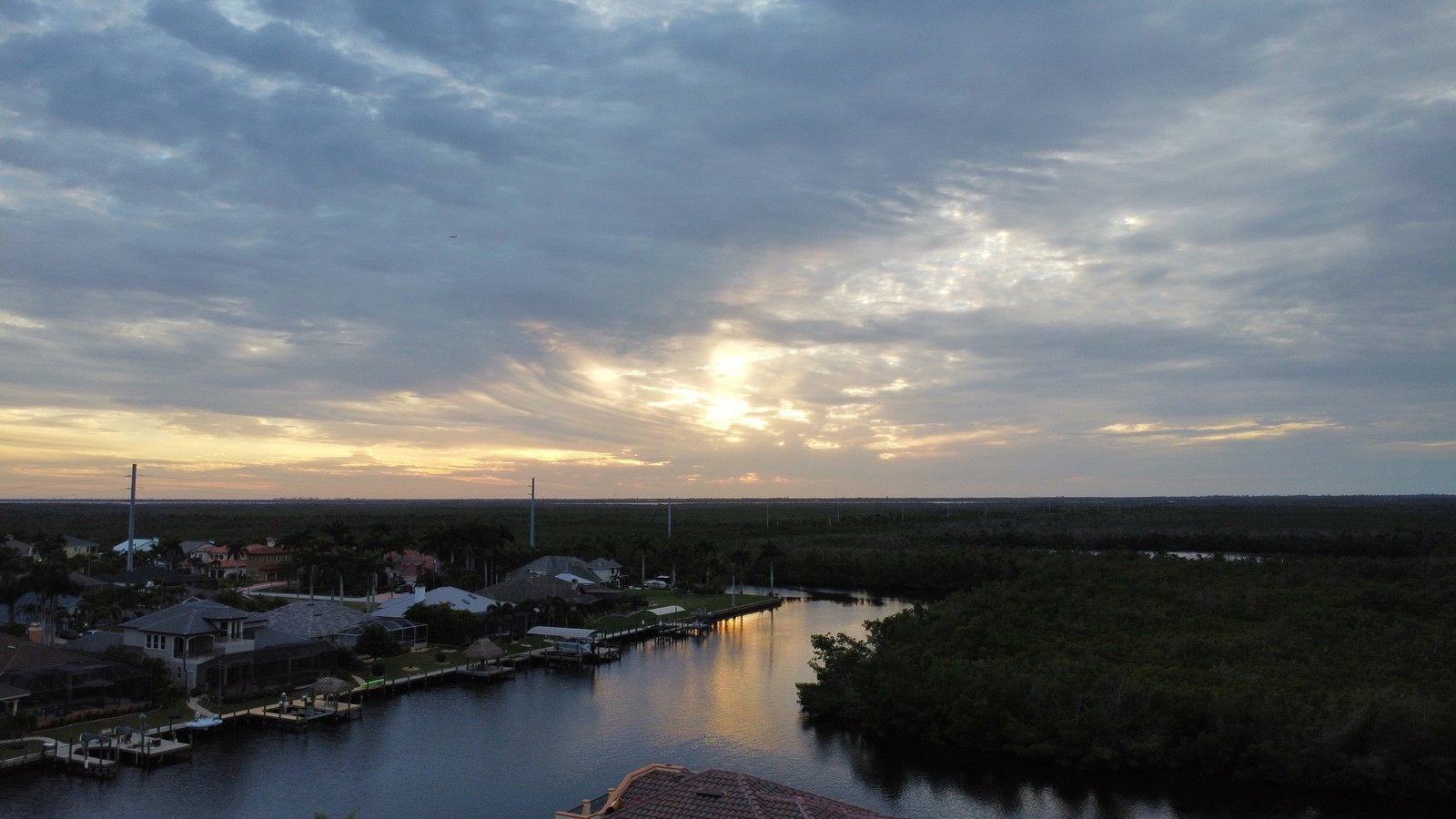
If you guys are looking at Cape Coral from out of state, there’s one line quoted to you over and over by everyone who has never lived here: Florida insurance is unaffordable, the companies are leaving, you’ll get a quote that wipes out your monthly budget. The truth is more complicated than the headline and more survivable than the panic.
I’m Brayden Milner. Third-generation Realtor with Florida Future Realty, born and raised in Cape Coral. Real estate is the water I grew up swimming in. I own a house here, I pay an insurance bill every year, and I’ve watched the market melt down after Ian and start to put itself back together in 2025 and 2026. What follows is what I’m quoting my own buyers this week: the policy stack, the post-Ian disruption, NFIP versus private flood, Risk Rating 2.0, wind mitigation credits, Citizens, real Cape Coral premium ranges, and the rule that matters more than any of it. Get a real quote before you remove your contingencies.
The Honest Framing: Real, Expensive, Survivable
Insurance in Cape Coral is real, expensive relative to most of the country, and survivable for almost every informed buyer. All three are true at once, and the conversation gets weird when somebody picks just one.
The average Lee County homeowners premium runs around $3,600 per year, or roughly $300 a month, per Florida’s Office of Insurance Regulation statewide data — Cape Coral sits inside that county-wide number. That’s the wind/fire/liability policy, the standard HO-3. It doesn’t include flood. Flood is always a separate policy in Florida, and that single fact catches more buyers off guard than anything else. You guys don’t buy “homeowners insurance” the way you buy it in Ohio. You buy a wind/fire/liability policy from one carrier, then if you’re in a flood zone, a flood policy from a different carrier (federal NFIP or private). Two policies, sometimes three if you stack a private excess on top of NFIP. That’s the architecture.
Within that average, the range is enormous. New construction under current code, with CBS construction, impact windows, a current-code roof, and 11-foot finished-floor elevation routinely comes in well under $1,500 a year on the wind/fire/liability side, with smaller new builds as low as $900. An older Rosen-era home in Zone AE with a pre-2017 roof and original openings can run $5,000 to $10,000 or more if you can place it. Same city, same market, different physical building. Both numbers are real Cape Coral numbers and the difference between them is the whole game.
What Hurricane Ian Did to the Market (and Where We Are Now)
You can’t understand Cape Coral insurance in 2026 without understanding 2022. Hurricane Ian made landfall as a Category 4 at Cayo Costa, just west of us, on September 28, 2022, with the eye passing north over Punta Gorda while Cape Coral sat in the southern eyewall. It pushed 10 to 15 feet of storm surge onto Fort Myers Beach, 9 to 13 feet across eastern Sanibel, and 6 to 9 feet through Pine Island, the Cape Coral waterfront, and the communities at the mouth of the Caloosahatchee. The Yacht Club basin took catastrophic damage. Properties in FEMA Zone X that had been dry for 30+ years took 2 to 4 feet of water. The regional insured loss was one of the largest in U.S. history.
What happened next was a carrier-side contraction. Private wind carriers pulled out of SWFL or issued mass non-renewals. Reinsurance costs doubled and tripled. Premiums spiked 30 to 60% across 2023 and 2024. Citizens absorbed hundreds of thousands of displaced policies statewide. The tier-one national carriers were already largely out of Florida before Ian and stayed out after. That’s not a credit problem; that’s a Florida market reality.
The 2024 season layered on top. Helene made landfall in the Big Bend, Milton hit near Siesta Key. Neither did catastrophic physical damage in SWFL, but both re-traumatized the market and triggered another round of FEMA remapping. After Ian, companies left. After Milton and Helene, the ones that came back got cautious all over again.
Where we are in 2026 is the start of a recovery. More than a dozen new carriers have been approved in Florida, reinsurance costs (the biggest driver of retail rates) are down 15 to 20% at recent renewals, and that’s starting to show up as retail rate decreases in the high single digits to mid-teens from Citizens and several private carriers writing in SWFL. Slide, American Integrity, Kin, and various surplus-lines companies are writing again with appetite for the right risk. New construction is the easiest box to check; older homes with current-code roofs and impact protection are placeable. The genuinely difficult risks (1970s direct Gulf access, pre-2017 roofs, prior claim history) are still hard. The buyers I’m working with this year are getting real quotes in reasonable timeframes.
Wind vs. Flood: Two Separate Policies
This is the biggest misunderstanding new buyers walk in with. Your standard homeowners policy in Florida is an HO-3. It covers wind, fire, liability, theft, and the usual perils. In wind-borne debris regions like Cape Coral, the wind portion is the big driver of cost, and that’s the line item wind mitigation credits attack. The HO-3 doesn’t cover flood. If water rises from a canal and gets into your house, that’s a flood claim. If wind blows the roof off and rain falls into your living room, that’s a wind claim. Same water, different cause, different policy.
Flood is a separate policy. You buy it from the National Flood Insurance Program (NFIP, federal) or from a private flood carrier (Neptune, Wright Flood, others). If your home is in FEMA Flood Zone AE and you have a federally backed mortgage, your lender will require flood. If you’re in Zone X with a mortgage, the lender may not require it, but skipping coverage in Cape Coral is a real risk decision, not a free pass. Depending on the reporting period FEMA cites, 20% to 40% of NFIP claims nationally come from lower-risk X zones. Ian flooded houses in Zone X that had been dry for three decades.
For the full zone breakdown, read Cape Coral Flood Zones: AE, X, and What They Actually Mean for Your Mortgage and Insurance. The summary: most direct Gulf-access waterfront sits in Zone AE; off-water and freshwater canal homes are more often Zone X. Zone determines whether flood is mandatory. Elevation, vintage, and construction determine the price within the zone.
NFIP, Private Flood, and the $250K Cap
You can read the full NFIP structure at fema.gov. The piece you need to know as a Cape Coral buyer is the coverage cap: NFIP tops out at $250,000 building and $100,000 contents on a residential policy. That ceiling hasn’t moved in a long time relative to Florida home prices.
For a $250K starter home, the cap roughly covers you. For nearly every canal home in Cape Coral, priced well above $250K, the NFIP cap leaves a real replacement-cost gap. That’s where private flood comes in. Carriers like Neptune and Wright Flood offer higher limits, sometimes lower premiums, and on certain homes outcompete NFIP. Private flood typically takes 14 to 30 days to bind and is not transferable to a buyer the way NFIP policies often are.
That transferability piece is genuinely important and most buyers don’t know it exists. Existing NFIP policies are assumable. If the seller has held a flood policy at a legacy premium basis (which under Risk Rating 2.0 can be dramatically lower than a new policy), you may be able to take it over at that rate. I’ve seen Cape Coral deals where an assumable $800 NFIP policy was a material negotiation point. Get the seller’s declarations page before you write the offer.
Risk Rating 2.0: How FEMA Changed the Math
FEMA rolled out Risk Rating 2.0 starting in 2021 and fully phased it in through 2023. It was the biggest overhaul to NFIP pricing in the program’s history. NFIP used to price flood policies largely on the FEMA flood zone (AE versus X) and the elevation certificate. Risk Rating 2.0 prices on a wider set of property-specific variables: distance to water, replacement cost, building characteristics, flood frequency, and multiple flood types.
The practical effect in Cape Coral: a brand new NFIP policy on a $600,000 canal home in Zone AE can be substantially more expensive than the same property’s legacy policy from before Risk Rating 2.0. That’s why an assumable seller policy is so valuable. Some lower-value or properly elevated properties have actually seen NFIP rates come down under 2.0. Either way, don’t assume the seller’s NFIP premium is what you’ll pay. Get a written quote based on your own ownership at current rates.
Wind Mitigation Credits: 20 to 45% Off the Wind Premium
Here’s the highest-leverage thing you can do to lower your Cape Coral insurance bill. A wind mitigation inspection documents the hurricane-resistant features of the home and converts them into a documented insurance credit. The credits run 20 to 45% off the wind portion of your premium. The inspector looks at:
- Roof-to-wall attachments. Toe nails, clips, single wraps, double wraps. Modern straps and wraps earn the largest credit.
- Roof deck attachment. The nailing schedule that holds the plywood deck to the trusses.
- Roof covering. Whether the shingles, tile, or metal meets current Florida Building Code wind-load standards.
- Secondary water resistance. Peel-and-stick membrane underlayment that keeps water out if the primary covering fails.
- Opening protection. Impact windows and doors, hurricane shutters, or no protection. Impact windows earn the strongest credit and they earn it on every opening.
- Building shape. Hip roofs (sloped on all four sides) shed wind better than gable roofs and earn a meaningful credit.
Combined with a 4-point inspection (roof, HVAC, electrical, plumbing), the wind mitigation report produces the best premium that carrier will give you on that house. Every buyer should commission both. They pay for themselves inside the first policy year. Impact windows are the largest line-item credit available: they earn the discount on every opening, never have to be deployed before a storm, and are part of why new construction in Cape Coral insures so cheaply. Older homes with retrofitted impact glass pull the same credit, plus the great peace of mind that comes with not bolting plywood at midnight before a storm.
Citizens Property Insurance: The Insurer of Last Resort
Citizens Property Insurance Corporation is Florida’s state-backed insurer of last resort. It writes policies when private companies won’t, which is why Citizens grew enormous after Ian. The state has been actively pushing depopulation since. As of 2026, Citizens is shrinking back toward its intended role.
One rule worth flagging on higher-value property: Florida law requires Citizens residential (multiperil) policies to include flood coverage, with the dwelling-value threshold phasing down through 2028 ($400K as of January 2026, reaching all policies by 2028). Separately, Citizens wind-only policies also have a flood-coverage requirement phasing in through January 2027. If you end up with a Citizens wind policy on a higher-value Cape Coral home, you’ll also need flood, even if you’re technically not in a mandatory flood zone. Where the private market can write your house, that’s generally where you want to be. Citizens is the backstop, not the preferred long-term home.
The New Construction Premium Advantage
This is one of the strongest financial arguments for buying new construction in Cape Coral, and most out-of-state buyers don’t see it. New construction built to current Florida code, with CBS construction, impact windows, current-code roof, and 11-foot finished-floor elevation (2 feet above the FEMA base flood elevation in Zone AE), routinely insures under $1,500 a year on the wind/fire/liability side. Some smaller new builds have come in as low as $900. Even in Zone AE, a current-code new build can run thousands of dollars less per year in total insurance than an older home in the same zone. Over a 10-year hold, the delta between a 1970s home with deferred features and a 2023 build with full mitigation can be $40,000 to $80,000 in real money. I cover the broader new construction picture and the seven-rung builder price ladder in Cape Coral Housing Stock: What People Buy Here.
Roof condition is the practical gating item on older homes. Florida law (s. 627.7011(5), F.S.) bars an insurer from refusing to write or renew solely because of roof age when the roof is under 15 years old, and for a roof 15 years or older you can provide an inspection showing at least 5 years of useful life remaining, which the insurer can’t refuse solely on age. Carriers can still decline on the roof’s actual condition and remaining useful life, so a worn or end-of-life roof remains a hard placement in the standard market. For a buyer looking at a resale with an older roof, factor a $15,000 to $30,000 roof replacement into the offer math, because it directly affects whether the property is insurable at all and at what price.
Real Cape Coral Numbers: My Own House as an Anchor
It’s easy to throw ranges around; it’s harder to tell you what I personally pay. My house is a 2003-build in Flood Zone X (Cape Coral’s lower-risk band, covering a significant share of the city’s inland parcels), with a 2023 roof, CBS construction, and impact protection. My total homeowners insurance is $1,871 a year. That’s the bill I actually pay. It sits at the low end of the Cape Coral spread because the variables line up: a Zone X designation (the lower-risk band — not AE, so flood isn’t federally mandated), a 2023 roof inside every carrier’s comfort window, and a post-2002 build vintage.
That number isn’t the average. The Lee County average HO premium is closer to $3,600, per Florida’s Office of Insurance Regulation. Here’s the rough premium ladder on the wind/fire/liability side in 2026:
- New construction under $500K, current code, Zone X: $900 to $1,500 per year is common.
- Newer mid-market resale, Zone X or X500, post-2017 roof, impact protection: $1,500 to $3,000 per year.
- 2000s vintage Zone AE waterfront, current roof, full mitigation: $3,000 to $5,000 per year wind, plus flood.
- Older direct Gulf-access home, pre-2002 build, pre-2017 roof, no impact: $5,000 to $10,000+ per year wind, plus flood, if you can place it at all without surplus-lines or Citizens.
On the flood side, for federal NFIP policies in Cape Coral: Zone X Unshaded runs $500 to $1,500 if elected (in Cape Coral parcel data, Zone X is the lower-risk band — shaded X (0.2% annual chance) areas do exist in the county mapping but are not separately itemized in the city’s public parcel data); Zone AE on newer construction with an elevation certificate runs $3,000 to $5,000; Zone AE on 1970s direct Gulf-access with claim history runs $7,000 to $12,000. Stack the two sides and you get the total carrying cost. For a typical newer resale in a moderate-risk zone, $3,500 to $6,000 total is realistic. A brand new build in Zone X, under $2,500 total is achievable. A 1970s waterfront with deferred features, $15,000+ total is real. That entire spread lives inside the city limits.
The Get-a-Quote-Before-Contingency-Removal Rule
If you guys remember nothing else from this article, remember this. Get a real insurance quote on a specific property before you remove your contingencies. Not after, not the week of closing. Before your inspection period ends and your earnest money goes hard.
The reason this matters so much in Cape Coral is that insurance is the longest single path in any closing here, often longer than title search or mortgage underwriting. The binder has to come back, the 4-point inspection has to clear, the wind mitigation report has to be processed, and the flood policy (NFIP or private) has to bind, which on the private side can take 14 to 30 days. Wait until two weeks before close to call a carrier on a 1972 direct Gulf-access home with a 2010 roof and you’ll discover that no admitted carrier will write it, that the surplus-lines quote is $9,500 a year, and that you’ve already shipped furniture from Pennsylvania.
The fix is simple and free. The day your offer is accepted, call a local insurance agent who writes in Cape Coral and give them the property address. They’ll run it through their carrier panel, flag any structural issues (roof age, opening protection, claim history), and give you a real number. If it’s workable, you proceed. If not, you have time to re-negotiate, walk away inside your inspection window with earnest money intact, or pivot. The local real estate community has long recommended this insurance-binder-first approach for SWFL transactions.
Insurance as a Buying Lever
Most buyers walk in thinking about mortgage payment. In Cape Coral, the real monthly carrying cost is PITI plus the insurance carry, and the insurance carry can easily be the difference between two otherwise-comparable homes feeling like the same purchase or very different purchases.
Two examples. House A: 2022 new build, Zone X, CBS construction, impact windows, metal roof, 11-foot elevation, $475,000. Total insurance: $1,800 a year. House B: 1985 direct Gulf-access home, Zone AE, 2014 roof, shutters not impact, $475,000. Total insurance: $9,500 a year. Same purchase price, same monthly principal and interest. The carrying cost differs by $640 a month, equivalent to a $100K difference in mortgage at current rates. The Zone X new build is, in actual monthly outflow, a meaningfully cheaper house to own than the AE waterfront.
That math isn’t an argument against waterfront. Plenty of buyers want the canal, want the dock, want the boat ride to Sanibel, and they gladly pay the carrying cost because the lifestyle is the whole point. I cover the waterfront tradeoffs in The Cape Coral Canal System: Direct Access, Indirect Access, and Freshwater Explained. The point is that the carrying cost is a real variable you can shop. The bad outcome is the buyer who picks the AE waterfront on Saturday and discovers the insurance number on Tuesday.
The Cost of Living in Paradise
Insurance is part of the cost of living in paradise. It’s the carrying cost of being in a coastal hurricane-exposed market with 255 sunny days a year and waterfront inventory that doesn’t exist at this price point anywhere else in the United States. It’s real money, it’s not optional, and it buys you something tangible: great peace of mind that when the next storm comes through, your loss is bounded, your home is repaired, and your financial life doesn’t get destroyed in one bad weekend.
The good news, which gets less airtime than the panic narrative, is that the market is working. New carriers are entering, rates are softening, new construction is genuinely affordable to insure, wind mitigation credits cut real money off real bills, and NFIP transfers preserve legacy rates. The system has rules, the rules are knowable, and an informed buyer can structure a Cape Coral purchase that pencils.
Frequently Asked Questions
How much does homeowners insurance cost in Cape Coral?
The Lee County average runs around $3,600 a year for the standard HO-3 wind/fire/liability policy, per Florida’s Office of Insurance Regulation. New construction under current code with CBS construction and impact windows comes in under $1,500, with some smaller builds as low as $900. Older homes with pre-2017 roofs or no impact protection can run $5,000 to $10,000 or more. Flood is separate and adds $500 in Zone X Unshaded up to $7,000+ in Zone AE on older Gulf-access homes.
Is homeowners insurance even available in Cape Coral right now?
Yes. The post-Ian contraction was real, but the SWFL market has been recovering through 2025 and 2026. More than a dozen new carriers have been approved in Florida. Reinsurance costs are down 15 to 20% at recent renewals, and that’s translating into retail rate decreases in the high single digits to mid-teens from Citizens and several private carriers. Older homes with current-code roofs and impact protection are placeable through admitted carriers; the hardest risks end up in surplus-lines or Citizens, but coverage is generally available.
Do I need flood insurance if I’m not in Flood Zone AE?
Federally, no. If you have a federally backed mortgage and the property is in Zone X, your lender won’t require it. However, depending on the reporting period, 20% to 40% of NFIP claims come from lower-risk X zones, and Ian flooded Cape Coral Zone X homes that had been dry for 30+ years. Premiums in Zone X Unshaded run $500 to $1,500 a year and most local agents recommend at least basic coverage as a hedge.
What is the difference between NFIP and private flood insurance?
NFIP is the federal flood program run by FEMA. It caps coverage at $250,000 building and $100,000 contents; existing policies are often transferable to a new buyer at the seller’s legacy premium basis. Private flood carriers like Neptune and Wright Flood offer higher limits and on certain properties lower premiums. Private policies take 14 to 30 days to bind and are not transferable. For high-value canal homes, NFIP plus a private excess stacked on top is common.
What is a wind mitigation credit and how much can it save?
A wind mitigation inspection documents hurricane-resistant features (roof-to-wall attachments, roof deck, roof covering, secondary water resistance, opening protection, building shape) and generates credits of 20 to 45% off the wind portion of your premium. Combined with a 4-point inspection, it produces the best premium available from that carrier. Every Cape Coral buyer should commission both during due diligence.
What is Citizens Property Insurance and should I use it?
Citizens is Florida’s state-backed insurer of last resort. As of January 2026, Citizens flood-coverage requirements are phasing in: residential policies at $400K and above must carry flood now, with all policies covered by 2028, and wind-only policies reaching full coverage by January 2027. Where the private market can write your house, that’s where you want to be. Citizens is the backstop, not the preferred long-term home.
How does roof age affect my Cape Coral insurance options?
Roof condition is the most binary insurance variable on any older Cape Coral home, but you have more legal standing than most buyers realize. Under s. 627.7011(5), Florida Statutes, an insurer can’t refuse to issue or renew a policy solely because of roof age if the roof is under 15 years old; for a roof 15 years or older, you can provide an inspection showing at least 5 years of useful life remaining and the insurer can’t refuse solely on age. Carriers can still decline on the roof’s condition and remaining life, so an aging or worn roof is still a hard conversation with the standard market. Factor a $15,000 to $30,000 roof replacement into offer math on any home with an aging roof.
Can I take over the seller’s existing flood insurance policy?
Yes, if it’s NFIP. Existing NFIP policies are transferable to a new buyer at the seller’s existing premium basis. Under Risk Rating 2.0, a brand new NFIP policy on the same property can be substantially more expensive than the seller’s legacy policy. An assumable $800 NFIP policy is a real negotiation point. Ask the seller for the current declarations page early. Private flood policies are not transferable the same way.
Why should I get an insurance quote before removing my contingencies?
The insurance binder is the longest single path in any Cape Coral closing, often longer than title or mortgage underwriting. Private flood requires 14 to 30 days to bind. If you wait until two weeks before close to discover no admitted carrier will write the property and the surplus-lines quote is unworkable, your options narrow dramatically. Calling a local agent the day your offer is accepted gives you a real number inside your inspection period, with full negotiation leverage and earnest money recoverable.
The Bottom Line
Cape Coral insurance in 2026 isn’t the apocalypse the internet says it is, and it isn’t as casual as a Midwest premium quote either. It’s a structured, knowable cost that breaks into two policies (wind/fire/liability and flood), gets driven by a handful of variables (zone, vintage, roof age, opening protection, claim history), and gets discounted in a handful of ways (wind mitigation credits, NFIP transfer, elevation certificates, LOMA filings). The market is in active recovery after Ian.
Bad outcomes happen to buyers who skip the quote, ignore the roof age, or assume the seller’s premium is what they’ll pay. Good outcomes happen to buyers who get a real number on a specific address before contingency removal, factor full PITI plus insurance into affordability, and choose between waterfront-with-higher-carry and inland-with-lower-carry with their eyes open.
My own house, 2003 build in Zone X (Cape Coral’s lower-risk band) with a 2023 roof, runs $1,871 a year for total homeowners insurance. New construction under current code in Zone X can come in under $1,500, with some smaller builds under $900. A 2000s Zone AE waterfront with current mitigation runs $3,000 to $5,000 wind plus flood. A 1970s direct Gulf-access with deferred features can run $10,000+. The spread is real and shoppable. The Lee County emergency management resources at leegov.com are a good free starting point for understanding evacuation zones and the regional risk picture.
If you guys want a straight read on what the insurance number is likely to look like on a specific Cape Coral property, that’s exactly the conversation I’m built for. I grew up on these canals, I own one of these houses, and I can connect you to local insurance agents who write here every day. Reach out and let’s talk about your Cape Coral purchase. Whether you’re a year out or actively writing offers, I’ll give you the same straight read I give every buyer who sits down with me.