

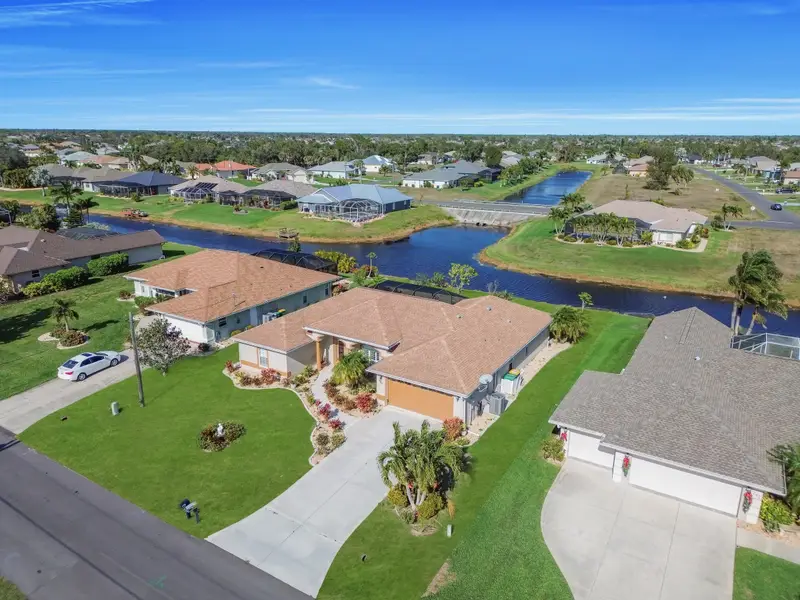
Most out-of-state buyers come into Cape Coral looking for a neighborhood the way they would in any other city: which subdivision has the right fit, which one is up-and-coming, which one lines up with the school-choice plan. The answer they keep getting from local agents sounds like a dodge: “What quadrant are you looking in?” It’s not. Cape Coral doesn’t work like other Florida cities. There are very few named subdivisions, and the ones that exist are mostly gated pockets inside a much larger grid. Locals price properties and route buyers by quadrant: Southeast, Southwest, Northeast, Northwest. Four quadrants, four different products, four different conversations.
Search Cape Coral homes
Browse Cape Coral homes for sale, gulf access homes for sale, or Cape Coral homes under $500,000. Explore the Cape Coral guide, Sandoval, and Tarpon Point.
I’m Brayden Milner. Third-generation Realtor with Florida Future Realty, born and raised here. Real estate isn’t a career I chose out of a catalog. It’s the water I grew up swimming in. I’ve sold homes in every quadrant and sat across from buyers who came in convinced they wanted SE and left under contract in NW (and vice versa) once they understood the differences. This is the walk-through I do with every relocation client the first time we sit down with a map. By the end, you’ll know which quadrant fits your budget, your boat (if you have one), your family, and your timeline, plus the named communities inside each one worth your attention.
Why Cape Coral Is a Quadrant City, Not a Neighborhood City
You guys have to start with the founding. Everything about Cape Coral’s layout traces to one decision the Rosen brothers made in 1957. They bought 103 square miles of raw land in NW Lee County and platted the entire thing as a single uniform residential grid before any infrastructure existed. Tens of thousands of lots drawn across the whole city at once. No neighborhoods in the traditional Florida sense where a developer carves a tract, names it, builds 200 homes, gates it, and moves on. The entire plat is one giant subdivision still being built out today in the northern reaches.
That’s why locals talk in quadrants. The four are split by Santa Barbara Boulevard running north-south and the Hancock Bridge Parkway / Embers Parkway line running east-west. Pine Island Road is the shorthand people reach for, but it actually cuts a diagonal across the grid, and a large stretch of NE-addressed streets sits south of it. Each quadrant has its own canal type, utility status, price tier, development era, and price trajectory. Drop a pin and you can predict housing-stock age, water access, utility status, and roughly the price per square foot. Cape Coral is the canal city by design, and the quadrant framework is how the canal city gets sorted into livable parts. The full plat-and-grid backstory is in our Cape Coral 101 overview, and the canal hierarchy is in the Cape Coral canal system guide.
Named communities exist inside the grid but they’re the exception: Yacht Club, Cape Harbour, Tarpon Point, Sandoval, Stonewater, Coral Lakes, Bellavida, Burnt Store Marina. They sit inside a much larger framework of plain-grid Cape Coral, which is what most of the city actually is: a residential street, a canal or no canal, a lot you own outright, no HOA fees showing up monthly. That’s why the pentad (no HOA, no CDD, own your land, Zone X or X500 on many off-water lots, lower insurance potential on newer construction) carries the weight it does.
Southeast Cape: The Oldest Quadrant, the Yacht Club, and the Post-Ian Rebuild
Southeast Cape is the original city. Development dates to the late 1950s and 1960s, the first wave after the Rosen plat went in. Drive through SE today and the visible signal is the tree canopy: Australian pines, banyans, and oaks that have had sixty years to mature. Most of the rest of the city looks comparatively sparse. SE looks like a real, lived-in neighborhood because it is one.
SE housing stock is the most varied in the city: original 1960s and 1970s concrete-block bungalows (some original, some gut-renovated), 1980s and 1990s tract homes, teardown-rebuilds on premium canal frontage, and an active post-Ian rebuild wave in the Yacht Club basin and along direct-access reaches that took storm surge. The 2022 surge damage was real, and the rebuild is still working through inventory three-plus years later. Vintage and construction-era detail lives in the Cape Coral housing stock guide.
SE Cape carries the densest grid of tidal saltwater canals in the city, with most waterfront feeding the Bimini Basin or out via the Yacht Club basin. A lot of SE waterfront qualifies as direct Gulf access (no bridges, no locks), the top tier of the canal hierarchy, giving you a straight shot out to the Caloosahatchee, Fort Myers Beach, Sanibel, and Captiva. The Caloosahatchee riverfront itself is the absolute price ceiling for the entire city, where the largest custom estates change hands. Standard direct-access near the Yacht Club typically trades at a clear premium to the citywide Gulf-access price range, which runs roughly $650K to $900K-plus depending on canal position, seawall condition, and dock/lift specs. The full breakdown is in the canal system article.
The Yacht Club and South Cape Downtown
The Yacht Club is the oldest and most recognized neighborhood name in Cape Coral, anchored at the southeastern tip by the Yacht Club basin and the public beach. Know going in that the park itself is a redevelopment site right now, not an operating amenity set: the Cape Coral Pier rebuild has been designed and funded in phases after Ian, and the Boathouse Tiki Bar & Grill — lost to a fire in 2024 and since demolished — is slated to return as a rebuilt, storm-ready venue under a new 30-year concessionaire agreement. Homes inside the immediate Yacht Club footprint carry a name-recognition premium on top of waterfront and location value. The other thing SE has that no other quadrant matches is downtown. The South Cape entertainment district along Cape Coral Parkway and SE 47th Terrace carries the densest concentration of restaurants, bars, breweries, and live music in the city. If you want to walk or bike to dinner on a Friday night, SE is the only quadrant where that’s realistic. Add Sun Splash Waterpark, Four Mile Cove Ecological Preserve, and the Cape Coral Historical Museum, and SE has the most amenity density per square mile. SE also has the shortest commute to Fort Myers via the Cape Coral Bridge; toll structure and crossings are in the transportation article.
SE at a glance: direct Gulf access canals, walk-to-restaurants lifestyle in the South Cape, mature established neighborhoods, and a price premium for older inventory or a renovation budget on a 1960s shell. This is where the older Cape Coral money has lived for decades.
Southwest Cape: The Premium Quadrant, Marina Communities, and the Chiquita Re-Rate
Southwest Cape is the highest-priced quadrant per square foot, and it concentrates the largest share of premium waterfront and gated-community inventory. City water and sewer are fully in place across nearly all of SW, and UEP assessments for those areas have been paid or rolled into property tax (the City of Cape Coral publishes utility status by parcel at capecoral.gov). That removes a whole category of uncertainty NE and NW buyers carry. In SW, you don’t have to ask whether it’s on well, whether the septic field is healthy, or whether a $20K-plus utility assessment is going to land on your mailbox next year.
The SW canal grid mixes direct Gulf-access routes with (historically) indirect routes that ran through the Chiquita Lock. Lock removal in the 2023 to 2025 window changed a lot of SW addresses overnight. Properties that traded for years as indirect-access (the lock added 20 to 30 minutes each direction and constrained vessel size) re-rated as direct-access after the lock came out. Same house, same lot, different product. Any agent pricing SW off pre-2023 comps is structurally mispricing the listing. Full mechanics are in the canal system article.
Cape Harbour, Tarpon Point, and Sandoval
Cape Harbour is the gated marina community that built a true walk-to-docks-and-dining environment inside its gates: Rum Runners, the French Press café, and the Marina Villas overlooking the boat basin. Keep your boat at the slip, eat dinner at the waterfront without getting in your car. Premium price tier, a heavy concentration of second homes and lock-and-leave condos, attracting buyers who want marina lifestyle without managing a single-family lot.
Tarpon Point sits at the southwestern edge at a different density and price tier than the surrounding streets. The footprint includes a Westin resort, Pinchers, Marker 92 waterfront dining, and a marina with slips for larger vessels than the standard residential canal accommodates. Luxury-spec inventory trades at the top of the SW market, and on-site amenity density means residents have less reason to leave the community for daily errands than almost anywhere else in the city.
Sandoval is the roughly 1,500-home gated master-planned community in SW, spread across 524 acres. The HOA handles lawn care and exterior maintenance, the amenity center includes a pool, clubhouse, and fitness, and short-term rentals are prohibited by HOA rules. Most of Cape Coral allows STRs on residential parcels, so investor buyers compete for inventory across most of the city. Inside Sandoval, that competition is structurally removed. The result is a quieter, more residential-feeling community with a stable population of full-time and seasonal owners. If you specifically want gated, HOA-managed, no-STR living, Sandoval is the answer.
SW is also where active luxury new-construction is happening in 2025 and 2026. Frey & Sons and Driftwood / Coastal Craft Homes are building spec and custom homes in the $800K to $2M-plus range on premium canal frontage, particularly in reaches that re-rated after lock removal. This is where much of the city’s premium-tier new-construction activity is concentrated.
SW at a glance: premium-tier waterfront, quiet gated or near-gated streets, marina access without SE’s dense walkable urbanism, completed utilities with zero infrastructure risk, and new or near-new construction. A large share of homes here are second homes. This is where most Cape Coral new-build money is currently being deployed.
Northeast Cape: The Affordability Anchor, Freshwater Only, and the UEP Question
Northeast Cape is the affordability floor inside the city limits. Entry-level new construction starts in the low $300Ks for a 3-bedroom, 2-bath concrete-block home on a standard lot, no pool, no HOA, fee-simple ownership of the land. That’s the cheapest new construction you can buy in Cape Coral proper. The reason: the canals in NE are freshwater only. They do not connect to the Caloosahatchee or the Gulf. They’re retention and drainage canals that give you a water view, bass and tilapia fishing, and kayak access, but they go nowhere a boat can actually use.
Freshwater only is not a defect. It’s a different product. NE is the right quadrant for the buyer who wants the Cape Coral lifestyle on a budget: owned land, no HOA, Florida tax structure, concrete-block construction, modern floor plans, impact windows on most current-build product. The pentad is strongest in NE when the parcel checks out: no HOA, no CDD, owned land, Zone X or X500 on many off-water lots, and lower insurance potential for modern construction outside AE. Below $500K, the pentad is the close.
The big NE due-diligence question is the Utility Expansion Project. Much of NE has been converted, but status varies block by block. Some streets are on city utilities and paid. Some have assessments pending. Some are still on well and septic with no firm timeline. Connecting a home once utilities reach your street adds separate costs on top of the assessment itself: a plumber’s connection (roughly $3,000 on average), a $325 water-meter install, a $225 utility account deposit, and a $100 septic-abandonment permit, call it $3,650 total. The current phase (North Cape 1 East) carries a total UEP assessment around $32,288 per lot — the Equivalent Parcel charge for water, sewer, and irrigation ($25,538) plus the Capital Facility Expansion Charge ($6,759) stacked together. Older infill assessments off the original schedule can run $20,000 to $35,000 per lot. Always pull parcel-level utility status before writing an offer (the City of Cape Coral publishes records at capecoral.gov).
Coral Lakes, Bellavida, and Pine Island Road
Coral Lakes is the gated freshwater community in NE with a standard amenity set, drawing value-conscious buyers and seasonal owners who want gated living without the SW saltwater premium. Bellavida is a smaller gated community with a residential feel and daily-life convenience. Both trade well below comparable SW inventory. NE also has the Pine Island Road commercial spine: Home Depot, Target, a continuous strip of restaurants, medical offices, banks, and service businesses on both sides of SR 78. Most NE daily errands are inside a 10-minute drive.
NE at a glance: the most square footage per dollar in the city, heavy new-construction inventory with strong rental fundamentals, freshwater canals, and no beach or bridge proximity. NE is also where SE and SW shoppers land after they run the numbers and realize they can get a brand-new 4/2 with a two-car garage for the price of a 1970s renovation candidate in SE.
Northwest Cape: The Active Frontier, Spreader Canal, and the 2040 Timeline
Northwest Cape is the city’s growth frontier: most recently developed, largest stretches of greenfield where the Rosen plat hasn’t built out, home of most active master-planned development. Off-water NW lots are typically the lowest priced per square foot in the city, and there’s tons of new construction as builders work through improved-lot inventory.
The defining water feature in NW is the Spreader Canal, a wide natural-and-engineered waterway wrapping the northern and western edge of the city and separating the developed grid from the mangrove estuaries of Matlacha Pass. The Spreader is substantially wider than standard residential canals, and inventory fronting it can include direct Gulf-access opportunities at a lower price per square foot than SE direct access. The west-of-Burnt-Store-Road corridor is the part of NW most people miss on the first pass: an infrastructure and waterfront-access story with future luxury inventory now approved and under construction (Seven Islands most-cited). It does not fit the “NW means freshwater” shorthand. Always verify canal route, lock status, and access class on the specific parcel. East and interior NW is where the freshwater framing applies reliably.
Stonewater, Burnt Store Marina, Seven Islands, and North Cape 9
Stonewater is the gated D.R. Horton master-planned community in NW, 337 homes organized around freshwater lakes, with three floor plans from a 1,816 sqft single-story to a two-story of roughly 2,756 sqft. Lakefront lots start at the community’s entry price point and resale has been clearing under $500K. The HOA is structured low for a master-planned community, smart-home integration is standard. Stonewater is the entry-level master-planned alternative in Cape Coral.
Burnt Store Marina sits at the far northwestern edge, just south of the Charlotte County line. The Punta Gorda mailing address trips buyers up, but the community’s parcels are all on the Lee County tax rolls: a portion sits inside the City of Cape Coral taxing district (annexed), and the rest is unincorporated Lee County served by the Burnt Store fire district. That distinction matters for the tax bill and the fire/EMS district. Verify the taxing district on every specific parcel (Lee County records at leegov.com). Burnt Store is the largest deepwater marina on Florida’s Gulf Coast by slip count, with a gated footprint that includes a golf course, on-site dining, and direct Gulf access with no lock between the marina and open water. The trade-off is run time: the boat ride to the open Gulf is longer than from SE or SW, even though access is direct.
Two structural facts shape the NW long-term outlook. Seven Islands is the canal-side residential development that will meaningfully expand NW waterfront inventory: the City Council approved the development agreement in January 2026 and construction has begun on the 47-acre project, planned for roughly 1,000 homes plus a hotel and marina. It’s approved and under construction, but first deliveries are still years out. Don’t price a 2026 purchase off a delivery promise that’s still years away. And North Cape 9 at the northernmost edge has no UEP assessments scheduled until approximately 2040, which effectively freezes large-scale development there because builders need municipal water and sewer to build at volume. North Cape 9 stays on well and septic until the city’s schedule reaches it.
NW at a glance: new construction at the most affordable price point, in a developing area where commercial services are still being built out, with a longer drive to bridges and downtown. The trade for the commute is new and clean over established and mature. The Spreader Canal offers waterfront at a discount to SE and SW.
The Pentad: Why “No HOA, No CDD, Own Your Land” Is the Cape Coral Close
One framing applies across all four quadrants and out-of-state buyers consistently underweight it. The pentad: no HOA, no CDD, own your land, no lender-required flood insurance when the parcel is in Zone X or X500, and lower insurance potential when the home is newer CBS with impact windows and a current-code roof. On much of Cape Coral’s off-water inventory, all five flags can be green. That’s not the case in most comparable Florida markets.
If you’ve shopped Bonita Springs, Estero, or Naples-area master-planned communities, you’ve seen the alternative: $200 to $800-plus per month in HOA fees, often layered with CDD bond assessments, plus exterior-paint approvals, lawn-service mandates, fence-height restrictions, and (in the heaviest cases) rental restrictions. Over ten years, an HOA at $400/month is $48,000 for amenities you may or may not use. Cape Coral’s plat-and-grid structure means most of the city is plain fee-simple residential property. You own the lot. No HOA dues. No CDD bond. No architectural review board approving your fence color.
The pentad does not apply universally. Gated communities (Sandoval, Cape Harbour, Tarpon Point, Coral Lakes, Bellavida, Stonewater, Burnt Store Marina) have HOAs, and some buyers want the structure for lawn-care and amenity value. AE-zone waterfront lots knock out the “no lender-required flood insurance” flag, and older Rosen-era homes with pre-2017 roofs usually can’t deliver lower insurance without renovation. But the framework holds: a brand-new CBS 3/2 with impact windows in NE on an off-water Zone X or X500 lot can get all five flags green at a price point that’s hard to match in Florida. Below $500K, the pentad is the close. Above $500K, the conversation shifts to lifestyle and waterfront, and the pentad recedes.
How to Pick the Right Quadrant for Your Situation
If you remember nothing else, remember the routing logic. Quadrant selection comes down to three variables in priority order: water access, budget, and infrastructure tolerance.
- If you need saltwater boat access from your backyard, the search narrows immediately to SE and SW. NE is out because the canals are freshwater only. Most of NW interior is out for the same reason, though the Spreader Canal corridor and select Burnt Store and west-of-Burnt-Store positions are direct-access exceptions to the NW shorthand.
- If your budget is under $400K and you want new construction on owned land with no HOA, the search narrows to NE and parts of NW. SE and SW won’t deliver new construction at that price point on the lots you’d actually want.
- If you can’t tolerate well water and septic risk, or you don’t want to underwrite a future UEP assessment, SW is the cleanest quadrant from a utility-due-diligence standpoint and parts of SE are next. NE and NW require parcel-by-parcel UEP verification before you sign.
- If you want walkable downtown and dining, SE is the only quadrant where that’s a daily lifestyle option.
- If you want a gated community, SW gives you Sandoval, Cape Harbour, and Tarpon Point at the premium end. NE gives you Coral Lakes and Bellavida at the affordable end. NW gives you Stonewater and Burnt Store Marina at the new-construction end.
- If you’re commuting daily to Fort Myers, SE wins on bridge proximity. SW is next. NW is the longest commute by a wide margin.
The right quadrant falls out of the variables above: canal class, utilities, price tier, build era, and commute. Short-term rental rules cut across all four, so before you underwrite a rental, check HOA restrictions first (Sandoval and several gated communities prohibit STRs), then pool expectations and realistic rent comps.
If you’re relocating from out of state without a strong opinion yet on which quadrant fits, that’s normal. The right answer comes out of a 30 to 60 minute conversation about your boat (if any), budget, daily routine, and what you’re trying to escape from. The full relocation framework is in the moving to Cape Coral guide.
Quadrant Flood-Zone and Insurance Implications
One last cross-cutting variable affects every quadrant differently: flood zones and insurance. Most direct Gulf-access lots in SE and SW sit in FEMA Zone AE, triggering mandatory flood insurance for federally backed mortgages and meaningfully higher premiums than the X or X500 zones that cover most off-water inventory. Most of NE and NW sit in X or X500, the lower-risk zones with cheaper flood insurance. Full mechanics live in Cape Coral flood zones and carrier-side dynamics in the Cape Coral insurance landscape article.
What that means in practice: a $500K SE direct-access waterfront home and a $500K NE freshwater off-water home are not the same total cost of ownership. The SE home likely carries higher flood insurance, higher wind premiums (if older), seawall maintenance, and AE-zone elevation. The NE home likely carries low flood insurance (or none if the lender doesn’t require it), lower wind premiums on current-code construction, no seawall, and X-zone risk treatment. Same listing price, different ongoing carry. Build total cost of ownership into the quadrant decision, not just purchase price.
Frequently Asked Questions
How many quadrants does Cape Coral have, and how are they divided?
Cape Coral has four quadrants: Southeast (SE), Southwest (SW), Northeast (NE), and Northwest (NW), divided roughly by Santa Barbara Boulevard north-south and the Hancock Bridge Parkway / Embers Parkway line east-west. Each has its own canal type, utility status, price tier, development era, and price trajectory. Quadrant references are the practical vocabulary locals and agents use rather than formal subdivision names.
Which quadrant of Cape Coral is the most expensive?
Southwest Cape carries the highest price per square foot, driven by direct Gulf-access waterfront, completed utilities, premium gated communities (Cape Harbour, Tarpon Point), and active luxury new-construction in the $800K to $2M-plus range. SE Cape’s Caloosahatchee riverfront hits the absolute price ceiling for individual parcels, but quadrant-wide SW is the premium quadrant. NE and NW are the affordability tiers.
Which quadrant of Cape Coral is the most affordable?
Northeast Cape is the affordability floor for new construction, with entry-level 3-bedroom, 2-bath concrete-block homes starting in the low $300Ks. NW also offers low per-square-foot pricing on off-water lots, particularly inland away from the Spreader Canal corridor. Both require parcel-by-parcel utility verification.
Are there saltwater canals in Northeast Cape Coral?
No. Northeast Cape is freshwater only. NE canals are retention and drainage canals that do not connect to the Caloosahatchee or the Gulf. They support kayaking, paddleboarding, and freshwater fishing but cannot be used to boat to open water. This is the largest reason NE pricing sits well below SE and SW. Buyers who need saltwater backyard boat access should focus on SE and SW.
What is the Utility Expansion Project (UEP) and why does it matter by quadrant?
The UEP is the city’s multi-decade program to extend water and sewer across the entire plat, replacing private wells and septic. SE and SW are largely utility-complete with assessments paid. NE and NW have patchwork status: some sections converted and paid, some pending, some still on well and septic. North Cape 9 has no UEP assessments expected until approximately 2040. Verify parcel-level utility status before writing an offer, because pending assessments can run $20,000 to $35,000 per lot for infill conversions.
Is Burnt Store Marina actually in Cape Coral?
Burnt Store Marina sits at the far northwestern edge, just south of the Charlotte County line, and carries a Punta Gorda mailing address. Its parcels are taxed in Lee County: some sit inside the City of Cape Coral limits (annexed), and the rest are unincorporated Lee County. Verify the taxing district on any specific parcel. Burnt Store is the largest deepwater marina on Florida’s Gulf Coast by slip count and offers direct Gulf access with no lock, though boat run time to open water is longer than from SE or SW.
Which Cape Coral neighborhoods allow short-term rentals?
Most of plain-grid Cape Coral allows STRs on residential parcels, subject to city ordinances. The notable exception is Sandoval, where the HOA prohibits STRs across all of its roughly 1,500 homes. Other gated communities may have STR restrictions or rental-minimum requirements. Check both city ordinances and HOA documents before purchase.
Which Cape Coral quadrant has the shortest commute to Fort Myers?
Southeast Cape has the shortest commute via the Cape Coral Bridge into McGregor Boulevard and downtown Fort Myers. SW is next closest. NE uses the US-41 / Caloosahatchee Bridge crossing via Pine Island Road into North Fort Myers. NW has the longest commute by a meaningful margin. Cape Coral’s average commute is approximately 28 minutes, the longest of any city in Florida, driven by the three-bridge bottleneck across the Caloosahatchee.
What does “no HOA, no CDD, own your land” mean in Cape Coral?
It means the vast majority of Cape Coral parcels are fee-simple lots with no HOA dues, no CDD bond on the tax bill, and no shared-ownership restrictions. This contrasts with most master-planned and gated Florida communities where HOA fees run $200 to $800-plus per month and CDD bonds add annual costs. The exceptions are Cape Coral’s gated communities (Sandoval, Cape Harbour, Tarpon Point, Coral Lakes, Bellavida, Stonewater, Burnt Store Marina), which operate under HOA structures.
The Bottom Line
Cape Coral is a quadrant city, not a neighborhood city. Southeast: oldest, most walkable, closest to downtown and the bridges, densest tidal canal grid, active post-Ian rebuild. Southwest: highest price per square foot, biggest concentration of gated waterfront and marina communities, completed utilities, active luxury new-construction post-Chiquita-Lock-removal. Northeast: affordability anchor, freshwater only, lowest entry point for new construction on owned land, Pine Island Road retail corridor. Northwest: most greenfield acreage, Spreader Canal direct-access exceptions in the west, master-planned development (Stonewater built, Seven Islands approved and under construction), North Cape 9 frozen on well and septic until ~2040.
Named communities matter but they sit inside the quadrant logic. Yacht Club is SE waterfront name-recognition premium. Cape Harbour and Tarpon Point are SW marina lifestyle. Sandoval is SW gated, no-STR, HOA-managed living. Coral Lakes and Bellavida are NE affordable gated. Stonewater is NW master-planned entry-level. Burnt Store Marina is NW edge-of-city direct-access marina with a Punta Gorda mailing address on Lee County tax rolls. The pentad is the close on much of off-water Cape Coral below $500K and the structural advantage out-of-state buyers underweight most consistently when comparing against gated and master-planned alternatives elsewhere in Florida.
If you guys want a walk-through of a specific quadrant or a side-by-side comparison of named communities you’ve been shopping online, that’s a 30 to 60 minute conversation and it’ll save you from buying in the wrong part of the city for your use case.
Reach out and let’s talk about which Cape Coral quadrant fits your search. Whether you’re a year out or actively writing offers, I’ll give you the same straight read I give every buyer who sits down with me.
Browse live Cape Coral inventory: homes for sale · gulf access · new construction.