

Cape Coral Canal Homes
We don’t write our reviews. Our clients do. Read them on Google, Zillow, and Realtor.com.
Cape Coral Canal Homes: what this search actually is.
832 active Cape Coral listings on a saltwater/gulf-navigable canal in our live MLS mirror, as of October 10, 2026.
This page covers Cape Coral homes on a saltwater canal that connects toward the Gulf, the broad "canal home" category, whether or not the specific route out is bridge-limited. If you specifically need no-bridge direct access, use our dedicated Gulf Access page instead; this page is the wider canal-home search.
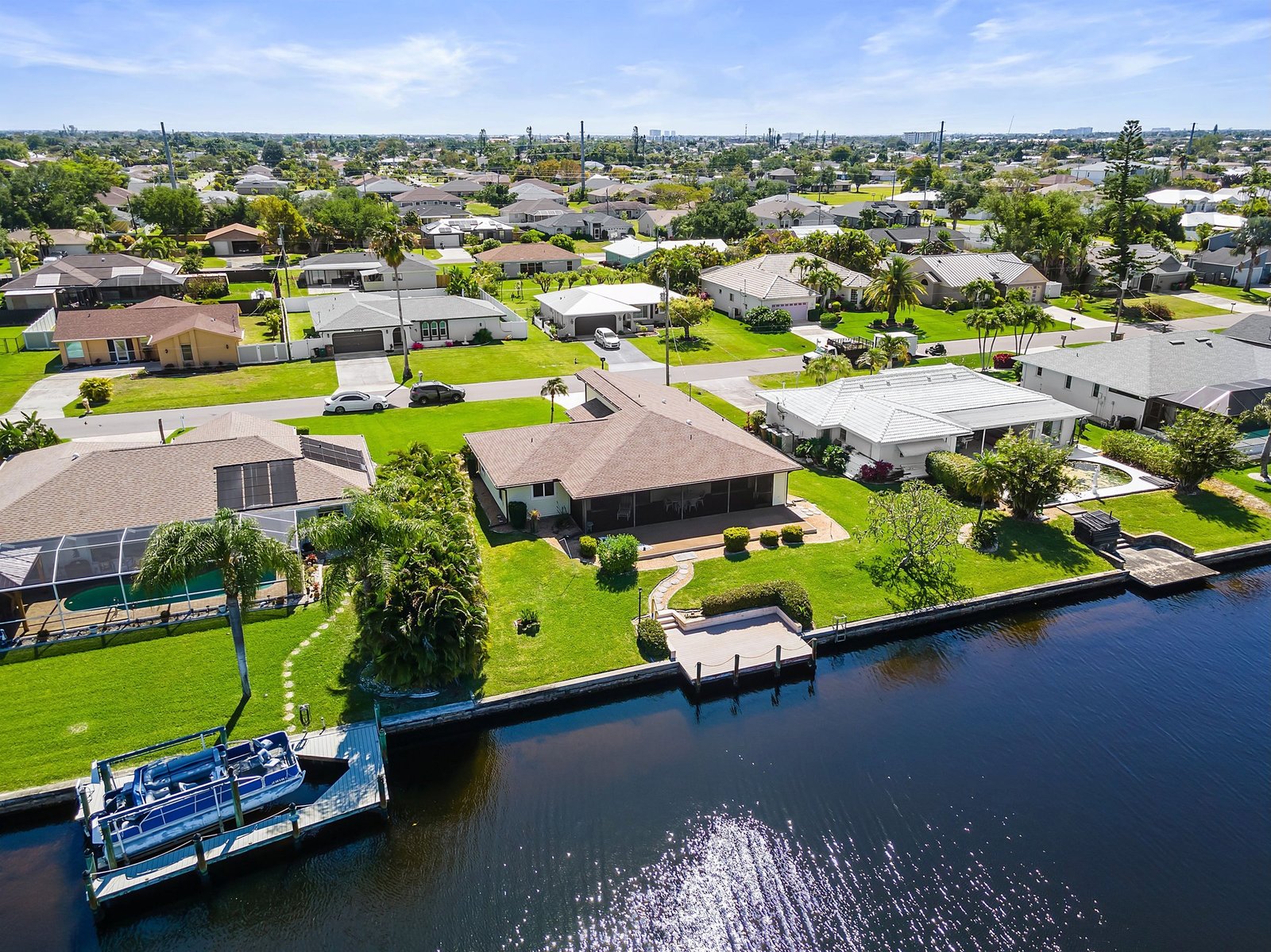
A canal address in Cape Coral can mean a dozen different things in practice: a straight run to open water, a route with one or two fixed bridges to clear first, a seawall that needs replacing in five years or was replaced last year, and a dock that may or may not have a lift already installed. The MLS listing photos rarely tell you which one you're looking at.
We check the actual canal route and, where it matters, the seawall and dock condition on any listing before a client makes an offer, that's table stakes for buying on the water here, not an upsell. If you want a specific address checked before you tour it, send it over.
Reading a Cape Coral canal listing past the label
Cape Coral has more than 400 miles of canals, more than any other city in the world, and the water behind any given dock belongs to one of three separate systems. Which system it is, how long the run to open water actually takes, and what the tide does along the way are the details that decide whether a canal address fits how you plan to use the water. Here is how those pieces work, and where to check them for a specific home.
Why “direct access” doesn’t promise a short ride
The canal classes, direct, indirect, and freshwater, are defined by bridges and locks rather than by the length of the trip to open water, and that distinction trips up a lot of buyers. A canal can be labeled direct access and still be a long, winding run out depending on where it sits in the system; all “direct” guarantees is that no fixed bridge or lock stands between the dock and the Caloosahatchee River. The clearance under an indirect canal’s fixed bridge runs about 8 to 10 feet above mean high water, enough for most powerboats, short for a sailboat’s mast, which is the other reason the label alone rarely settles the question. If exit time matters more to you than the classification, check the actual route canal by canal.
The Chiquita Lock is gone, and it changed some access ratings
For decades the Chiquita Lock in Southwest Cape Coral gated a stretch of canals, forcing boats through one at a time. It was permanently removed in June 2025. That change re-rated a number of Southwest Cape addresses from indirect to direct gulf access, the same house and dock, a different classification than it carried a year earlier. If you are comparing an older listing description or a past appraisal against a home in that area today, don’t assume the access type on paper still matches the water.
How deep the canal runs, and how it behaves at low tide
Cape Coral’s canals were dredged in the 1960s rather than formed naturally, and the spoil from that digging was used to raise the adjacent lots above grade, part of why waterfront parcels here sit a little higher than you might expect. Depth and clearance both vary canal by canal, and the tidal range across the system typically runs 1 to 2 feet. Because of that swing, any bridge-clearance figure should be read at mean high water, the tightest point in the tide cycle. There is no single citywide depth number that applies everywhere, so if depth or clearance is a dealbreaker for your boat, confirm the specific route before you tour rather than after you have made an offer.
Flood zones on a canal lot
FEMA sorts nearly every Cape Coral parcel into one of three flood zones. Zone AE is the 1% annual-chance zone; a federally backed mortgage requires flood insurance here, and that 1% annual figure compounds to roughly a 26% chance of a flood event over a 30-year mortgage. Zone X500 is the 0.2% annual-chance zone, where coverage is not federally required. Zone X, the lowest-risk designation used in the city, does not require it either. As a general pattern, direct gulf-access lots run almost universally AE, indirect lots are mostly AE with some X500, and freshwater canal lots generally land in X or X500. A flood zone is a statistical designation rather than a guarantee, and zones do get reclassified over time, so pull the current designation for the specific parcel before you rely on an old listing sheet.
Where the price differences come from
Access type, bridge count, and flood zone all feed into what a canal home costs, and they stack up differently in every neighborhood. The full canal-system breakdown walks through how those factors compare tier by tier. For where canal-home pricing sits right now, current market context for Cape Coral loads below:
Cape Coral, FL · active listings in our live IDX search feed, default map view · updated October 10, 2026
Those figures move as listings come and go, which is why this guide points you to the live number instead of printing one that goes stale a week after publication.
Before you commit to a showing
A few of our other tools go deeper on the pieces that decide whether a specific canal address fits: what a freshwater canal does and does not offer, realistic boat time to the Gulf from different parts of the city, and the flood-zone specifics for the area you are weighing. Send us an address and we will trace the route on it before you spend a Saturday touring.
Check the route before you tour
Not every canal in Cape Coral behaves the same way, and the MLS water-type field doesn't always reflect what's actually navigable. Our Waterway Map tool lets you type in any Cape Coral address and see the route toward the Gulf before you decide it's worth a showing.
Active listings matching this search in Cape Coral, counted October 10, 2026. Houses, condos and townhouses only. The 284 vacant lots also listed here are excluded, because counting dirt alongside houses pulls the median below what a house actually costs. Price per sq ft is the median of 200 mid-market listings with a stated living area. Source: our own MLS mirror, not a third-party estimate.
Updated 1 second ago, refreshed every 60 seconds
Canal-front listings on the market now.
Live snapshot of active Cape Coral listings on a saltwater/gulf-navigable canal, newest first.
 $499,900
5227 Coronado PKWY
Listing courtesy of Compass Florida LLC
 $2,499,000
3820 Surfside BLVD
Listing courtesy of EXP Realty LLC
 $520,000
1522 Shelby PKWY
Listing courtesy of Armada Real Estate, Inc.
 $825,000
3818 SW 17th AVE
Listing courtesy of RE/MAX Trend
 $840,000
1925 NW 34th PL
Listing courtesy of Southern Luxury Realty, LLC
 $1,849,900
5322 Bayshore AVE
Listing courtesy of KW Elevate Luxury
Updated 2 seconds ago, refreshed every 60 seconds
Read more, or start over.
What buyers ask us about this search.
What counts as a "canal home" on this page, vs. the Gulf Access page?
This page covers any Cape Coral listing on a saltwater canal that connects toward the Gulf, whether the route is direct (no fixed bridges) or bridge-limited (passes under a fixed bridge first). Our Gulf Access page narrows to direct-access-only. If a fixed bridge in the route is a dealbreaker for your boat, use the Gulf Access page or ask us to check the specific address.
Do I need to worry about seawall condition on a canal home?
Yes, seawall condition is one of the biggest hidden costs on a Cape Coral canal property. Replacement can run into the tens of thousands of dollars, and age alone doesn't tell you the condition; we check this on any canal listing before a client gets attached to it.
Does every canal home in Cape Coral already have a boat dock and lift?
No. Some do, some have a dock with no lift, and some have no dock at all despite being on a canal. Listing photos and descriptions aren't always current or complete on this point, so we verify it directly rather than assume from the listing sheet.
Book a 15–30 minute intro call.
We’ll walk through what’s relevant to where you are now and what you’re trying to do. No pitch. No pressure. Just a real conversation with someone who grew up in this market.
Pick a time, or leave a note.
Real conversation. No pressure. No call-center handoff.
Send Us a Message
We usually respond the same business day.