

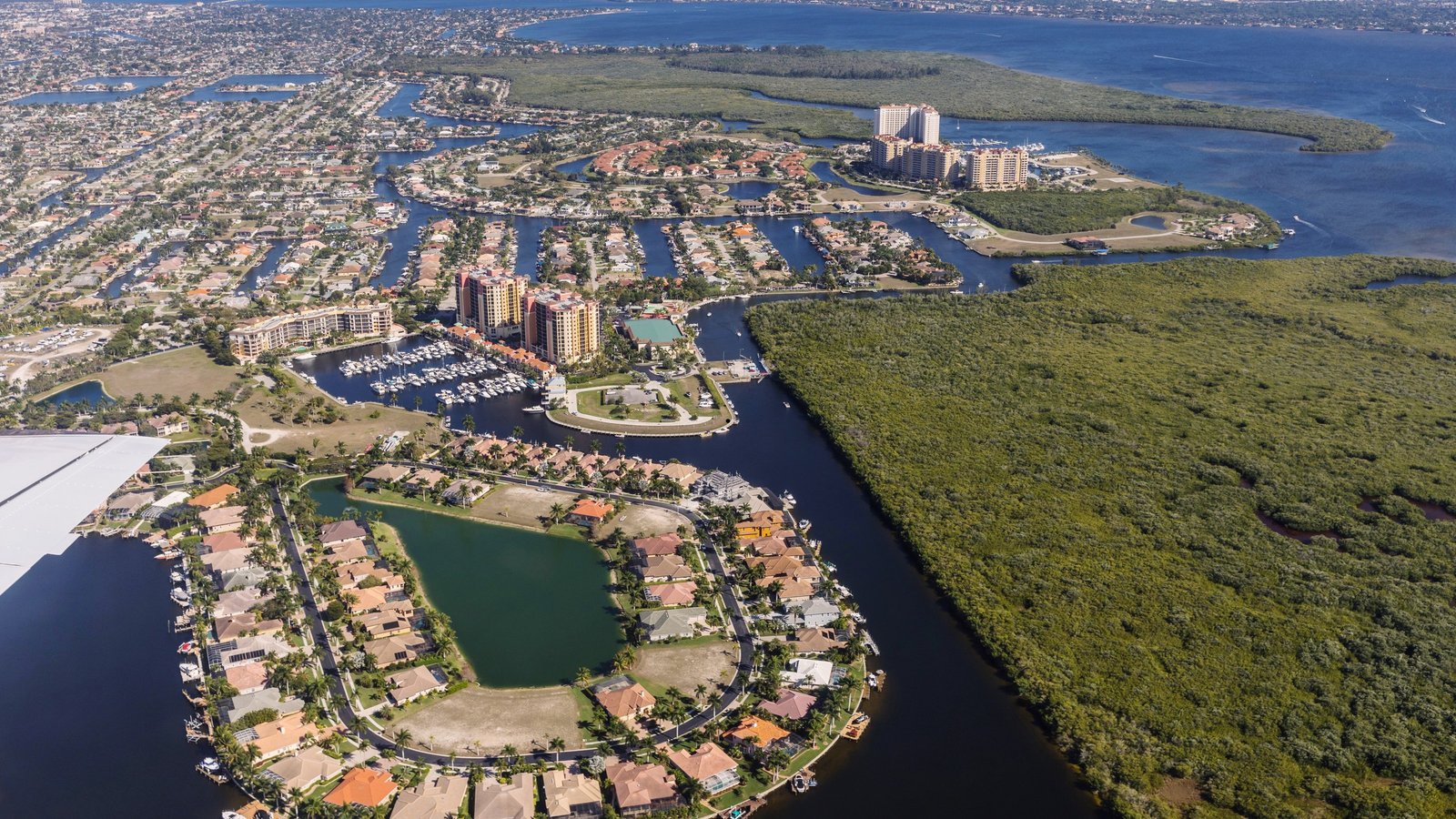
Buyers love to ask me the same question two different ways. The polite version: “What’s it like to live in Cape Coral?” The honest version, usually three drinks into a relocation dinner: “Is it actually as good as the YouTube videos make it look?” The lifestyle here is real. It’s also seasonal, car-dependent, and split down the middle by a five-month weather window. To figure out whether Cape Coral fits how you actually want to live, you have to look at both halves of the year, not just the postcard half.
I’m Brayden Milner. I’m a third-generation realtor with Florida Future Realty, born and raised in Cape Coral. Real estate isn’t a career I chose out of a catalog. It’s the water I grew up swimming in. I’ve lived through every season of this city, from the dead-quiet July afternoons when nothing moves except the AC, to the January Saturdays when you can’t get a table on Cape Coral Parkway without a 90-minute wait. Both versions are accurate. Neither is the whole picture. This is the lifestyle walk-through I give every relocation buyer asking the right question.
The Climate Split That Shapes Everything
The single biggest thing to understand about lifestyle in Cape Coral is that the year is not one year. It’s two. The dry season runs October through May. The wet season runs June through September. Almost every decision people make here, when they entertain, when they boat, when they leave town, when family flies in, is downstream of that split.
The dry-season number to know is roughly 265 sunny days a year. Low humidity, daytime highs in the mid-70s to low 80s, overnight lows in the 60s. You can sit on the lanai with a coffee at 7 a.m. in February and the air feels almost crisp. Boats are out every weekend. Restaurants spill onto sidewalks. This is the Cape Coral the YouTube videos show, and it’s not a marketing trick. Seven months of objectively pleasant outdoor living.
The wet-season reality is different. June through September, daytime highs sit in the low 90s (averaging around 92°F) with dew points in the 70s, and the heat index midday routinely runs 105°F or higher. Afternoon thunderstorms roll through almost daily, dump an inch of rain in 30 minutes, and clear off by sunset. Mornings before 10 and evenings after 7 are still livable, but the middle of the day belongs to the AC. (Our Hurricane Reality guide covers the storm-risk side of June through November.)
The honest framing I give relocation buyers: if you’ve never spent a Florida August in your life, plan a visit before you write an offer. Walk around outside at 1 p.m. and see how your body feels. If you can handle that day, you can handle the lifestyle full-time. If you can’t, a Halloween-to-Easter place is a totally valid path. A huge portion of Cape Coral lives here Halloween to Easter and goes home for the summer. The city is built around that rhythm.
The Winter Season: Halloween to Easter
You’ll hear locals describe the seasonal cycle the same way every time: Halloween to Easter. Arrivals trickle in mid-October, build through November, and by the week between Christmas and New Year’s the city is functionally at peak. January through March is the absolute peak. Departures begin around the second week of April and finish by Easter. By May, half the seasonal driveways are empty again and the city exhales.
The winter origin map is consistent year over year. The arrivals come from Michigan, Ohio, Illinois, Wisconsin, Indiana, NY, NJ, PA, MA, and the Canadian Great Lakes provinces. The reasons: cold winters at home, no state income tax in Florida, established cultural ties, and a lifestyle that lines up with retirement or remote work. What this means in practical terms:
- January through March is loud. Restaurants need reservations. Boat ramps fill by 8 a.m. Bridge traffic at the Cape Coral Bridge and the Midpoint can turn a 10-minute crossing into a 25-minute one at rush hour.
- April through October is quiet. Same restaurants, same ramps, same bridges. Walk-in tables. Empty ramps at 11 a.m. Different city.
- Service businesses run the same calendar. Lawn guys, pool guys, contractors are booked out further in season. Schedule maintenance off-season.
- Rental pricing follows the curve. Short-term rates January through March can be three to four times the summer rate for the same unit.
If you’ve only visited Cape Coral in February or March, you have only seen half the picture. Come back in August. If you still love it, then you know.
The Beach Conversation (the Honest Disclosure)
I lead with this one because it’s the most common misconception out-of-state buyers carry into a Cape Coral search: there are no Gulf beaches inside the city of Cape Coral. None. Cape Coral sits on the Caloosahatchee River and behind the barrier islands. Our shoreline is mangrove, seawall, and rip-rap, not sand. The Yacht Club has a small riverfront beach (closed right now during the park’s redevelopment), and even that faces the Caloosahatchee, not the Gulf. If your Florida fantasy is walking out your front door onto white sand, Cape Coral is not that city, and any agent telling you otherwise is selling you something.
The nearest Gulf beaches, by car, look like this:
- Fort Myers Beach (Estero Island): 30 to 40 minutes depending on quadrant, traffic, and the drawbridge. Closest and most accessible Gulf beach.
- Sanibel Island: 45 to 60 minutes via the Sanibel Causeway (toll). Famous for shelling, the Ding Darling refuge, and a low-density beach feel.
- Captiva Island: 60 to 75 minutes (through Sanibel). Smaller, quieter, more upscale. Day-trip distance, not a casual sunset run.
- Bonita Beach and Barefoot Beach: 45 to 60 minutes south. Legitimately good Gulf beaches with easier parking than Fort Myers Beach.
That’s what “30 minutes to the beach” actually looks like from Cape Coral. Plan the trip, pack the cooler. An afternoon-out experience, not a walk-out-the-door experience. For a lot of buyers, the math works in your favor: waterfront living and direct Gulf-access boating at Cape Coral prices, then drive 35 minutes when you want sand underfoot. For buyers who want beach as the daily ritual, Naples, Bonita, Marco, or Sanibel proper are the right markets, and you’ll pay the premium.
The Boating Culture (Why People Move Here)
If beaches are what Cape Coral doesn’t have, boating is what it has more of than anywhere in the country. The 400-plus miles of canals are the marketing line, but the lifestyle reality is this: a direct Gulf-access home is a personal marina. Your boat lives at your dock. You walk out the back door, untie, and you’re on the water in 60 seconds. (I break down what “direct Gulf access” means in our Cape Coral Canal System guide.)
From a direct-access dock in Southeast or Southwest Cape, here’s where the boat takes you on a typical Saturday:
- Fort Myers Beach by water: 30 to 45 minutes. Anchor off the Times Square sandbar, walk into a restaurant for lunch.
- Sanibel Causeway sandbar: 30 to 40 minutes. Drop anchor, jump out, enjoy the only “beach in Cape Coral” reachable without a car.
- Picnic Island: 20 to 30 minutes. Tiny mangrove cay where everybody on the water converges Sunday afternoons.
- Cabbage Key for lunch: Full-day run up the intracoastal. Boat-in lunch at the famous “dollar bill bar.”
- Boca Grande: 75 to 90 minutes north. World-class tarpon fishing in season, lunch at the Pink Elephant or the Temptation.
- Captiva, North Captiva, Cayo Costa: 60 to 90 minutes. Cayo Costa is a state park, accessible only by boat, with miles of empty beach.
That’s the boating reality. Straight shot out the canal, through the Caloosahatchee, into San Carlos Bay, and you’re on some of the best inshore and near-shore water in the country. If you’re not a boater, be honest about whether the waterfront premium is worth it. A Gulf-access home costs meaningfully more than a comparable off-water home. If the boat never materializes, you’re paying for a view and a story you won’t use.
Parks, Pools, and Outdoor Recreation
The city of Cape Coral runs a surprisingly deep parks and recreation network. The full inventory and operating schedules are at capecoral.gov, which is the authoritative source for hours, fees, and seasonal closures. The ones worth knowing as a buyer or new resident:
- Sun Splash Family Waterpark: City-run water park off Santa Barbara Boulevard. Slides, lazy river, kiddie areas. Seasonal (typically March through September). The default kid-birthday-party destination.
- Cape Coral Yacht Club Community Park: Southeast Cape, at the southern tip. Currently in the middle of a full teardown-and-rebuild: the historic ballroom was demolished in 2024, the old pool is gone, the riverfront beach is closed (as of mid-2026), and a new pier is under construction (marine work began December 2025). The redevelopment budget has been quoted at $197–225 million by the city through various council discussions (as of mid-2026), so check capecoral.gov for what’s actually open before you plan around it.
- Four Mile Cove Ecological Preserve: Boardwalk through mangrove forest along the Caloosahatchee. Kayak launch. Closest thing to a true nature-park experience inside city limits.
- Rotary Park Environmental Center: 97 acres of preserve with butterfly gardens, walking trails, and a dog park. Off Pelican Boulevard in Southwest Cape.
- Jaycee Park: Riverfront park on Beach Parkway with pavilions, playgrounds, and one of the best sunset views in the city.
- Four Freedoms Park: Centrally located, popular for festivals, farmers markets, and community events.
- Coral Oaks Golf Course: The city’s municipal 18-hole course in the Northwest quadrant. Affordable greens fees, walkable, well-maintained.
Outside the city-run inventory, pickleball has gone from a niche hobby to a citywide religion in about three years. Tennis courts get striped for pickleball at most parks, private clubs are adding dedicated courts, leagues run year-round. Golf expands beyond Coral Oaks to nearby clubs like Palmetto-Pine and Hunters Run. Local boating clubs give owners a built-in social network with monthly poker runs and group trips.
The Lanai Life (Escape the Sun, Escape the Rain, Escape the Elements)
The single most underrated piece of Cape Coral architecture is the covered lanai. Nearly every house has one. Screen enclosure overhead to keep mosquitoes and palmetto bugs out. Covered roof line over part of it for shade and rain protection. Pool in the middle on a meaningful chunk of homes. Outdoor kitchen on the higher-end builds. The phrase I use on tours, almost without thinking, is that the lanai lets you escape the sun, escape the rain, escape the elements. That’s what it actually delivers. You get the outdoor experience without the brutal trade-offs of being fully exposed.
In practical terms, this is where the day actually happens. Morning coffee on the lanai while you watch boats run out of the canal. Evening drinks with the pool light on, the screen keeping bugs out, a late-summer thunderstorm rolling through five feet away under a covered roof. A screened-and-covered lanai keeps the pool usable from sunrise to sunset without anybody getting eaten alive at dusk. If you’ve come from a part of the country where outdoor space means a deck you use three months a year, the Florida lanai is a structural lifestyle upgrade.
Where People Actually Eat: Restaurants and Nightlife
Cape Coral’s dining scene has been climbing year over year. It’s still not Naples or downtown Fort Myers in raw diversity, but the gap has narrowed. The geography breaks into a few clusters.
South Cape downtown corridor (Cape Coral Parkway and SE 47th Terrace): The most walkable strip in the city, which still isn’t all that walkable, but for Cape Coral it’s the densest grouping of bars, restaurants, and live music. Names locals keep coming back to: Backyard Social, Cork Soakers, Nice Guys Pizza, Annie’s for breakfast, Iguana Mia for Mexican. Anchor for most date nights.
Cape Harbour and Tarpon Point (Southwest Cape): The two waterfront-marina dining clusters. Cape Harbour has Rumrunners on the water for sunset drinks, French Press for coffee, and Fathoms. Tarpon Point houses the Westin, with Marker 92 and Pinchers handling waterfront seafood. A slightly more polished pace.
Slipaway and Lobster Lady: Two standout independents with citywide reputations. Slipaway is the tucked-back waterfront spot people drive across town for. Lobster Lady is where you bring out-of-town visitors. Botanical Brewing and Wicked Dolphin rum distillery anchor the small but growing craft-spirits cluster.
Cross-bridge dining: A meaningful share of the best dining in our metro is across the river in downtown Fort Myers, on McGregor Boulevard, or out at Fort Myers Beach. For a special-occasion night out, plan on crossing a bridge. (Our Cape Coral transportation guide covers the bridge-and-traffic side.) That’s not a knock on Cape Coral, it’s the geography. We’re a residential city. The metro restaurant gravity sits in Fort Myers.
Festivals, Culture, and the Practical Stuff
Cape Coral has a small but committed festival calendar that does most of its work in the dry season. The Cape Coral Festival of the Arts in January closes the South Cape corridor for two days. The Cape Coral Coconut Festival was the long-running fall carnival for years, but it hasn’t been held recently — check with the city’s Special Events office before you count on it. The Burrowing Owl Festival celebrates Cape Coral’s status as one of the largest urban populations of the Florida burrowing owl, a protected species. In-season farmers markets (October through May) run at Club Square. The Cape Coral Historical Museum and the Tom Allen Butterfly Garden are both small, worth a visit, quintessentially local.
For broader cultural depth, you cross the bridge. Downtown Fort Myers has the Florida Repertory Theatre, the Sidney and Berne Davis Art Center, the Edison and Ford Winter Estates, and a more established arts and music scene. Lee County’s library directory is at leegov.com. The Cape Coral Public Library, one of the largest branches in the county, sits centrally on Mohawk Parkway.
Healthcare: Cape Coral Hospital is a Lee Health facility off Del Prado Boulevard with a full-service ER and cardiac care. For higher-acuity care, you cross the bridge to HealthPark or the main Lee Memorial campus in Fort Myers. Specialist coverage across cardiology, orthopedics, oncology, and most major fields sits within a 30-minute drive.
Shopping: Pine Island Road carries the big-box inventory (Target, BJ’s, and Aldi, with Costco and Home Depot on the SW Pine Island Road stretch), most chain restaurants, and the dense medical-office cluster. Coralwood Plaza on Del Prado is a long-standing community center. Cape Coral Parkway handles boutique and independent retail. For mall-format shopping, Bell Tower and Edison Mall are across the bridge; Gulf Coast Town Center and Coconut Point are 25 to 35 minutes south. Cape Coral is also genuinely pet-friendly.
Day Trips: What’s Within Reach
One of the structural advantages of living here is the day-trip radius. Inside an hour to 90 minutes by car, you have a different vacation every weekend. Sanibel and Captiva for shelling and the wildlife refuge. Fort Myers Beach for beach-with-restaurants. Naples (60 minutes south) for Fifth Avenue, the Mercato, and the pier. Boca Grande (90 minutes north) for old Florida charm and the lighthouse. Punta Gorda (30 to 45 minutes north) for walkable historic downtown and Fishermen’s Village. Pine Island and Matlacha for the fishing-village vibe. The Everglades (90 minutes east) for airboats and alligators. RSW International Airport (35 to 45 minutes) handles the long trips, with a seasonal route map that expands dramatically October through April.
What You Don’t Get: The Honest Trade-Offs
I’d be doing you guys a disservice if I only covered the upside. Cape Coral has real trade-offs worth naming clearly:
- No walkable urban downtown. The South Cape corridor is the closest thing we have. Worth strolling, but not a true downtown like Naples 5th Avenue or downtown Fort Myers.
- No beach in the city. Covered above, but worth repeating. The barrier islands are 30 to 75 minutes away.
- No meaningful public transit. LeeTran exists, but Cape Coral is car-only in any realistic lifestyle sense. Plan on a vehicle per adult.
- Limited high-end retail. For luxury shopping you cross the bridge or drive south to Naples.
- The summer heat is real. Do that August test trip before you commit.
- Service businesses get strained in season. Contractors, reservations, even doctor appointments tighten up January through March.
None of these are deal-breakers. They’re the trade-offs in exchange for what Cape Coral does offer: waterfront living at a fraction of barrier-island prices, owned land with no HOA in most neighborhoods, the boating culture, dry-season weather, no state income tax, and a community that’s grown around the canals for almost 70 years. That’s the cost of living in paradise, and the same calculus that pushes some buyers away locks other buyers in for life. (Our Cape Coral neighborhoods breakdown walks SE, SW, NE, and NW quadrant by quadrant.)
Frequently Asked Questions
Are there beaches in Cape Coral?
No Gulf beaches inside the city limits. Cape Coral sits on the Caloosahatchee River and behind the barrier islands. The Yacht Club has a small riverfront beach that faces the Caloosahatchee, not the Gulf (and it is currently closed during the park’s redevelopment). The nearest Gulf beaches are Fort Myers Beach (30 to 40 minutes by car), Sanibel Island (45 to 60 minutes via the toll causeway), and Captiva Island (60 to 75 minutes). For beach access by boat from a direct Gulf-access dock, you can reach the Sanibel Causeway sandbar in roughly 30 to 40 minutes on the water.
What is the weather actually like in Cape Coral?
Cape Coral averages roughly 265 sunny days a year and splits sharply into two seasons. The dry season (October through May) brings daytime highs in the mid-70s to low 80s, low humidity, and minimal rainfall. The wet season (June through September) brings low-90s daytime highs (averaging around 92°F), dew points in the 70s, heat index values above 105°F midday, and near-daily afternoon thunderstorms. Most full-time residents structure their outdoor activity around early mornings and evenings during the wet season.
When is the winter season in Cape Coral?
The seasonal population window runs roughly Halloween through Easter, with arrivals building from mid-October and peak occupancy from January through March. Winter arrivals concentrate in the Midwest (Michigan, Ohio, Illinois, Wisconsin, Indiana), the Northeast (NY, NJ, PA, MA), and the Canadian Great Lakes provinces. During peak season, restaurant waits, bridge traffic, boat ramp occupancy, and rental rates all increase noticeably. May through October is dramatically quieter.
What is there to do in Cape Coral besides boating?
The recreation inventory includes Sun Splash Family Waterpark, the Cape Coral Yacht Club Community Park, Four Mile Cove Ecological Preserve, Rotary Park Environmental Center, Jaycee Park, Four Freedoms Park, and Coral Oaks Golf Course. Pickleball, tennis, and golf are all year-round activities. Restaurant clusters concentrate on Cape Coral Parkway (the South Cape downtown corridor), Cape Harbour, and Tarpon Point. Cross-bridge dining and culture in Fort Myers significantly expand the entertainment options beyond what the city itself provides. The official parks and recreation calendar is maintained at capecoral.gov.
Is Cape Coral a walkable city?
No. Cape Coral is a low-density, car-dependent suburban city covering roughly 120 square miles on a planned grid. The South Cape entertainment corridor on Cape Coral Parkway is the most walkable area in the city, but even there the form is strip-and-plaza commercial with parking lots in front of most businesses. There is no meaningful public transit. Households relocating from walkable urban environments should expect to need a vehicle per adult.
Where do residents go for healthcare in Cape Coral?
Cape Coral Hospital, a Lee Health facility located off Del Prado Boulevard, is the city’s primary acute-care hospital and ER. The Lee Health network operates additional facilities across the river in Fort Myers, including HealthPark Medical Center and the main Lee Memorial campus, which handle higher-acuity specialty care and trauma. Specialist coverage across most major fields is available within a 30-minute drive from most of Cape Coral.
Can I really boat to the Gulf from a Cape Coral house?
Yes, but only from a direct Gulf-access lot. Cape Coral has three canal tiers: direct Gulf access (no bridges, no locks, straight shot to the Caloosahatchee and out to the Gulf), indirect Gulf access (eventually reaches the river but requires going under fixed bridges or historically through a lock), and freshwater (landlocked, no connection to open water). Only direct-access lots support full open-water boating. From a direct-access dock in Southeast or Southwest Cape, you can reach Fort Myers Beach, Sanibel, Picnic Island, Cabbage Key, Boca Grande, and the broader Gulf without trailering. The full breakdown is in our canal system guide.
The Bottom Line
Lifestyle in Cape Coral is real, but it’s seasonal and specific. The dry season is genuinely one of the best lifestyle environments in the country. Roughly 265 sunny days spread across the year, mild temperatures, lanai mornings, boats on the water every weekend. The wet season is honest work: brutal midday heat, daily thunderstorms, an indoor-AC season for anyone who can’t take Florida summers. The winter rhythm reshapes the city Halloween to Easter, with January through March the peak. The boating culture is unmatched in the country at this price tier. The beaches are not in the city. The dining gets better every year but isn’t Naples. There is no walkable downtown, and you will drive for everything. (The full picture is in our Cape Coral 101 overview.)
For the right buyer, the trade-offs line up: waterfront living at a fraction of barrier-island prices, owned land with no HOA in most neighborhoods, direct access to some of the best inshore boating waters in the country, no state income tax, and a community of people who chose this place on purpose. For the wrong buyer, the seasonal compression, car dependence, and lack of a true beach-and-walkable urban form make Cape Coral the wrong fit. Better to know which you are before you write the offer than figure it out 18 months in.
If you guys want to talk through whether Cape Coral actually fits the life you’re trying to build, that’s the conversation I have every week. I’ll give you the same honest read I give my own family. We have our place here in paradise because the trade-offs work for us. Whether they work for you is the question worth answering first.
Reach out and let’s talk about your Cape Coral move. Whether you’re a year out, weighing a seasonal place against a full-time move, or actively writing offers, I’ll walk you through what the lifestyle actually looks like at every season of the year.