

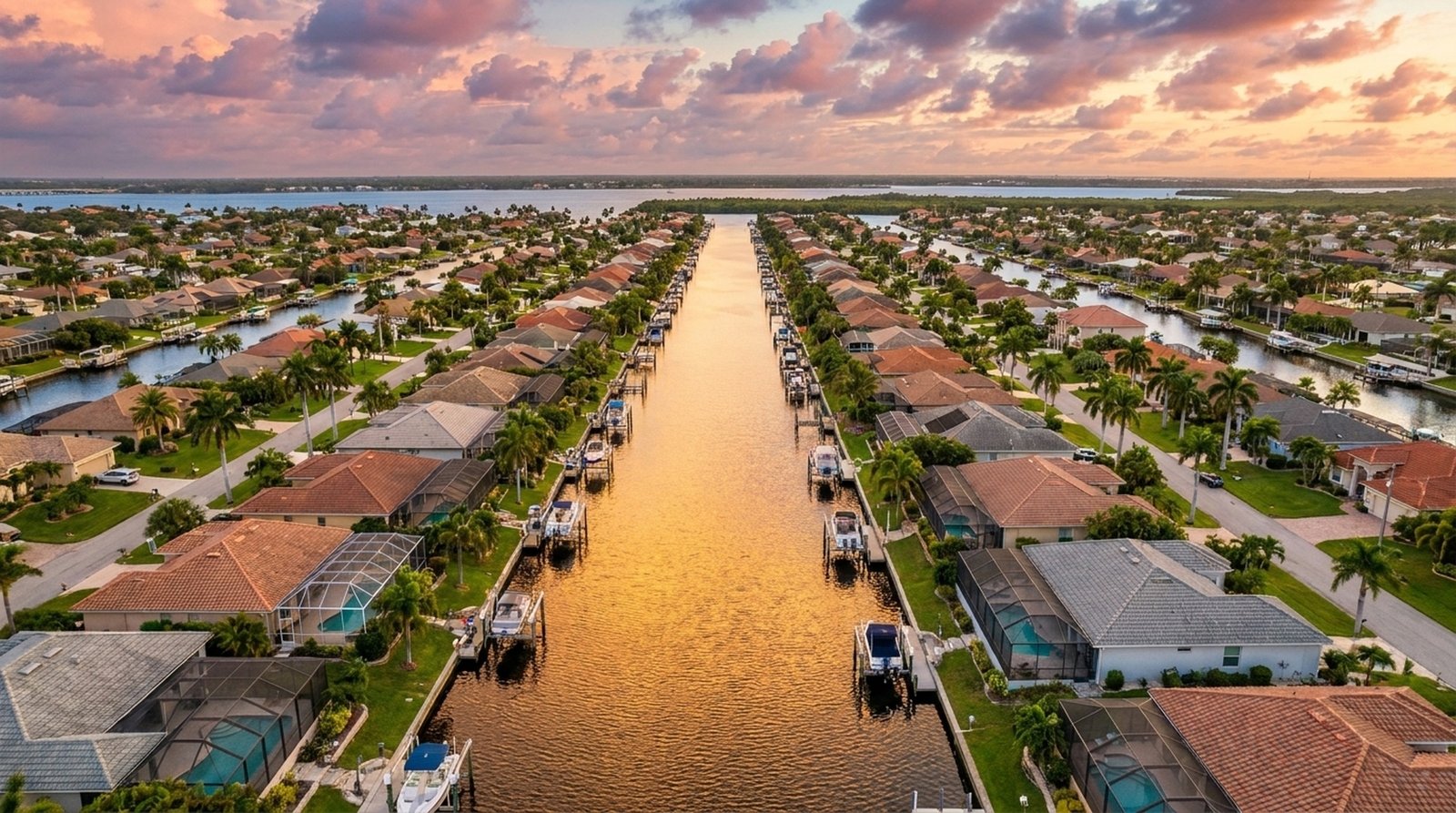
Moving to Cape Coral in 2026 means buying into a market that has changed character since the 2021–2022 frenzy. Inventory is deeper, sellers negotiate again, and the deciding factors for most relocating buyers are no longer just price and square footage, they are insurance, elevation, canal access, and property taxes. Those four inputs vary from one address to the next, which is why two homes a few streets apart can carry very different monthly costs.
This guide covers what actually determines your cost and quality of life here: the 2026 market backdrop, cost of living and Florida’s property-tax structure, hurricane and climate expectations, how Lee County school assignment really works, and honest commute realities across the river. Then it walks the address-level due diligence that protects the offer you write.
What the 2026 Cape Coral market looks like
The relocation math in 2026 is different from the pandemic-era market that many out-of-state buyers still have in mind. Three structural shifts matter most:
- Negotiating leverage returned to buyers. After the run-up through 2022, higher borrowing costs and a deeper resale supply slowed the pace of sales. Inspection periods, repair credits, and rate-buydown concessions are commonly on the table again, a reversal from the waived-contingency era.
- Insurance became a primary underwriting factor, not a footnote. Following Hurricane Ian (2022), carriers repriced and tightened appetite across coastal Lee County. Roof age and construction type now move premiums more than almost any other variable, which is why two similar homes can differ by thousands per year.
- New construction competes directly with resale. Cape Coral has one of the largest inventories of buildable platted lots in Florida, so builder inventory and spec homes compete with existing listings, often with incentives that resale sellers cannot match.
Because prices, mortgage rates, and inventory move monthly, this guide deliberately avoids quoting a snapshot median that would be stale by the time you read it. For current national rate context, Freddie Mac’s Primary Mortgage Market Survey and Mortgage News Daily publish daily and weekly averages. For current local pricing on the specific streets you are considering, ask us for an address-level comparable set.
Cost of living, property taxes, and the homestead rules
Florida’s tax structure is a genuine part of the relocation case, but it works differently than most incoming buyers expect.
No state income tax, but property taxes still require an address-level estimate
Florida levies no state personal income tax, but property taxes are specific to the parcel and owner. A bill can include ad valorem taxes based on taxable value, exemptions such as homestead, Save Our Homes treatment, and non-ad valorem assessments. Before making an offer, review the parcel and use the Lee County Property Appraiser Tax Estimator for the exact address. Do not use the seller’s current bill or a single countywide percentage as a forecast of your future bill.
Homestead exemption, Save Our Homes, and portability
- Homestead exemption: up to $50,000 off assessed value on your primary residence (the first $25,000 applies to all taxing authorities; the second $25,000 excludes school levies).
- Save Our Homes cap: once homesteaded, annual increases in assessed value are capped at 3% or the change in CPI, whichever is lower. This is why a long-time neighbor may pay far less tax than you will on an identical house.
- Portability: Florida homeowners moving within the state can transfer accumulated Save Our Homes benefit to a new homestead, subject to statutory limits.
- Budget for the reset: when a home sells, the cap benefit resets to market value for the new owner. Do not budget from the seller’s current tax bill, it will understate yours, sometimes substantially.
Insurance and utilities are the swing costs
Insurance is where relocation budgets most often break. A newer home built to current code, concrete block, elevated slab, wind-mitigation features, post-2017 roof, can quote meaningfully lower than an older home with an aging roof in the same neighborhood; differences of several thousand dollars a year are common. Cape Coral also has no municipal natural-gas network in most areas, so households run electric, and homes on well and septic differ from those on city water and sewer, which can carry outstanding utility-expansion assessments. Get property-specific quotes early; they are as decisive as the purchase price.
Climate and hurricane expectations, stated honestly
Cape Coral has a subtropical climate: hot, humid, storm-heavy summers and dry, mild winters that are the reason the seasonal population swells. Expect near-daily afternoon thunderstorms from roughly June through September and a distinctly dry season from November through April.
- Hurricane season runs June 1 through November 30 (NOAA), with peak activity typically August through October. Hurricane Ian in September 2022 is the reference event for current construction standards, insurance pricing, and storm-surge awareness.
- Flood elevation is property-specific. A parcel’s FEMA map, flood zone, and mapped Base Flood Elevation can affect insurance, permitting, and building design; there is no universal 11-foot Cape Coral standard. Check the exact address in the FEMA Flood Map Service Center, then confirm current requirements with the City of Cape Coral.
- Summer is genuinely humid. Many relocating families visit in February and are surprised by August. If possible, experience the shoulder season before committing.
- Evacuation planning is normal here, not alarmist. Know your evacuation zone, it is distinct from your FEMA flood zone, and confirm both for the specific address.
How Lee County schools actually work
This is the single most misunderstood item for relocating families, because Cape Coral does not work the way most Northeastern and Midwestern districts do.
All of Cape Coral falls within the Lee County School District, a consolidated county-wide district serving more than 90,000 students, among the largest in Florida. There are no municipal sub-districts, and the district operates a school choice model rather than strict geographic zoning. Your address does not automatically determine your child’s school assignment; families submit choice applications within a proximity-based zone, and popular schools can fill through a lottery.
The practical consequence: buying a specific house does not guarantee a specific school. If a particular campus is central to your decision, confirm current assignment rules, application windows, and capacity directly with the Lee County School District before you write an offer, not after. Charter, magnet, and private options are also part of the local mix, and school infrastructure on the Cape itself has expanded substantially over the past two decades, reducing cross-river school commutes.
Commute realities and getting around
Cape Coral is geographically large, roughly 120 square miles, and it is a peninsula. Both facts shape daily life more than newcomers expect.
- Two bridges connect Cape Coral directly to Fort Myers: the Cape Coral Bridge and the Midpoint Memorial Bridge, and both are tolled, check LeeWay’s current toll information for current rates, payment methods, and discounts. The third crossing is an overland route north via Del Prado Boulevard into North Fort Myers, then across the river on US 41 over the Caloosahatchee Bridge.
- Bridge capacity is the commute. If you work in Fort Myers, at a hospital campus, or near the airport, peak-hour bridge traffic, not mileage, determines your drive time. The same address can feel very different at 7:45 a.m. than at noon.
- North Cape is still filling in. Northern neighborhoods offer larger lots and lower prices, with longer drives to shopping, dining, and medical care concentrated along Del Prado Boulevard, Pine Island Road, and Cape Coral Parkway.
- RSW airport is on the far side of the river, which matters for frequent travelers and for out-of-state family visits.
- This is a car-dependent city. Public transit is limited, and most errands assume a vehicle.
Drive your real routes at the hours you will actually travel them, work, school, and medical, before you commit to a quadrant.
Start with the address, not a quadrant stereotype
Cape Coral uses northeast, northwest, southeast, and southwest quadrant names as part of its addressing system. Those labels are useful for orientation, but they are not reliable shortcuts for price, waterfront access, age, or lifestyle. Every quadrant contains meaningful variation, so confirm the location on an official City of Cape Coral map and then evaluate the individual property.
- Southeast Cape Coral: includes established inland neighborhoods as well as saltwater and Gulf-access canal areas. Access and bridge conditions are property-specific.
- Southwest Cape Coral: includes both inland and waterfront communities. Cape Harbour and Tarpon Point are waterfront developments, while Sandoval is an inland gated, master-planned residential community in southwest Cape Coral.
- Northeast Cape Coral: includes inland homes, freshwater-canal properties, and areas with ongoing development.
- Northwest Cape Coral: also includes inland, freshwater, and saltwater-access properties. A canal shown behind a home does not by itself establish Gulf access.
For any community with an association, request the current governing documents, budget, fees, application rules, and restrictions during your due-diligence period. Amenities and association requirements can change, so current documents matter more than an old listing description.
Waterfront access requires a route check
“Canal-front” and “Gulf access” are not interchangeable. Cape Coral properties may sit on freshwater canals, saltwater canals, or routes that reach open water through bridges and other navigational constraints. The practical question is whether the full route works for your vessel and how you plan to use it.
- Confirm the waterway type. Ask for documentation showing whether the canal is freshwater, saltwater, or connected to open water.
- Trace the complete route. Identify every bridge and navigational constraint between the property and the intended destination.
- Verify clearance for the specific route. Bridge count, tides, vessel dimensions, and exact posted or official clearances all matter. Do not rely on a generic clearance range or a listing agent’s estimate.
- Inspect the waterfront improvements. A qualified marine contractor can evaluate the seawall, dock, lift, electrical components, and permitting history.
If boating access is central to the purchase, make the route review part of your property-level due diligence before the applicable deadlines. Our Cape Coral waterfront homes page can help you start a search, but the route still needs to be verified for each property.
Flood maps, elevation, and insurance are separate checks
A flood-zone label does not answer every flood or insurance question. Use the current FEMA Flood Map Service Center for the address, then review any available elevation certificate, permit records, and prior flood information. Map designations and insurance requirements can change, and a lender’s requirements may differ from a buyer’s risk tolerance.
Read the zone at the parcel level. Zone X sits outside the Special Flood Hazard Area shown on the effective FEMA map, but that does not mean zero flood risk or a guarantee that a lender will not require insurance. Zone AE is a mapped Special Flood Hazard Area, where location-specific flood data can affect insurance, permitting, and building design.
Do not assume one fixed number above the Base Flood Elevation applies to every building component. For a property within Cape Coral city limits, the City of Cape Coral is the permitting and floodplain authority. Verify the required elevations for the lowest floor, floodproofing where applicable, equipment, and any freeboard for the exact address with the City and qualified floodplain, design, and insurance professionals. Lee County requirements may apply to parcels in unincorporated Lee County.
Request insurance quotes early in the offer process. Give the insurance professional the exact address and the information available for that home, including roof details, wind-mitigation documentation, four-point inspection results when applicable, elevation information, and claims history that the seller is authorized to provide. A quote for a nearby house is not a dependable substitute.
Check utilities and assessments property by property
Cape Coral homes may have different water, sewer, irrigation, well, septic, and assessment histories. Before closing, confirm the current utility status and any balance or assessment tied to the parcel through official records and the title process. Do not infer the answer from the street, the age of nearby homes, or an online description.
The Lee County Property Appraiser is a useful starting point for parcel information, but public-record research does not replace the title search, municipal lien search, seller disclosures, or professional inspections required for the transaction.
Build a relocation offer around due diligence
A strong relocation plan gives you enough time to verify the house rather than rushing after the contract is signed. Before making an offer, discuss the applicable contract, deadlines, and contingency options with your real estate professional and, when legal interpretation is needed, a Florida real estate attorney.
- Schedule the general home inspection and any appropriate roof, plumbing, electrical, HVAC, pool, pest, seawall, dock, or septic review.
- Order property-specific insurance quotes and confirm lender requirements early.
- Review the flood map, elevation information, permits, utilities, assessments, association documents, and title findings.
- Drive the actual routes you expect to use for work, shopping, medical appointments, schools, airports, or recreation rather than relying only on a mileage estimate.
- If waterfront access matters, verify the complete boat route and waterfront improvements before the relevant deadline.
Plan your scouting trip before moving to Cape Coral
A useful scouting trip should compare homes that meet the same core criteria in more than one part of the city. That makes it easier to separate a property feature from a location assumption. Bring a short list covering budget, home type, waterfront needs, insurance comfort, utility preference, association preference, and the routes you expect to drive regularly.
After each showing, write down what the visit could not answer, those are the questions that decide your monthly cost. The most important ones are often not visible during a tour: the canal route, permit history, flood documentation, insurance inputs, utility balances, association rules, and title findings.
Get a property-specific relocation plan
If you are considering a move to Cape Coral, The Milner Team can help you narrow the search and organize the address-level questions before you commit. Start with our guide to Cape Coral homes under $300K, review what it is like to live in Cape Coral, or contact us with your timeline, budget, and must-have property features.
Next step: contact The Milner Team for a property-specific relocation plan, call or text (239) 895-9383, or request a free home valuation if you need to sell before you move.
This guide is general real estate information, not legal, engineering, floodplain, marine, insurance, or code advice. Verify material facts and requirements for the exact property with the appropriate public authority and qualified professional.
Start with live inventory: Cape Coral homes for sale · gulf access · Zone X homes.