How do flood zones work in Cape Coral, and do I need flood insurance?
Cape Coral homes mostly sit in either Zone AE (1% annual chance flood zone, federally backed mortgages require flood insurance), Zone X500 (0.2% annual chance, not federally required, often still smart), or Zone X (lower mapped risk, not zero risk). The label on the map is one variable. Base Flood Elevation and finished-floor elevation matter just as much. An elevation certificate can change insurance pricing and sometimes support a Letter of Map Amendment review. We pull flood zone and elevation context before you step into a showing.
What’s the real difference between gulf-access canals and freshwater canals?
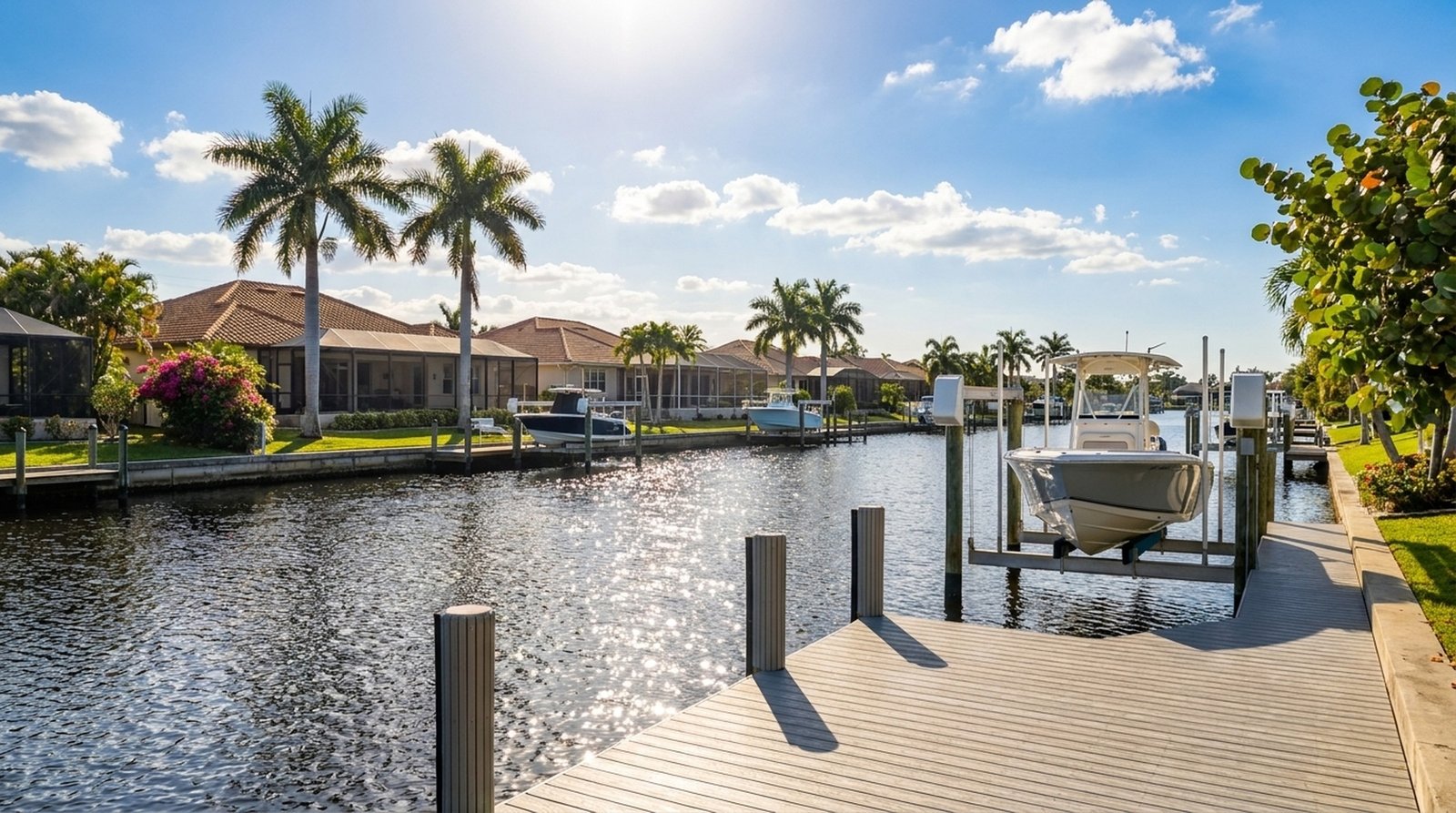
Gulf-access canals connect to the Caloosahatchee River and the Gulf. You can take a boat from your backyard out to open water. Indirect gulf-access often involves bridges, weirs, or vessel-height limits. Freshwater canals are landlocked. Great for views, kayaks, paddleboards, and fishing, but no boating to the Gulf. The same street can have different canal types on opposite sides. We verify canal type and the actual route to open water before you write any offer.
Is insurance in Southwest Florida really as bad as people say?
The headlines aren’t the full picture. Cape Coral’s average homeowner’s insurance runs around $2,520 per year, and well-mitigated homes (newer roof, impact windows, elevated construction, post-2002 building code) often come in meaningfully lower. New construction is particularly favored by insurers. Brayden’s own Cape Coral home runs $1,871 per year. We quote insurance early in the process and choose properties with the carrying cost in mind, not after the fact.
What are closing costs and utility assessments going to cost me?
Buyer closing costs in Cape Coral typically run 2–5% of purchase price before any property-specific utility balance. Utility assessments are a Cape Coral-specific cost tied to water, sewer, and irrigation infrastructure, and they vary significantly by phase. North 1 East: about $25,538 in line assessments plus $6,750 in CFEC for a typical 10,000 sq ft residential lot. North 1 West: about $26,617 in line assessments plus the same $6,750 CFEC. North 2 was the historical benchmark at roughly $12,632 line plus $6,750 CFEC — newer phases are running nearly double. These figures are before payoff status, interest, plumber connection, or septic abandonment. Some parcels are paid, some are financed on the tax bill, some are pending, and some are not scheduled yet. We pull assessment status before you write an offer.
I’m self-employed or 1099. Can I still get a loan here?
Usually yes. Just not always on the standard FHA or conventional path. Brayden bought his own first house on a bank-statement loan because self-employment write-offs put his taxable income below the conventional qualifying threshold. Non-QM products (bank-statement, DSCR, asset-based) are real options with the right local lender. Don’t assume you’re out before we’ve looked.
What does the first call look like?
It’s a quick 15–30 minute discussion on your scenario, our area, next steps, and your chance to ask any questions. We can do it by phone or video chat. There’s no pressure to commit to anything. Most first calls end with us sending you two or three resources and agreeing to check back in.