

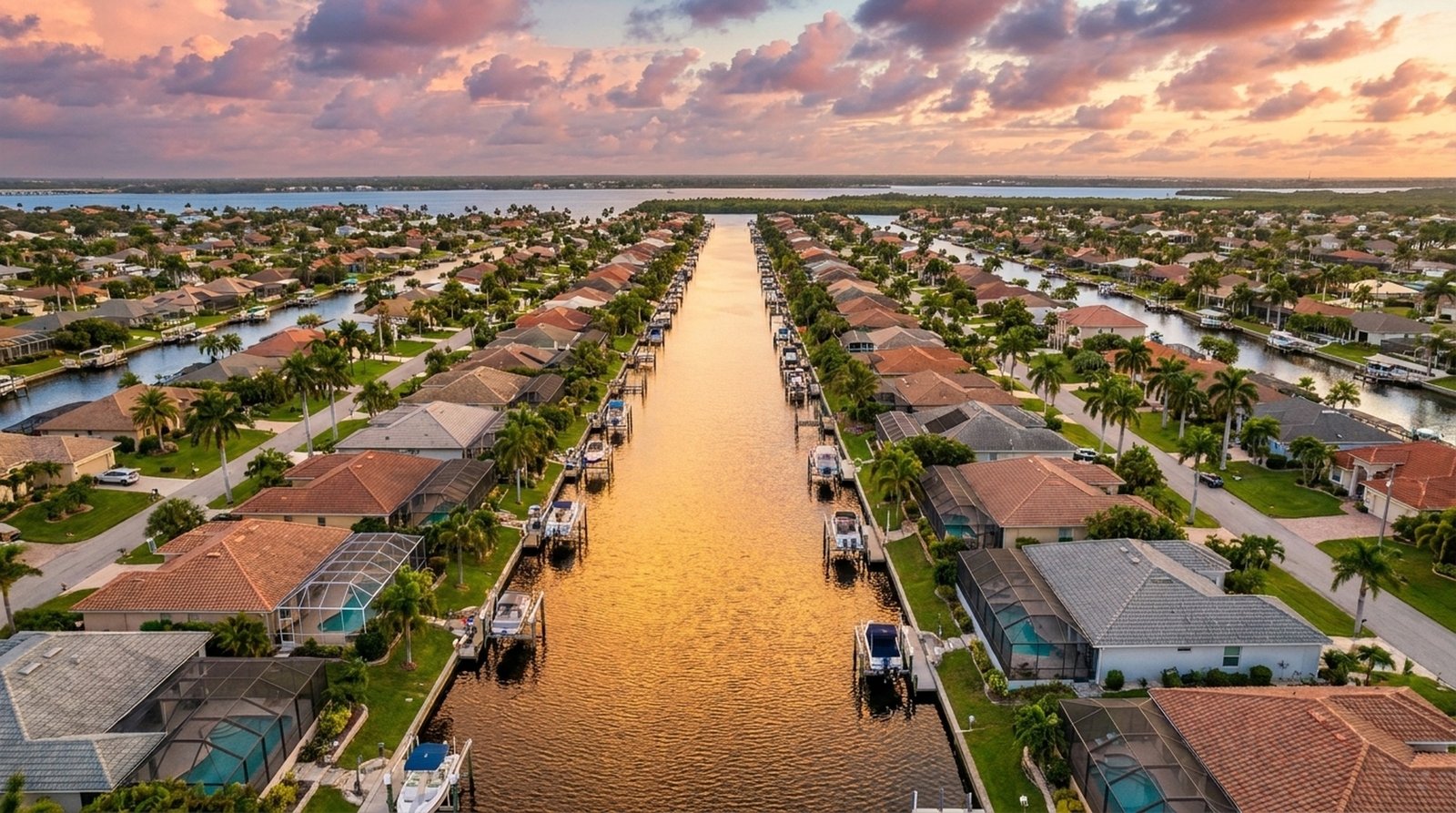
The mortgage piece is where most Cape Coral buyers I work with feel the most behind. Not because the loan products are complicated. They aren’t, really. It’s because the lender, the insurance carrier, the appraiser, and the closing agent all touch the same file at the same time, and if any one of them is three days late, the closing date slips. In Cape Coral, where insurance availability can change between contract and closing depending on what’s spinning in the Atlantic, that calendar pressure is a real thing.
I’m Brayden Milner. I’m a third-generation Realtor with Florida Future Realty, born and raised in Cape Coral. This city is the water I grew up swimming in, and the mortgage process here has its own flavor. Insurance can be more expensive, insurance can be harder to bind, flood zones change the bill, and the lender has to verify all of it before they cut the wire. The four mainstream loan types (conventional, FHA, VA, USDA) all work in Cape Coral. They just work a little differently when the property has a seawall, an AE-zone designation, and a four-point inspection attached.
Here’s what this article is. The four loan types and which one fits which buyer. The pre-approval-first rule and why I’m inflexible about it. The processing sequence from contract to clear-to-close. And the Cape Coral-specific friction (insurance binders, four-point inspections, flood determination) that lenders out of state aren’t always ready for. By the end of this you guys should be able to walk into a lender’s office and have a real conversation, not a sales pitch.
Pre-Approval First, Always (the Rule I Don’t Bend)
If I had to keep one line from this entire article, it’s this: pre-approval first, always. Not pre-qualified. Pre-approved. The two words sound interchangeable and they are not the same product.
A pre-qualification is usually a quick conversation where you tell the loan officer your income, debts, and credit score, and they give you an estimate of what you’d probably qualify for. Typically no credit is pulled and no documents are reviewed. Many listing agents will not take an offer seriously with only a pre-qualification letter attached. A pre-approval is the real product: the loan officer typically pulls credit, reviews your income and asset documents (commonly tax returns, paystubs, and bank statements), calculates your DTI, and issues a letter tied to a specific loan program and purchase price. Ask your lender exactly what it will review.
Why I’m inflexible: when a well-priced house can draw multiple offers quickly, you don’t want to start a pre-approval after you find the home. A real letter can take several days, and that’s the window where you can lose the house. The Consumer Financial Protection Bureau publishes a free homebuyer guide (see consumerfinance.gov) and my advice is simple: get the financing arranged before you write the offer.
Pre-approval also sets a real ceiling. Buyers come in thinking they can afford $500K and find out the number is $425K, or the other way around: they assume they’re stuck at $350K and the lender clears them to $475K. Either way, it reshapes the search. We cover this dynamic from the buyer side in The First-Time Cape Coral Buyer Guide.
The Four Loan Types and Who They’re Built For
For most Cape Coral buyers, the financing decision comes down to four programs. Niche products exist (jumbo, non-QM, bank statement loans, construction-to-perm) but the four below are the mainstream options. Each one has a different sweet spot.
Conventional Loans (Fannie Mae / Freddie Mac)
Conventional is the default product for buyers with strong credit and stable income; better credit generally earns better pricing. The loans are written to Fannie Mae or Freddie Mac guidelines (see singlefamily.fanniemae.com).
- Down payment: as low as 3% on some conforming programs such as HomeReady or Home Possible (eligibility rules apply). 5% down is a common starting point. 20% down eliminates PMI.
- PMI: generally required under 20% down. You can request removal once you reach 80% of the home’s original value (conditions apply), and it terminates automatically when the scheduled balance reaches 78% of original value (CFPB). That is a big structural advantage over FHA, where MIP is harder to shake.
- Loan limit: The 2026 conforming loan limit for a one-unit home in Lee County is $832,750 (FHFA). Above that is jumbo, which usually comes with stricter underwriting.
- Best for: buyers with strong credit, 5%+ down, and a loan amount within the conforming limit.
One thing that catches Cape Coral buyers off guard: the lender confirms that homeowners and (if applicable) flood insurance can actually be bound before clearing to close. If you can’t bind insurance during a named-storm window, the loan can’t fund. That applies to all four programs, not just conventional.
FHA Loans
FHA is the federally backed program built for buyers who can’t quite hit conventional’s box: lower credit, lower down payment, or a thinner file. Administered by the Federal Housing Administration under HUD (see hud.gov).
- Down payment: 3.5% with 580+ credit. Under HUD Handbook 4000.1, a 580+ score qualifies for maximum financing and a 500-579 score is limited to a 90% loan-to-value ratio (10% down), but many lenders set higher minimums of their own.
- MIP: 1.75% upfront (rollable) plus an annual MIP of 0.55%, collected monthly, on a 30-year loan with a base loan amount of $726,200 or less and less than 5% down (HUD Mortgagee Letter 2023-05; confirm the current schedule with your lender). At that loan-to-value, the MIP lasts for the life of the loan unless the FHA loan is paid off, for example by refinancing into conventional. That’s the structural downside.
- Loan limit: The 2026 FHA forward-mortgage limit for a one-unit home in Lee County is $541,287 (HUD).
- Property condition: FHA appraisals include minimum property standards. Working heat, water heater, roof condition, no peeling paint on pre-1978 homes. On older Cape Coral homes with deferred maintenance, FHA can flag conditions conventional would have let pass.
- Best for: first-time buyers, credit between 580 and 680, limited down payment, a loan amount within the Lee County FHA limit.
The honest tradeoff: FHA lets you in with less cash and lower credit, but the lifetime MIP adds up. A buyer who expects credit to improve often refinances into conventional once equity reaches 20%, which removes the FHA MIP (approval is not guaranteed). If you’re using FHA, plan for that exit ramp from day one.
VA Loans
The VA loan is one of the most generous mainstream products in the country, and Cape Coral has a real veteran population to use it. Eligibility runs through the Department of Veterans Affairs (see va.gov) for active duty, qualifying veterans, Guard and Reserve with sufficient service, and certain surviving spouses.
- Down payment: 0%. Zero on a primary residence for buyers with full entitlement, who have no VA loan limit (your lender and the appraisal still decide how much you can borrow). With only partial entitlement, the county loan limit determines your remaining bonus entitlement, which affects how much you can borrow with no down payment.
- No PMI: ever. Single largest monthly-payment advantage in the loan stack. A VA buyer at 100% LTV has no PMI line item; a conventional buyer at 95% LTV is paying PMI until they request removal at 80% or it terminates automatically at 78% of original value.
- Funding fee: one-time, 2.15% for first use and 3.3% after first use with less than 5% down (va.gov, October 2026). Rollable into the loan. Veterans receiving VA compensation for a service-connected disability, and certain others, are exempt.
- Credit: VA and your lender both set credit standards, and lender minimum scores vary.
- VA appraisal: includes a minimum-property-requirements checklist covering roof, electrical, wood-rot, water intrusion.
- Best for: any eligible veteran, active duty, or qualifying surviving spouse. If you guys are VA-eligible and you’re not using it, you’re leaving real money on the table.
Worth noting: VA loans can be assumed by qualified buyers with lender or VA approval. If a seller has a 3% VA loan and a buyer is qualified to assume it, that’s a real conversation, and a tool in the toolbox.
USDA Rural Development Loans
USDA is a loan many Cape Coral buyers never think to check. Administered by USDA Rural Development (see rd.usda.gov), it’s built for primary-residence buyers in eligible rural and semi-rural areas. The kicker: eligibility is decided address by address, so check the property before you rule it out.
- Down payment: 0%.
- Income limits: household income capped at 115% of median household income per USDA (the dollar limit varies by county and household size). Higher-income buyers don’t qualify even in an eligible area.
- Guarantee fee: an upfront guarantee fee plus an annual fee, both set by USDA and usually passed through by the lender. Confirm the current rates with your lender or on rd.usda.gov.
- Primary residence only: no investment, no second homes, no STRs.
- Eligible area required: Parts of Cape Coral may qualify. Check the specific address on the USDA eligibility map.
- Best for: moderate-income primary-residence buyers buying in a USDA-eligible area who want to keep cash at closing as low as possible.
USDA is easy to overlook. If you’re a moderate-income buyer and nobody has mentioned USDA, ask whether the address you’re looking at is in an eligible area. It can be an option worth comparing for the right buyer.
The Processing Timeline: Contract to Clear-to-Close
Once you go under contract, the lender is on a clock. A financed purchase commonly takes about 30 to 45 days from contract to closing, depending on the contract’s closing date and the lender’s queue. The lender’s processing sequence inside that window looks roughly like this, and the order matters because the steps are stacked.
- Loan application and disclosures (Day 1-3): formal application, intent-to-proceed, Loan Estimate showing your estimated rate, fees, and costs.
- Appraisal ordered (Day 3-7): ordered through an Appraisal Management Company. Appraisal timing varies by season and appraiser. Plan on roughly 10 to 21 days from order to report, and longer in busy periods.
- Insurance shopping (Day 1-7): start the day you go under contract. Homeowners and (if AE) flood binders need to be in the lender’s hands well before final approval. This is a common source of closing delays. Carrier landscape covered in The Cape Coral Insurance Landscape.
- Underwriting (Day 7-21): the underwriter pulls every document, the appraisal, the title commitment, the insurance binders, and the survey, then issues conditions to clear.
- Four-point inspection (Day 7-21): if the home is older, the insurer may require a four-point inspection of the roof, electrical, plumbing, and HVAC. Without it, the insurer may not bind coverage.
- Final income re-verification (Day 21-close): within ~10 days of closing, the lender may re-verify employment and re-check credit. Don’t open new credit, don’t finance a car, don’t change jobs. I’ve watched a closing collapse because a buyer financed living-room furniture three days before close.
- Clear to close (Day 25-30): all conditions cleared, insurance bound, final approval issued.
- Closing Disclosure (3 business days before closing): you must receive it at least 3 business days before closing. Certain changes to the Closing Disclosure can require a new 3-day wait.
- Closing: sign the stack, fund the wire, get the keys.
The compressed version: insurance binders and the appraisal are two common timeline risks for Cape Coral closings. Shop insurance the day you go under contract. Don’t wait.
DTI, Down Payment Sources, and the Numbers Lenders Actually Care About
Behind the loan-program acronyms, two numbers drive almost every approval: debt-to-income ratio (DTI) and the source of your down payment.
Debt-to-Income Ratios
DTI compares your monthly debt payments to your gross monthly income. Lenders look at two flavors:
- Front-end DTI (housing only): proposed PITI (principal, interest, taxes, insurance) plus HOA divided by gross monthly income. Limits vary by program and lender.
- Back-end DTI (total debt): PITI plus HOA plus all other monthly debt obligations (car loans, student loans, minimum credit card payments, child support) divided by gross monthly income. Limits vary by program and underwriting findings, and some programs allow higher ratios with compensating factors. VA uses a residual-income calculation alongside DTI.
The Cape Coral wrinkle: insurance is heavier here than most of the country, which inflates the “I” inside PITI and pushes front-end DTI higher than the same purchase price would in, say, Tennessee. Two buyers with identical income and identical purchase price can have meaningfully different DTI numbers in Cape Coral versus a low-insurance state. Plan for it.
Where the Down Payment Comes From
Underwriters care a lot about the source of your down payment. The funds need to be “sourced and seasoned,” which means the lender can trace where the money came from and confirm it came from an acceptable source; many programs look at about two months of statements, so ask your lender what applies. Common down payment sources:
- Personal savings: simplest. Bank statements showing the balance over the seasoning window.
- Gift funds: eligible donor (typically family), signed gift letter, paper trail from donor account to yours, plus (on FHA) source documentation on the donor side.
- 401(k) loan or withdrawal: loan is generally treated more favorably than a withdrawal because it generally avoids the taxes and penalties a withdrawal can trigger, though plan rules and repayment terms apply.
- Sale of an existing home: Lender requires the settlement statement showing net proceeds and the deposit.
- Florida down payment assistance: state and county programs may pair with FHA, USDA, and VA for first-time buyers. Verify current program status with your LO.
- VA / USDA (0% down): source-of-funds matters less but the lender still verifies closing-cost reserves.
One number worth thinking about hard: 5% down on a conventional loan with strong credit gets buyers into a Cape Coral home much sooner than waiting to put 20% down. PMI on a strong-credit conventional file is a real cost but often manageable, and whether buying now beats waiting depends on your numbers, since prices can rise or fall. Run both scenarios with your lender.
“Marry the House, Date the Rate”
There’s a phrase that’s been in mortgage circles for years: marry the house, date the rate. The house you buy is a 10 to 30 year commitment. The rate on your loan is, in most environments, a refinance opportunity waiting to happen.
The rough math: if you close today at 7% and rates drop to 5.75% over the next 18 to 24 months, the refinance break-even at those numbers runs about 25 months (at 2% closing costs) to about 37 months (at 3%). For this example, assume refi closing costs of 2% to 3% of the loan, a 30-year loan, the same balance, and costs paid in cash. If the monthly savings recover those costs and you plan to stay in the house, refinancing can make sense, though it isn’t guaranteed.
This is why I don’t let buyers talk themselves out of buying because they don’t like today’s rate. The house, the lot, the canal, the neighborhood, the school: those don’t refinance. The rate does. Refinancing isn’t guaranteed, so budget for your starting payment and treat a later refinance as a bonus.
The other side of that coin: don’t pay points to buy down a rate you intend to refinance out of in 18 months. Discount-point break-even depends on what the points cost and what they save you each month, and it often takes several years. If you’re planning to refinance early, save the points for the refi.
Cape Coral-Specific Mortgage Friction
Most of what’s above applies anywhere in the country. The pieces below are the Cape Coral-specific items that lenders out of state are sometimes unprepared for, and that I want every buyer to know going in.
Insurance Binders Drive the Close Date
No insurance, no loan. The lender requires a bound homeowners policy at closing, plus a bound flood policy if the property sits in FEMA Zone AE or another high-risk flood zone. Carriers run moratoriums on binding new policies during active named-storm watches and warnings, which is a real consideration June through November. A storm in the Gulf during your closing window can push the close until it clears. Start insurance shopping the day you go under contract.
Four-Point Inspections on Older Homes
If the house is older, expect the insurer to ask for a four-point inspection; requirements vary by carrier, so confirm with your insurance agent early. A failing roof, an old electrical panel (Federal Pacific, Zinsco, Challenger are common red flags), Polybutylene plumbing, or an HVAC at end of life can trigger a carrier non-bind. Sometimes the seller fixes it to save the deal. Sometimes you renegotiate or walk. Build the four-point timing into your contingency window.
Flood Zone Determination
The lender pulls a flood zone determination on every Cape Coral property. If it comes back AE (or VE), your lender will require flood insurance for as long as the property stays in that zone. Premium depends on factors such as elevation, year built, and coverage. Full breakdown in Cape Coral Flood Zones: AE, X, and What They Actually Mean for Your Mortgage and Insurance.
HOA, CDD, and UEP Assessments
Most active Cape Coral single-family listings are not flagged with an HOA (in our MLS mirror on Oct. 20, 2026, 110 of 2,690 were flagged yes, 2,127 no, and 453 blank), so many purchases skip an HOA estoppel; confirm per property. Pockets like Sandoval, Cape Royal, Tarpon Point, and Cape Harbour have active listings flagged with HOAs (Sandoval, Cape Royal, Cape Harbour, and Tarpon Point each did in our MLS mirror on Oct. 20, 2026), and an estoppel can add time. Some communities carry CDD assessments, so confirm with your title agent. The bigger Cape-specific verification is Utility Expansion Project (UEP) assessment status: paid, or passing to the buyer? Title agent and Realtor verify before contingencies are released.
New Construction Builder-Lender Packages
If you’re buying new construction, builders commonly have a preferred lender attached and a financial incentive (rate buydown, closing-cost credit, sometimes both) to use them. The incentive can be real money. It can also mask a rate or program that isn’t competitive once you back out the buydown. Get pre-approved with an outside lender first, then compare both all-in packages. Sometimes the builder wins, sometimes they don’t. Don’t accept the builder lender on autopilot. We cover this dynamic in The Cape Coral New Construction Buyer’s Guide.
How I’d Pick a Loan Officer in Cape Coral
The structural rule I tell every buyer: use a local lender who closes in Lee County weekly, not an out-of-state online retailer. Local lenders often know the four-point process, the carriers that are binding this week, the appraisers, and the title companies. A small rate savings from an online lender can disappear into a missed-closing scramble. We don’t pick on price. We pick on certainty of close.
Frequently Asked Questions
What’s the difference between pre-qualified and pre-approved?
Pre-qualification is a quick estimate based on what you tell the loan officer. Typically no documents are pulled and no credit is checked. The letter is not binding and many listing agents will not consider an offer with only a pre-qualification attached. Pre-approval is the real product: the lender typically pulls credit, reviews income and asset documents, calculates DTI, and issues a letter tied to a maximum purchase price and a specific loan program. Always get pre-approved before house hunting.
How much down payment do I need to buy a house in Cape Coral?
It depends on the loan program. Conventional loans can go as low as 3% on some programs (5% is the standard floor), FHA requires 3.5% with a 580+ credit score, VA loans are 0% down for eligible veterans, and USDA Rural Development loans are 0% down in USDA-eligible areas for income-qualifying buyers. Conventional loans avoid PMI at 20% down. Many buyers use either 5% down conventional or 3.5% down FHA depending on credit and income.
Are USDA loans actually available in Cape Coral?
Possibly. Parts of Cape Coral may qualify, so check the specific address on USDA’s eligibility map. The catch is that USDA also caps borrower household income at 115% of median household income (the dollar limit varies by county and household size), so higher-earning buyers don’t qualify even if the property is in an eligible area. For moderate-income buyers with a property in an eligible area, 0% down makes USDA an option worth comparing.
How long does it take to close on a Cape Coral home?
A financed purchase commonly takes about 30 to 45 days to close, depending on the contract and the lender. The lender needs that window to complete the appraisal (timing varies), underwriting, the four-point inspection insurers often require on older homes, insurance binder verification, final income re-verification, and the legally required 3-business-day Closing Disclosure waiting period. The two most common sources of delay are insurance binders (start shopping the day you go under contract) and four-point inspection findings on older homes.
Should I use the builder’s preferred lender on new construction?
Sometimes yes, sometimes no. Cape Coral new construction builders frequently offer rate buydowns or closing-cost credits worth real money to use their preferred lender. Sometimes the all-in package beats an outside lender. Sometimes it doesn’t, particularly once you compare the rate after the buydown to a competitive outside quote. The right move is to get pre-approved with an outside lender first, then compare both packages side by side. Don’t accept the builder lender on autopilot.
What is “marry the house, date the rate”?
It’s a common piece of mortgage guidance reminding buyers that the house is a long-term commitment but the rate is refinanceable. If you close today at 7% and rates drop to 5.75% in 18 to 24 months, refinancing at those numbers (30-year loan, same balance, costs paid in cash) pays back 2% to 3% in closing costs in roughly 25 to 37 months. Don’t pass on the right house because today’s rate isn’t your forever rate. Refinancing isn’t guaranteed, so budget for your starting payment.
Does flood insurance affect my mortgage approval in Cape Coral?
Yes. If the property sits in FEMA Flood Zone AE (or another high-risk zone) and you have a federally backed mortgage, your lender will require a bound flood insurance policy at closing for the life of the loan. The premium counts in your DTI calculation alongside the homeowners premium and property taxes. During hurricane season, carrier moratoriums on binding new policies can delay closing if a named storm enters the Gulf in your closing window.
The Bottom Line
The Cape Coral mortgage process is not exotic. Conventional, FHA, VA, and USDA cover almost every buyer. The Cape Coral-specific friction shows up around insurance: binders have to come together fast, four-point inspections can derail older homes, and flood insurance is required on properties in high-risk zones such as AE. The single most important step is the one that happens before you look at a listing: pre-approval first, always.
Most of the avoidable closing pain I see comes from buyers who started the lender conversation too late, shopped insurance too late, or underestimated how much DTI room Cape Coral’s insurance eats. All of it is preventable if the financing piece gets handled with the same seriousness as the home search.
If you guys want a real walk-through of which loan program fits your situation, a referral to a local lender who closes in this market weekly, and a calendar that maps the contract-to-close window backwards from your target closing date, that’s the conversation I’m built for.
Reach out and let’s talk about your Cape Coral home financing. Whether you’re a year out from buying or actively shopping for a lender, the pre-approval conversation is the right starting line.