

Source note: this comparison uses field experience plus dated market inputs where stated. For exact price, rent, tax, HOA, insurance, and commute numbers, verify current listings, county tax records, carrier quotes, and drive times for the specific property. For Cape Coral median/rate context, see the mid-May 2026 SWFL market snapshot.
I get this question, no exaggeration, every single week. Someone calls me up, or shoots me a message on Instagram, or sits down across from me at the office, and the sentence is some variation of the same thing: “We’re looking at Southwest Florida. We can’t decide between Cape Coral and Naples. Which one should we buy in?” And the honest answer is that the question itself is a little wrong. Neither city is “better” than the other. They are two completely different products, often marketed as two different real-estate products, separated by a roughly 30-plus-mile drive depending on starting point, and often by a major difference in what you get for the money.
I’m Brayden Milner. I’m a third-generation Realtor with Florida Future Realty, born and raised in Cape Coral. Real estate isn’t a career I chose out of a catalog. It’s the water I grew up swimming in. I sell mostly in Cape Coral and the broader Lee County market, but I sit at showings down in Naples often enough to have a real opinion on what’s down there and who it’s for. This article is the comparison I’d give you over coffee if we sat down for an hour. No marketing fluff, no “both are amazing in their own way” hedging, no slide deck.
Here’s what you’re going to get. The basic geography, because most out-of-state buyers don’t actually know the line between Lee County and Collier County or what that line means for taxes and services. The price-per-dollar reality, which is where the conversation usually ends for a lot of buyers. Waterfront access, which is wildly different between the two cities and is the single biggest misconception I hear. Taxes, insurance, schools, lifestyle, and finally, the honest read on who Cape Coral wins for, who Naples wins for, and how some of my smartest clients play both.
The Basic Geography: Two Counties, 30 Miles, Two Different Markets
Cape Coral sits in northwest Lee County, on the west bank of the Caloosahatchee River, directly across from Fort Myers. Population about 233,000 on the latest U.S. Census Bureau estimate (roughly 233,000, vintage July 1, 2024). It is the largest city by land area between Tampa and Miami, roughly 120 square miles of platted residential grid that we cover in detail in our Cape Coral 101 overview. The city was founded in 1957 by the Rosen brothers as a dredge-and-fill canal development, and that engineering choice still defines almost everything about how the city functions today.
Naples sits about 30 miles south, in Collier County. The City of Naples proper is small (home to just over 20,000 residents on the most recent U.S. Census Bureau population estimate (vintage July 1, 2024)) and is wrapped by a much larger unincorporated Collier metro area that includes Pelican Bay, Park Shore, Pine Ridge, North Naples, and East Naples to the east. When people say “Naples,” they usually mean the broader Collier metro, not just the small incorporated city. For the rest of this article, I’ll use “Naples” the way buyers actually use it, to mean the broader Collier coastal market.
The drive between the two is straightforward. Cape Coral to downtown Naples is roughly 40 miles door to door, and you have to cross into Fort Myers before you pick up I-75 south, so plan on 45 to 60 minutes in normal conditions — longer in season, at rush hour, or if you start from the far northwest Cape. US-41 through the back roads is slower still. Same airport for both (RSW, Southwest Florida International, which sits between the two and serves both cities well). Same regional weather. Same hurricane exposure. Same Gulf of Mexico off the coast. From 30,000 feet, they’re neighbors. From ground level inside a closing room, they are completely different markets.
The single most important distinction at the geography level is the county line. Cape Coral pays Lee County property tax. Naples pays Collier County property tax. Two different appraisers’ offices (the Lee County Property Appraiser and the Collier County Property Appraiser are the authoritative records for each). Two different school districts. Two different sets of millage rates, building departments, and emergency services. The county line is not cosmetic. It runs through your tax bill, the assigned school zone, and the agency that comes when you call 911.
Price Per Dollar Reality (the Conversation Most Buyers End On)
This is where most of the Cape-vs-Naples conversation actually gets decided. Cape Coral’s citywide median sale price has been running in the mid-$300,000s through 2026 (The Milner Team’s own weekly Lee County MLS tracking — week ending July 27, 2026: $338,000 all-property median, $385,000 single-family). The Naples / Collier coastal market runs meaningfully higher. Note that the Naples Area Board of Realtors reports single-family and condo medians separately: through 2026 the single-family median has been running in the mid-$800,000s and the condo median in the mid-$400,000s (NABOR monthly market report, April 2026). There is no official blended “Naples median” — if you see one quoted, it is a derived number, so compare segment to segment instead. That gap is not a rounding error. On the same general square footage, the same general year built, the same general neighborhood quality tier, Naples typically costs on the order of twice as much as Cape Coral at the single-family median.
The segment-level math sharpens the picture. In Cape Coral, Gulf-access single-family homes have been clearing in the low-to-mid $700,000s, freshwater canal homes in the low $400,000s, and off-water single-family in the low-to-mid $300,000s (The Milner Team weekly Lee County MLS tracking, 2026 year-to-date). Segment medians move month to month on thin sample sizes, so ask for a current pull on your specific quadrant or canal before you anchor on any one figure. In Naples, the single-family median has been running in the mid-$800,000s (Naples Area Board of Realtors monthly market report, April 2026), and direct Gulf-access homes in neighborhoods like Port Royal, Aqualane Shores, Royal Harbor, and Old Naples run well above that into seven figures, with beachfront and Port Royal trades regularly running into the tens of millions. You can buy a direct-access Gulf canal home with a dock in southeast Cape Coral for what a non-waterfront condo costs in Park Shore.
Think about that the way I tell buyers to think about any value question. You’re getting waterfront for the same dollar that buys you “near the water” in Naples. You’re getting 80 to 100 feet of seawall with a dock for the same dollar that gets you a beach-walk condo five blocks from the sand. Neither product is wrong. They’re just priced for different buyers chasing different lifestyles, and you need to know which lifestyle you’re actually buying before you start writing offers.
One thing I tell every relocation buyer: don’t confuse “Naples is generally more expensive in many buyer searches” with “Naples will appreciate more.” During the 2023 to 2026 correction, Collier County actually held up better year-over-year than Lee County in several reporting windows. But the long-arc appreciation argument cuts both ways. Cape Coral inventory turns over to a much broader buyer pool because the entry price is reachable for far more households. That is its own form of liquidity. We unpack the broader correction-not-crash dynamics in Moving to Cape Coral in 2026.
Waterfront Access: 400+ Miles of Canals vs Gulf Beaches and Bay
This is the single biggest misconception I correct in Cape-vs-Naples conversations, and I want to be really clear about it because buyers spend six-figure premiums on the wrong understanding all the time.
Cape Coral and Naples both have waterfront real estate, but the waterfront they have is fundamentally different. Cape Coral has over 400 miles of navigable canals, the most of any city in the world. Almost every Cape Coral homeowner who wants waterfront can have it at some price point, and the city’s three-tier canal hierarchy (direct Gulf access, indirect Gulf access, freshwater) means you can dial in your waterfront with your boat in mind. We cover the full hierarchy and what each tier actually means in The Cape Coral Canal System: Direct, Indirect, and Freshwater Explained. The headline: in Cape Coral, you keep your boat at your own dock, in your own back yard, and on a direct-access canal you have no bridges, no locks, nothing standing in your way to get out to the Gulf of Mexico.
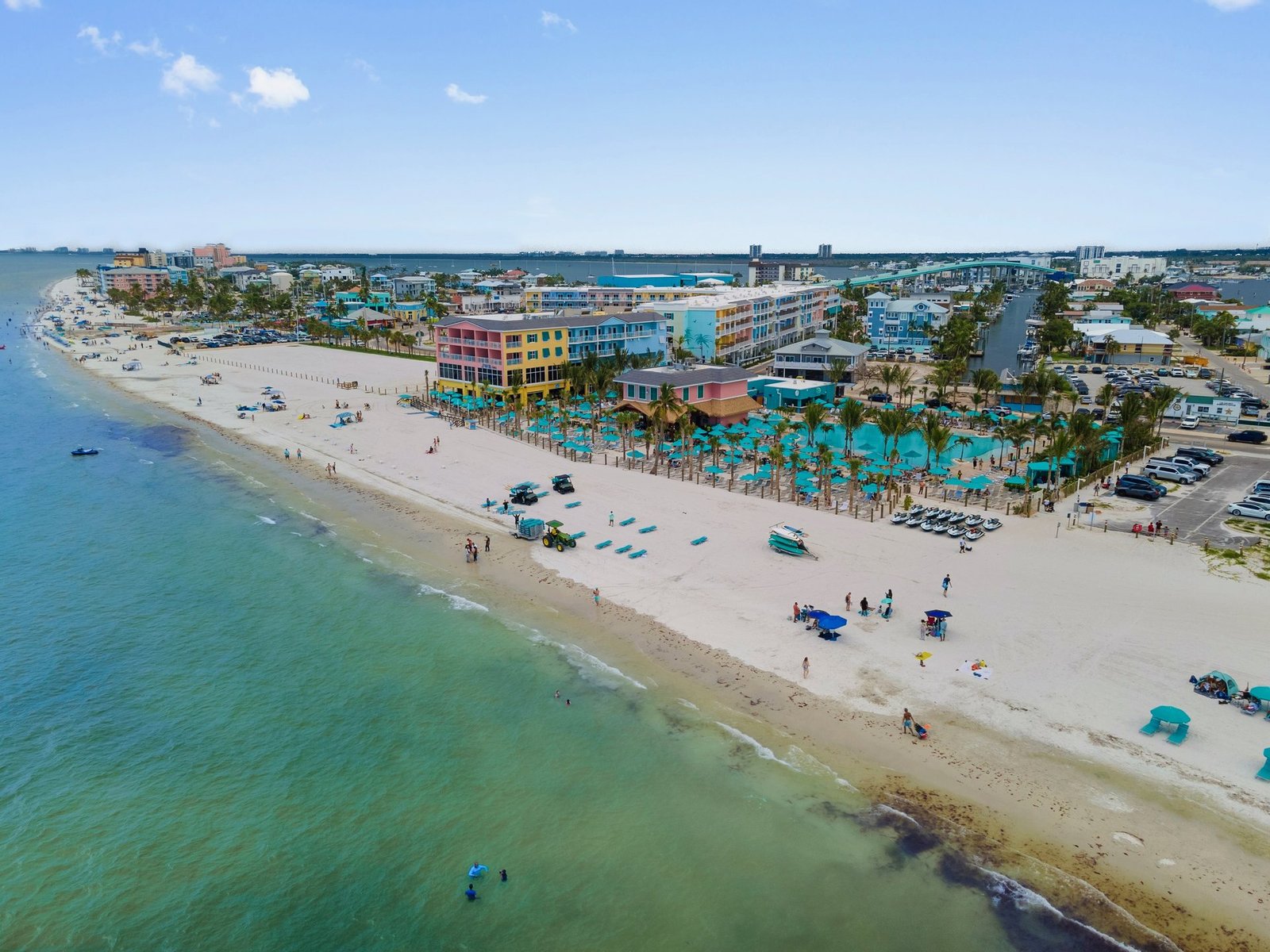
Naples is a different product entirely. The Naples waterfront story is dominated by the Gulf beaches. Naples Beach, Vanderbilt Beach, Park Shore Beach, Lowdermilk Park, the Naples Pier. These are some of the most beautiful soft-sand Gulf beaches anywhere on the west coast of Florida, and they are the primary lifestyle anchor for Naples buyers. If you want to walk five minutes from your front door to a sugar-sand Gulf beach, Naples is built for that and Cape Coral is not.
Naples also has select canal and bay-front communities for boaters: Port Royal, Aqualane Shores, Royal Harbor, Moorings, Park Shore (along the Venetian Bay), and pockets of Old Naples. These communities offer real waterfront for boats, and the very best of them rival or exceed anything in Florida for absolute prestige and price. What Naples does not have is Cape Coral’s structural inventory of mid-range canal homes. The price of entry for direct Gulf-access boating in Naples is, in most cases, multiples of what the same access costs in Cape Coral.
The way I summarize it for buyers: if your top priority is keeping a real boat at your own back-yard dock for under a million dollars, you’re shopping Cape Coral. If your top priority is walking to a Gulf beach at sunset, you’re shopping Naples. Both are valid. They’re just different products. And the buyer who tries to get both in one purchase usually ends up paying Naples prices for less canal access and less beach access than they could have had by picking a lane.
Taxes: Same State Income Tax (Zero), Different Local Bills
Both cities benefit from Florida’s no-state-income-tax structure. That’s the headline tax advantage of moving to either one from a high-tax state, and it’s real. A two-income household relocating from New York, New Jersey, Illinois, Massachusetts, or California can see annual state-tax savings well into five figures, and that savings doesn’t change between Cape Coral and Naples.
Where the two cities differ is at the local millage level. Cape Coral’s combined millage (city + county + school district + special districts) varies by taxing district, pull the exact millage for any specific address from the Lee County Property Appraiser’s estimator before you compare. Collier’s effective property-tax burden generally runs lower than Lee County’s as a share of value, the exact gap depends on the taxing districts for the specific address, so run the real numbers on any home you’re comparing. The interaction is what matters: a lower mill rate on a much higher assessed value can still produce a larger tax bill than a higher mill rate on a lower assessed value.
The functional comparison most buyers care about is the actual annual tax bill on a comparable home. Because assessed value resets to market when you buy, a new homesteaded $400,000 purchase in Cape Coral runs roughly $6,100 to $6,800 per year after exemption, assuming a combined millage in the 16-to-18-mill range; the same purchase non-homesteaded runs about $7,000 or more. Treat these as district-dependent estimates — your actual rate depends on which fire, water, and special districts the parcel sits in, so pull the parcel’s TRIM notice for the exact millage before you budget. The $3,700-to-$4,200 bills you may see on a current owner’s tax record reflect a Save Our Homes-capped assessment, which does not transfer to a buyer. On an $800,000 homesteaded primary residence in Naples (Collier), the bill still lands meaningfully higher in absolute dollars even though Collier’s effective rate is lower, because that lower rate is applied to a much larger assessed value. The dollar number is higher in Naples not because Collier is taxing harder per dollar of value but because the dollar of value is bigger.
The Save Our Homes 3% annual cap and the homestead exemption work the same way in both counties. Year-one non-homestead tax bills are noticeably higher than year-two homesteaded bills in both Cape Coral and Naples. We cover the mechanics of Florida property taxes and homestead in detail in Cape Coral Property Taxes: What You Actually Pay, and most of that math carries over to Collier with the millage rates swapped in.
Insurance: Same Post-Ian Reality, Different Coastal Exposure Mix
Both cities sit in Hurricane Alley. Both took the leading edge of Hurricane Ian in September 2022. Both have seen the Florida property insurance market re-rate, retract, and slowly start to recover. The high-level insurance reality is the same: wind coverage is meaningful, flood coverage is essential on coastal and waterfront lots, and the carrier landscape is more competitive in 2026 than it was in 2023, but premiums are still higher than they were pre-Ian.
Where the two cities differ is in the exposure mix. Cape Coral’s waterfront exposure is canal-and-surge driven. The Gulf-access neighborhoods in southeast and southwest Cape Coral sit in FEMA Zone AE because of storm-surge potential through the canal system from the Caloosahatchee River. Most freshwater and off-water inventory in north Cape Coral sits in lower-risk Zone X or X500. The split is sharp and address-specific. We unpack the full insurance landscape, carriers, and post-Ian premium trends in The Cape Coral Insurance Landscape: Wind, Flood, and Citizens 2026.
Naples’ exposure is beach-and-bay-front driven. Properties directly on the Gulf or on the inland bay system have meaningful surge exposure and AE-zone designations. Inland Naples neighborhoods east of US-41 sit in lower-risk zones similar to inland Cape Coral. The carrier mix in Collier County overlaps heavily with Lee County, and a homeowner who has Citizens, Universal, or one of the new admitted carriers in Cape Coral will see the same names quoting in Naples.
The practical takeaway: insurance can be a real cost in both cities, the math is structurally similar, and the address-specific exposure inside the city matters more than the city label. A new-construction inland Naples home with current building code can carry a similar premium to a new-construction Cape Coral inland home. A 1970s Gulf-access Cape Coral home and a 1970s Royal Harbor Naples home both face the older-construction premium reality. Get a quote on the specific address, not the city.
Schools: Lee County School District vs Collier County Schools
The school comparison is something I deliberately do not rank, because school quality is a function of the specific school zone you fall into, not the county overall, and my job is to point you at the right tools for that research rather than handing you my opinion.
Cape Coral is served by the School District of Lee County, which serves all of Lee County including Fort Myers, Lehigh Acres, Bonita Springs, and Estero. Cape Coral has a mix of public elementary, middle, and high schools, multiple charter options, and a strong private-school presence. Naples is served by Collier County Public Schools, which is a smaller and generally well-regarded district.
For specific school ratings, zone boundaries, and current GreatSchools.org or Niche.com scores, use those tools directly. They update more often than I can keep an article current, and they’re set up to filter by the exact address you’re considering. School zones can be split right down a street in both cities, and the school that one side of a Cape Coral street feeds into can be completely different from the school across the street. Don’t guess. Pull the exact zone for the specific address before you go under contract if school assignment matters to your household.
Lifestyle: Year-Round Working City vs Seasonal Resort Town
This is where the cities feel most different the moment you actually walk around in them.
Cape Coral is a working city. More of Cape Coral’s population lives there year-round, which keeps restaurants, services, and neighborhoods active through the summer. The economy includes a meaningful base of construction and trades, real estate, healthcare, retail, hospitality, and increasingly remote-work professionals. You’re as likely to be neighbors with a school teacher as with a small-business owner or a seasonal resident. The vibe is suburban Florida, neighborhood-oriented, with a maturing downtown along Cape Coral Parkway, a growing restaurant scene, and a deeply embedded boating culture that runs from the Yacht Club to Cape Harbour to Tarpon Point.
Naples is a different cultural product. The economy is heavily oriented around tourism, second-home services, luxury retail (Fifth Avenue South, Third Street South, Waterside Shops, Mercato), high-end dining, golf (golf communities are a defining feature of the market), and a seasonal influx of high-budget winter buyers from October through April. The vibe is resort town meets old-Florida elegance. The downtown is walkable, beautifully landscaped, and built for sunset cocktails and gallery strolls. The City of Naples publishes its own civic information at naplesgov.com if you want the official local-government view.
The seasonality is also different. Both cities see a seasonal wave from Halloween through Easter, but the swing is more pronounced in Naples. The population swells dramatically in season. Restaurants that have a 20-minute wait in March take walk-ins all summer. Naples in August is a quieter, slower town that feels like a different city than Naples in February. Cape Coral has the same seasonal pattern but at lower amplitude, because more of the population is year-round residents rather than seasonal.
Neither vibe is “better.” They’re built for different lifestyles. A buyer who wants a year-round routine, a bigger lot, and a working city around them is going to feel more at home in Cape Coral. A buyer who wants to walk to Sea Salt for dinner and is shopping the luxury tier is going to feel more at home in Old Naples. The same buyer with different priorities might prefer different cities. That’s part of why some of my buyers actually buy in one and play in the other.
Who Cape Coral Wins For (Direct, Honest Read)
Cape Coral wins for buyers who want one or more of these to be true:
- Waterfront at a reachable price. If you want a real boat at your own dock with direct Gulf access for under $1M, Cape Coral is the answer. There are dozens of these homes on the market on any given week. In Naples, that same product is multiples of that price.
- No HOA, no CDD, own your land. Cape Coral’s residential grid is overwhelmingly non-HOA single-family on individually owned lots. You don’t have a board telling you what color to paint your house or when you can run a contractor truck through the gate. Naples has more deed-restricted master-planned communities by share, especially in the newer East Naples and North Naples corridors.
- Buyers who want year-round community and weekday convenience. The cost of housing, the school options, the year-round community feel, and the proximity to the trades workforce all favor Cape Coral for buyers who want a year-round weekday routine.
- Long-term equity build at the mid-market price point. Cape Coral’s structural buyer demand from seasonal buyers, year-round residents, and out-of-state relocators means the entry-level and mid-tier inventory has a deep, replenishing buyer pool.
- Boaters who actually boat. Daily boating, weekly boating, monthly boating. The convenience of walking from your kitchen to your dock and being out on the river in five minutes is structurally different from driving 20 minutes to a marina, paying slip fees, and managing a boat off-site.
Who Naples Wins For (Same Honest Read)
Naples wins for buyers who want one or more of these to be true:
- Walking distance to a Gulf beach. If your daily ritual is a sunset walk on white sand or a morning coffee with your toes in the surf, Naples is built for that and Cape Coral is not. Cape Coral does not have a Gulf beach inside city limits.
- Luxury and prestige as a primary buying motive. Port Royal, Old Naples, Aqualane Shores, Park Shore, Pelican Bay, Grey Oaks, Quail West. These are some of the most prestigious addresses in Florida, and they trade at prices that reflect that. If the address itself is part of what you’re buying, Naples has products that Cape Coral does not.
- Walkable downtown, fine dining, and arts. Fifth Avenue South, Third Street South, the Naples Players, Artis-Naples, the Baker Museum. Naples has invested heavily in a polished urban core that supports a walkable, sit-down-restaurant, gallery-stroll lifestyle that Cape Coral is still building toward.
- Golf as the primary lifestyle. Golf is woven into the fabric of Naples real estate, with gated golf communities and country clubs across the market. If your ideal week includes a country club membership and four rounds of golf, Naples has more options at more price points than Cape Coral.
- Seasonal and second-home buyers. The higher-budget, more seasonal buyer pool that Naples attracts means the social calendar, the services, and the high-end retail are all built for that buyer in a way Cape Coral’s market is not.
The Hybrid Play: Live Cape, Play Naples
Here’s the move I see more and more often, and it’s worth naming because most buyers don’t think of it on the way in.
You buy your primary residence in Cape Coral. You get the canal, the dock, the boat, the no-HOA single-family home with the pool and the lanai. You get the lower tax bill on the lower assessed value. You get the working-city vibe and the deeper buyer pool when you eventually sell. And then, when you want the Naples experience, you get in the car and drive 30 to 45 minutes south. You spend the afternoon on Fifth Avenue. You eat dinner at Sea Salt or Bha Bha. You walk the Naples Pier at sunset. You go home that night to your Cape Coral house.
The 30 to 45 minute drive is the entire feature. You’re not committing to Naples prices to enjoy what Naples offers. You’re treating Naples as a day-trip destination from a Cape Coral home base. The math is hard to argue with. You can save hundreds of thousands of dollars on the purchase, tens of thousands per year on the tax bill, and still drive down for dinner on Fifth Avenue South or an afternoon at Mercato whenever you want.
This is the play I run with a lot of my Midwest and Northeast buyers who came in thinking they had to choose. They didn’t have to choose. They had to think about what their daily life actually looks like and what they were willing to drive 30 minutes for. The boat at the back-yard dock isn’t something you can drive to. The Fifth Avenue sunset stroll is. So the boat lives at the house and the stroll lives in the car ride. Constants over outliers.
The same logic works the other direction for a smaller subset of buyers. You buy in Naples for the beach and the walkability. You keep a boat at one of the Cape Coral marinas (or a friend’s dock, or a covered slip at a Cape Coral facility) and you drive 30 minutes north when you want to be on the river. That play exists. It’s just much less common, because most people who want a boat want it at home.
How I Actually Answer the Question When Someone Asks
When somebody calls me cold and says “Cape Coral or Naples,” I usually ask three concrete questions before I give them any advice.
- What does your daily life actually look like? Are you boating? Are you walking to dinner? What does your weekday routine actually look like? Are you in your home office on calls? The answer to this almost always picks the city.
- What’s your real budget, including insurance, taxes, and maintenance carry? Not the asking-price budget. The all-in monthly carry budget. Naples at the same all-in carry as Cape Coral buys you a much smaller, less special home in Naples than the same dollars buy in Cape Coral.
- How long are you planning to hold this house? If the answer is 3 to 5 years and out, the math is different than if the answer is forever. Resale audience matters, and the two cities sell to different audiences with different liquidity profiles.
Once those three answers are on the table, the city usually picks itself. I have sent buyers to Naples whose dollars and lifestyle clearly belonged in Cape Coral, and I’ve kept buyers in Cape Coral whose dollars and lifestyle clearly belonged in Naples. The job isn’t to win you to my city. The job is to put you in the right house. If Naples is the right answer, I’ll tell you. I have referral relationships with Naples agents I trust, and a buyer who lands in the wrong city is a buyer I’ll see back on the market in three years selling at a discount. That’s not a win for anyone.
The closest comparison piece on this site is the one between Cape Coral and our immediate neighbor across the river, which is a different conversation than this one but related. We cover that one in Cape Coral vs Fort Myers: The Honest Local Read. Lee County versus Lee County is a different framework than Lee versus Collier, and the price-and-product gap is much narrower.
Frequently Asked Questions
Is Naples better than Cape Coral?
Neither city is universally better. Naples is a higher-priced, beach-and-golf resort town with a polished walkable downtown and a heavy concentration of luxury and seasonal buyers. Cape Coral is a year-round working city with 400+ miles of canals, far more affordable waterfront, and a deeper inventory of mid-priced single-family homes with no HOA. The right answer depends on whether your top priority is walking to a Gulf beach (Naples) or keeping a boat at your own back-yard dock (Cape Coral), and what your all-in carry budget realistically supports.
Is Cape Coral cheaper than Naples?
Yes, meaningfully. Cape Coral’s citywide median sale price has been running at well under half the Naples single-family median through 2026. When you run the comparison yourself, match the segments and the timeframes — a citywide all-property median and a single-family-only median are not the same measure, and a single month is not a year-to-date figure. The gap shows up at every segment level: a Gulf-access waterfront home in Cape Coral typically lists in the same price range as a non-waterfront condo in Park Shore or Pelican Bay. The annual property tax bill on a comparable home is also lower in Cape Coral because the assessed value is lower, even with Lee County’s slightly higher millage rate. Insurance, utility, and maintenance carrying costs are broadly similar between the two cities for comparable construction era and exposure.
Can you get waterfront boating in Naples?
Yes, but the inventory is concentrated in a small number of premium communities and the entry price is significantly higher than Cape Coral. Port Royal, Aqualane Shores, Royal Harbor, the Moorings, and pockets of Old Naples and Park Shore offer real Gulf-access and bay-front waterfront with private dockage. The very best of these addresses rival anything in Florida for prestige and price, but the structural mid-range inventory of canal homes that defines Cape Coral does not exist in Naples at the same volume or price point. If your primary buying motive is keeping a 25 to 35 foot boat at your own dock without spending seven figures on the dock itself, Cape Coral is the more accessible market.
Which city has better hurricane protection?
Both cities sit in the same hurricane corridor and both took meaningful damage from Hurricane Ian in September 2022. The Florida Building Code applies statewide, but design wind speeds are assigned by location, and coastal Collier sites can carry a higher design wind speed than inland Cape Coral parcels. So a 2020-built home in each city is built to the same code, not necessarily to an identical wind load — ask for the design wind speed and the product approvals on the specific address. Site-specific surge exposure matters more than the city label. A waterfront Gulf-access Cape Coral home and a Royal Harbor Naples home both face meaningful surge exposure and AE-zone flood requirements. An inland Cape Coral home in Zone X and an inland East Naples home in Zone X face similar lower-risk profiles. Get the FEMA flood zone, the elevation certificate, and the construction year on the specific address before drawing conclusions.
How do the two cities compare for seasonal and second-home buyers?
Both cities work for seasonal and second-home buyers, but they draw different profiles. Naples draws higher-net-worth buyers making multi-million-dollar second-home or primary-residence purchases, often in golf communities or walkable beach neighborhoods. Cape Coral draws middle-income to upper-middle-income buyers seeking single-family non-HOA homes, often on freshwater canals in NE Cape or off-water inland in NW Cape, with a smaller premium tier buying Gulf-access homes in SE and SW Cape. The Florida no-state-income-tax advantage applies equally in both cities. Homestead exemption and Save Our Homes 3% cap also apply equally. The differentiator is lifestyle preference (beach walks vs back-yard dock) and budget.
How far is Naples from Cape Coral?
About 40 miles, and realistically 45 to 60 minutes by car. You cross into Fort Myers first to pick up I-75 south, so the drive takes longer than the map distance suggests. From central Cape Coral to downtown Naples (Fifth Avenue South area), plan on 45 to 60 minutes in non-peak traffic and more from the north or west Cape. The drive lengthens during peak season (December through April) and during weekday rush hour. Both cities share Southwest Florida International Airport (RSW), which sits between the two and is roughly 20 to 30 minutes from either city. The reachable distance is the foundation of the “live Cape, play Naples” hybrid strategy that works well for buyers who want both lifestyles without paying for both addresses.
The Bottom Line
Cape Coral and Naples are not competitors. They’re complementary cities serving different buyers with different lifestyles at different price points, separated by 30 miles of I-75 and a county line that matters more than most out-of-state buyers realize on the way in.
Cape Coral wins on price per waterfront dollar, on no-HOA single-family inventory, on the depth of the canal system, on the year-round working-city feel, and on the deeper buyer pool for the mid-market home you’re eventually going to sell. Naples wins on Gulf beaches, on walkable downtown polish, on luxury and prestige addresses, on golf-community density, and on the seasonal high-net-worth buyer experience. Neither city has the other’s product. Both cities have the same Florida no-state-income-tax advantage, the same hurricane-corridor reality, and the same RSW airport. The site-specific math on a single address matters more than the city label.
If you guys are wrestling with this question, the answer is almost never “split the difference and look in both places at once.” The answer is to be honest about what your daily life actually looks like and what you’re willing to drive 30 minutes for. The boat at the back-yard dock is the thing you cannot drive to. The Fifth Avenue sunset stroll is the thing you can. Pick the city that matches the thing you cannot drive to. Buy the house. Drive to the other thing when you want it. That’s the real answer.
If you want a real walk-through of how Cape Coral and Naples actually compare for your specific budget, lifestyle, and timeline, reach out and let’s talk. I’ll give you the same straight read I’d give a family member. If Naples is the right answer for you, I’ll tell you that too and connect you with an agent there I trust. Honest fit beats forced sale every time.
Fit caveat: when this article says one city may fit a buyer better, it means property search profiles, budget, commute, HOA, waterfront, and due-diligence preferences, not protected-class demographics.