

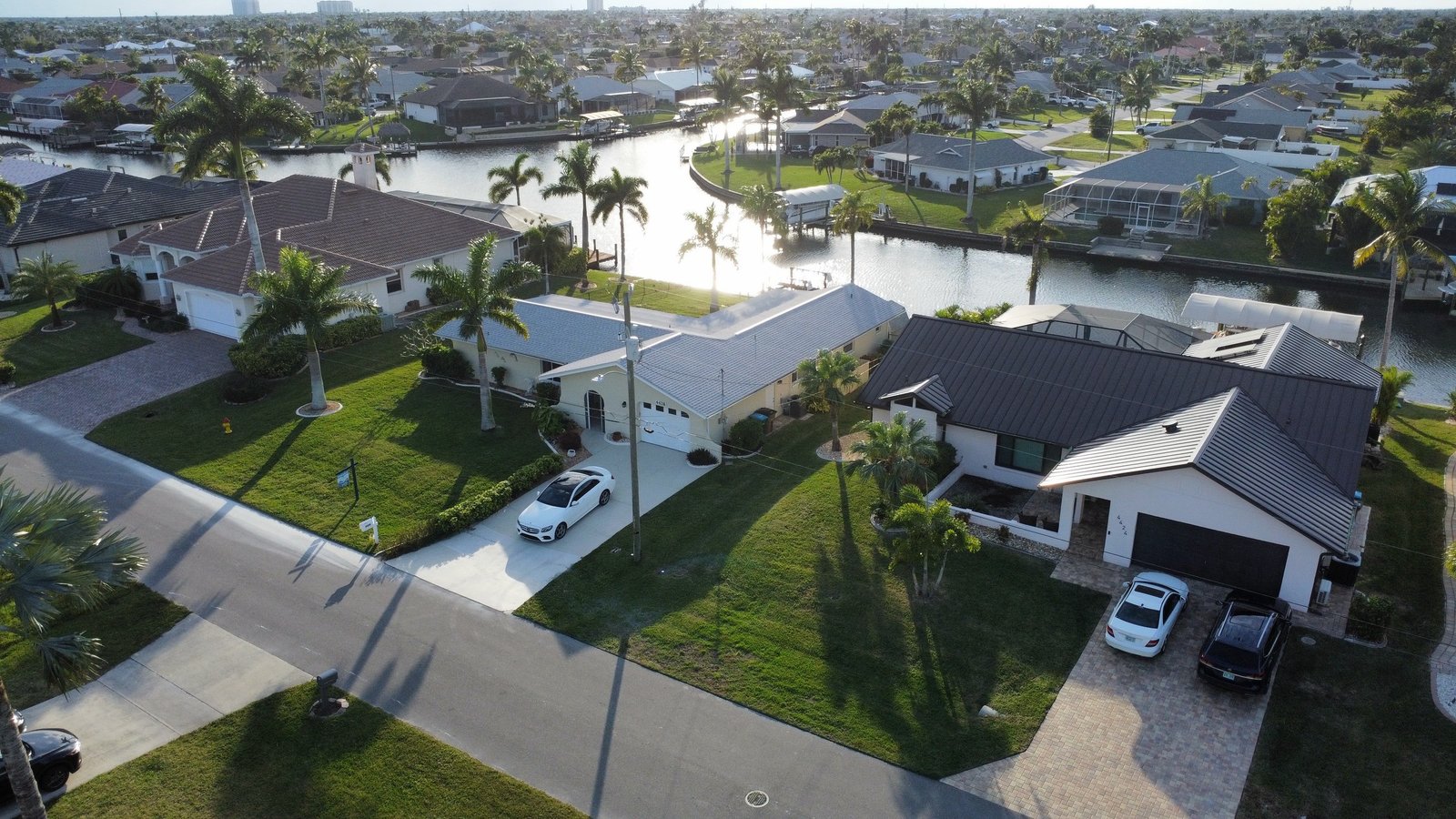
If you’re researching a move to Cape Coral, sooner or later you guys are going to ask the question everybody eventually asks: where does the money come from? It’s a fair question, and it’s one most relocation pages won’t answer honestly. Cape Coral is not Tampa. It’s not Orlando. It’s not a corporate-HQ city, and pretending otherwise sets up new residents to be disappointed. What it is, is a service-economy bedroom community with a healthcare anchor, a massive construction trade base, a seasonal population pulse, and a fast-growing population of remote workers who bring their jobs with them when they move here.
I’m Brayden Milner. I’m a third-generation Realtor with Florida Future Realty, born and raised in Cape Coral. The economy I’m describing in this article is the economy I grew up inside of. My family has worked in this real estate market since 1994. I’ve watched the city go from a sleepy retirement spot with a few subdivisions and one mall to a city of over 230,000 residents that absorbs people from every state in the union. The job market here is a real thing, but it doesn’t look like the job market most relocators are leaving behind, and the difference matters when you’re deciding whether to take the leap.
So here’s what this article is. It’s the honest read on how the Cape Coral economy actually works. Who the big employers are, what they pay, where the commute math sends you, what the no-state-income-tax advantage really buys you, and what kind of buyer should think twice before assuming they can land an equivalent corporate job here. By the end, you’ll know whether you’re moving to a city that fits your career or whether you’ll need to rewire your work setup before you close on a house.
The Big Picture: A Service and Trade Economy, Not a Corporate One
The single most important thing to understand about the Cape Coral economy is what it isn’t. Cape Coral does not have a Fortune 500 corporate headquarters. There is no major manufacturing hub. There is no concentration of tech employers the way you’d find in Austin or Raleigh. Florida’s big corporate clusters live in Tampa, Miami, Orlando, and Jacksonville. Cape Coral sits in the residential, service, healthcare, and trades band of the Florida economy, and the employment base reflects that.
What Cape Coral does have is a diversified, recession-resistant employment floor built on a handful of stable sectors:
- Healthcare through Lee Health, the regional nonprofit hospital system
- Education through the Lee County School District
- Local government through the City of Cape Coral and Lee County
- Retail and hospitality anchored by Publix, Walmart, and a long tail of restaurants and service businesses
- Construction and skilled trades, which exploded after Hurricane Ian and stayed elevated
- Marine industry, which is its own niche economy here in a way it isn’t most places
- Real estate, finance, and professional services, supporting the population inflow
- Self-employment and small business, which is bigger here than national averages
What it doesn’t have is large numbers of high-wage knowledge-economy jobs, large corporate offices, or the dense professional-services ecosystem you’d find in a major metro. There are exceptions, and I’ll get to them, but those are the structural facts. For broader context on the city itself, our Cape Coral 101 overview covers the history, geography, and the way the city is laid out, and the economic profile here builds on that foundation.
The unemployment rate in Cape Coral and Lee County ran around 3.3% through 2024, which was functionally full employment. It has since climbed: BLS Local Area Unemployment Statistics (LAUS) data put Lee County in a roughly 4.6% to 5.6% range through late 2025 and into 2026, with summer readings often the highest, as the region’s post-Ian hiring boom cooled. That’s still not a weak labor market by historical standards, but it has a specific meaning in a service-and-trades economy: there are plenty of jobs, but most of them don’t pay what comparable roles pay in higher-cost metros. The U.S. Bureau of Labor Statistics tracks the unemployment rate through its LAUS program and county-level wage and employment data through the Quarterly Census of Employment and Wages, and the public dataset for Lee County is the cleanest place to verify any specific sector, wage, or unemployment figure (census.gov QuickFacts for Cape Coral and Lee County provides the cross-walked numbers).
The Big Employers (and Why They Matter)
When buyers ask me about the local job market, they usually want me to name names. Fair enough. Here’s the list of the largest and most visible employers serving the Cape Coral workforce.
Lee Health
Lee Health is the regional nonprofit hospital system and is the single largest healthcare employer for Cape Coral and Lee County. The system operates Cape Coral Hospital here in the city, plus HealthPark Medical Center, Gulf Coast Medical Center, and Lee Memorial Hospital across the bridge in Fort Myers. We’re talking about thousands of clinical and administrative positions across the system: nurses, physicians, surgical techs, radiology, lab, allied health, EMS coordination, billing, IT, supply chain, and so on.
Cape Coral Hospital is the local node, but the larger campuses are in Fort Myers, which means a meaningful share of Cape Coral healthcare workers commute across the river. If healthcare is your field, the Lee Health system is going to be the dominant employer in your search regardless of which side of the Caloosahatchee you live on. Around Lee Health you’ve also got a growing universe of physician practices, urgent cares, outpatient surgery centers, home health agencies, and elder care facilities, which is what happens when a region’s population ages faster than the national average. Healthcare demand here is structural, not cyclical.
Lee County School District
The Lee County School District is one of the largest employers in the region, with schools spread across Cape Coral, Fort Myers, Lehigh Acres, Estero, and Bonita Springs. Teachers, administrators, instructional aides, transportation, food service, custodial, district office. If you’re an educator relocating to Cape Coral, the school district is the primary employer in your field. Pay scales are set by district pay tables and the state framework, and they are not what you’d expect to earn in higher-cost metros. The tradeoff is the climate, the lower cost of living relative to many northern states, and the no-state-income-tax advantage I cover further down.
City of Cape Coral and Lee County Government
Local government is a significant employer in its own right. The City of Cape Coral itself runs public works, utilities, parks and recreation, code enforcement, planning, the police department, the fire department, and a lot more. Lee County adds another layer of government employment on top: sheriff’s office, county-level public works, parks, libraries, social services, and the county administration. Government jobs here pay public-sector wages with public-sector benefits, which means they’re stable, they’re insulated from the business cycle in a way the trades aren’t, and they’re a real anchor for the local economy. They’re not, however, a growth engine. Hiring scales with population, and budgets are what they are.
Publix and Walmart
Publix is the dominant grocery employer across Southwest Florida and operates multiple stores in Cape Coral. Walmart maintains both retail and distribution operations in the area. Between the two of them, you’re looking at thousands of retail-sector jobs in the Cape Coral catchment. These are service-wage positions for the most part, with the standard structure you’d expect from large national and regional retailers. They are reliable employers and they hire steadily, but they aren’t the path to a six-figure household income on their own.
Chico’s FAS (Fort Myers Headquarters)
This one’s worth calling out because it’s one of the more prominent corporate headquarters in the broader Lee County area, though the biggest name is Hertz Global Holdings, whose worldwide headquarters sits in Estero, and Gartner maintains a large Fort Myers campus as well. Chico’s FAS, the women’s apparel retail chain, is headquartered in Fort Myers, not Cape Coral proper. For Cape Coral residents working in corporate retail, marketing, supply chain, or e-commerce, Chico’s is one of the few large-employer headquarters in regular commuting distance. The fact that it sits across the river in Fort Myers underscores the broader point: Cape Coral’s white-collar professional jobs tend to be Fort Myers jobs that Cape Coral residents commute to.
Construction Trades and Small Contractors
Construction is a category, not a single employer, and it’s massive here. A significant share of single-family home sales in Cape Coral involve new construction. That’s not a temporary spike. That’s the structure of this market. Behind that statistic is an enormous ecosystem of general contractors, framers, roofers, concrete finishers, plumbers, electricians, HVAC techs, drywall crews, painters, tile installers, dock builders, seawall contractors, and landscape companies. Most of them are small, owner-operated outfits employing a handful to a few dozen workers. Skilled tradespeople in particular, the licensed electricians, plumbers, and HVAC technicians, are in chronic demand and earn real money for it. After Hurricane Ian in 2022, demand for trades exploded as the region rebuilt, and that demand has not normalized back to pre-Ian levels.
The Sector Breakdown: Where Cape Coral Residents Actually Work
If you zoom out and look at the labor force by sector, the picture is consistent with what I just described, but a few things stand out that surprise people from out of state.
Healthcare and Social Assistance
This is the single largest stable employment cluster in the region. Lee Health is the anchor, but the broader category includes nursing homes, assisted living facilities, in-home care providers, physical therapy clinics, mental health services, and specialty practices. Demand is structurally supported by an aging population and continued in-migration, and it has been growing faster than the workforce can fill positions. Nurses and allied health professionals in particular are recruited aggressively, and openings stay open longer than employers want them to.
Construction and Skilled Trades
Construction is bigger here than national averages. The Rosen brothers platted Cape Coral in 1957 with tens of thousands of residential lots, and the buildout of those lots is still happening sixty-plus years later. Add in post-Ian rebuilding, teardown-rebuild activity on premium waterfront, and the steady churn of remodels and additions, and you get a construction sector that has been running hot for years. If you’re a tradesman with a license and a work ethic, Cape Coral is one of the friendlier markets in the country to land in. Wages have moved up, particularly for the licensed specialty trades.
Retail and Hospitality
Retail and hospitality together employ a huge share of the local workforce. Tourism and the seasonal cycle drives the rhythm: restaurants, bars, hotels, vacation rental management companies, marinas, fishing charters, golf courses, and a thousand small service businesses scale up between November and April and contract in the summer. The seasonality is real and it creates income volatility for workers in this category. Anyone planning to support a household on hospitality wages here needs to understand that the slow season is genuinely slow.
Real Estate, Finance, and Professional Services
Real estate, mortgage lending, title insurance, property management, and the supporting universe of legal, accounting, and insurance services all run on the back of the city’s population growth. Real estate alone is a major employment category, which I happen to know firsthand because it’s the industry I work in. Mortgage brokers, loan officers, insurance agents, escrow officers, surveyors, inspectors, appraisers. None of it is glamorous, none of it makes the cover of a magazine, but it’s a real chunk of the workforce. Professional services beyond that, like attorneys, CPAs, and consultants, exist but are not as deep as you’d find in a major metro. Specialists in many fields commute to or operate out of Fort Myers, Naples, or even Tampa or Miami via remote arrangements.
Marine Industry
This one’s distinctive to Cape Coral. With over 400 miles of canals and direct Gulf access, the marine industry is its own employment cluster. Boat dealers, marinas, marine repair shops, dock builders, yacht brokers, marine canvas shops, propeller specialists, charter captains. It overlaps with both tourism and construction. The dock and seawall trades alone employ a lot of people, and the work is steady because Florida sun and salt air put every dock and lift on a maintenance clock. If you’ve worked in the boating industry up north and you’re considering a move, this is one sector where Cape Coral genuinely punches above its weight nationally.
Education and Public Sector
Education through the Lee County School District and Florida SouthWestern State College, plus municipal and county government, round out the stable end of the labor market. These positions are insulated from the business cycle, they offer pensions and benefits that private-sector roles often don’t, and they’re a meaningful share of total employment. They’re not where you go to build wealth quickly, but they’re where you go for stability.
The Commute Reality: Cape Coral as a Bedroom Community
Here’s the thing nobody on a relocation site wants to spell out clearly, so I will. A meaningful share of working Cape Coral residents do not work in Cape Coral. They commute to Fort Myers across one of the three bridges over the Caloosahatchee, and the average Cape Coral commute is approximately 30 minutes (29.9 minutes per the latest Census ACS figures), which is slightly above the Florida statewide average. Some commute further: to Estero, Bonita Springs, or Naples, where drive times push 45 to 60 minutes each direction.
Cape Coral functions as a bedroom community for the broader Lee County employment base. You live here, you commute east across the river to work, you come home in the evening. That’s the pattern for office workers, healthcare staff at the larger Lee Health campuses, anyone in the Fort Myers professional ecosystem, and anyone working at RSW Southwest Florida International Airport (about 30 to 40 minutes depending on where you start in the Cape). The three bridges are the chokepoints. During season, when the seasonal population swells, bridge traffic gets noticeably worse, and that 30-minute average creeps higher.
This matters for your housing decision in a concrete way. If you’re going to be commuting to Fort Myers daily, proximity to a bridge approach affects your quality of life dramatically. Living five minutes from the Cape Coral Bridge versus thirty minutes deep in NW Cape compounds to roughly 50 extra minutes of driving every workday, which is over four hours a week, which is over 200 hours a year. That math should factor into which quadrant of the city you target, and our quadrant-by-quadrant neighborhoods guide walks through what each part of the city looks like with that in mind.
Remote Work: The Quiet Reshaping of the City
The biggest change in the Cape Coral economy in the last six years has nothing to do with a new factory opening or a corporate relocation. It’s the remote-work migration. Since 2020, thousands of professionals from higher-cost markets have moved to Cape Coral with their jobs in hand. Tech workers, finance professionals, consultants, sales professionals, marketers, designers, content creators. Their employers are headquartered in San Francisco, New York, Chicago, Boston, Atlanta, or anywhere else, and Cape Coral is now their address.
This is a structurally different kind of in-migration than the pension-and-Social-Security wave. That income arrives from elsewhere and gets spent locally. Remote workers earn full salaries from elsewhere, pay no state income tax on them, and spend a meaningful portion of that money on Cape Coral housing, dining, services, and entertainment. The net effect on the local economy has been pretty significant: higher disposable income flowing into local businesses, increased demand for housing in the mid and upper bands, and a growing professional-class population that didn’t exist here in the same numbers a decade ago.
What remote work doesn’t do is expand the local employer base. These workers aren’t hiring locally. Their salaries are paid by companies headquartered elsewhere. So while the inflow has been phenomenal for housing demand and consumer spending, it hasn’t created the white-collar professional employer ecosystem you’d find in a city like Tampa or Charlotte. The remote-worker pool is a flow of income into the city, not a build-out of new local employers.
The sustainability of this pattern depends on whether national employers maintain remote-work flexibility. So far, despite the back-and-forth on return-to-office mandates at major corporations, the Cape Coral inflow has continued. Workers who’ve already moved and bought homes here are unlikely to reverse course, and the structural draws (no state income tax, climate, waterfront lifestyle, lower cost of housing than coastal California or the Northeast) haven’t changed. Our moving to Cape Coral guide covers the practical mechanics of the relocation for remote workers specifically.
The No-State-Income-Tax Advantage (and What It Really Buys You)
Florida levies no state personal income tax. None. This is a real, material financial fact, and it’s one of the biggest reasons people from high-tax states relocate here. If you’re moving from California (which has a top marginal rate of 13.3%), New York (10.9% top rate plus NYC local tax up to 3.876%), New Jersey (10.75%), or Illinois (4.95% flat), the move to Florida can save you tens of thousands of dollars a year in state income tax alone, depending on your income level. For a high-earning remote worker or anyone drawing down a retirement account, that’s an enormous shift in after-tax disposable income.
Here’s what nobody likes to mention. The no-state-income-tax advantage isn’t a free lunch. Florida makes up part of the lost state revenue through sales tax (6% state, plus Lee County’s 0.5% local-option surtax, for a combined 6.5% rate here, some other Florida counties stack on more and land closer to 7%) and through property tax. Cape Coral property tax typically runs about 1.0% to 1.6% of market value depending on your exemptions, and the first-year tax bill for an out-of-state buyer who hasn’t yet established homestead exemption can be a sticker-shock moment. After you homestead the property and the 3% Save Our Homes cap kicks in for future years, the long-term tax picture is favorable, but year one stings. Our cost of living breakdown goes deeper on this.
Insurance is the other offset. Post-Ian, homeowners and flood insurance premiums in Cape Coral have risen meaningfully, and waterfront properties in AE flood zones can carry mandatory flood insurance running $3,000 to $7,000+ a year. New construction with current building codes mitigates that significantly, and you can land annual premiums under $1,500 on a newer build, but you have to do the math honestly. The no-state-income-tax win is real and large. The insurance and first-year property tax math eats a portion of it back. The net for most relocators is still positive, usually substantially so, but go in with eyes open.
Wages: An Honest Conversation
Time for the part nobody wants to print on a relocation brochure. Wages in Cape Coral and Lee County are generally lower than national averages for comparable roles in higher-cost metros. This is not a marketing pitch. This is the consistent finding in BLS wage data, FloridaCommerce labor market information, and any honest conversation with a recruiter who works the region. FloridaCommerce publishes county-level employment and wage data through its Labor Market Statistics program (floridajobs.org), and the public Lee County dashboards are the easiest way to verify the wage picture by occupation.
The cost-of-living offset is partial. Yes, Florida has no state income tax. Yes, housing in Cape Coral is meaningfully cheaper than coastal California or the Northeast. Yes, utilities and groceries are in line with national averages, not multiples of them. But comparing an entry-level professional salary in Cape Coral to the same role in Boston or San Francisco, the Cape Coral wage doesn’t fully close the gap even after you account for cost of living. That’s the trade. You’re trading a portion of your wage potential for climate, lifestyle, lower taxes, and a different pace of life.
The honest assessment by income source:
- Retirement and investment income: Local wage levels are irrelevant. The spend comes from pensions, Social Security, and account drawdowns built elsewhere.
- Remote workers: You’re bringing your wage with you. If your employer pays you the same regardless of zip code (many do, some don’t), Cape Coral is a high-leverage move financially. If your employer adjusts pay by cost of living, the math gets tighter but is still usually favorable.
- Skilled tradespeople with a license: Demand is real, wages have moved up, and you can build a solid business here, particularly if you can run your own outfit. Plumbers, electricians, HVAC, dock builders, seawall contractors, marine techs. This is a good market.
- Office professionals expecting to find an equivalent local corporate role: This is the hardest path. The corporate ecosystem here is thinner than what you’re used to, the senior-level white-collar jobs are concentrated in Fort Myers (not Cape Coral), and you may need to accept either a commute, a remote arrangement, or a step down in role to land here. Have the wage conversation honestly before you commit.
- Service workers in hospitality or retail: Plenty of openings, manageable cost of living relative to many northern cities, but the wage levels are what they are. Plan accordingly.
Self-Employment and Small Business: A Cape Coral Strength
One thing the wage data understates is the size of Cape Coral’s self-employment and small business culture. A lot of the economy here runs through small owner-operated outfits: independent contractors in the trades, real estate agents, mortgage brokers, marine service providers, charter captains, pool service companies, lawn care businesses, cleaning services, vacation rental managers, and a long tail of solo professionals and small partnerships. The Florida regulatory environment is comparatively friendly to small business formation. Sales tax filing is straightforward, the state’s Department of Business and Professional Regulation has clear licensing pathways for most trades, and the no-state-income-tax structure benefits sole proprietors and pass-through entities just as much as W-2 earners.
If you’ve been thinking about building your own business, Cape Coral is a friendlier place to do that than most. The cost structure is reasonable, the population is growing, the customer base is expanding, and there’s plenty of room for new entrants in most service categories. I don’t say that lightly. I built my own real estate business here as a 23-year-old in a market with established competitors, and the city’s growth made room for it. There’s no guarantee, but there’s opportunity for somebody willing to put in the work.
The Seasonal Pulse: Halloween to Easter
The Cape Coral economy doesn’t run on a flat annual cycle. It pulses with the seasonal migration. From roughly Halloween through Easter, the population swells as seasonal residents arrive from Michigan, Ohio, Illinois, Wisconsin, Pennsylvania, New York, New Jersey, Massachusetts, and the Canadian Great Lakes provinces. Restaurants are packed. Retail volume jumps. Healthcare practices fill their winter slots months in advance. Marinas and boat dealers see their busiest stretch. Real estate transaction volume spikes. Service businesses, from lawn care to pool service to home repair, get inundated.
From May through October, the city contracts. Many seasonal residents leave. Tourism slows in the hottest months. Restaurants reduce hours or close on certain days. Some businesses scale back staff. The transaction pace in real estate slows. Hurricane season runs June through November and adds an anxiety overlay from July through September.
For a worker dependent on hospitality or seasonal retail wages, that’s real income volatility. For a homeowner, the seasonal cycle just means the rhythm of life shifts. For a business owner, calibrating staffing and inventory to the cycle is the difference between profitable and not. The seasonality isn’t a problem, it’s a feature, but it has to be planned for if your income depends on customer traffic.
What Lee County Economic Development Is Trying to Build
The Lee County Office of Economic Development and various regional partners have been working for years on diversifying the employment base beyond the service-and-trades anchor. The aspirations include attracting more technology employers, growing biotech and medical device manufacturing, expanding light manufacturing along the I-75 corridor and near RSW airport, and supporting small business formation. The county publishes its initiatives, incentive programs, and major project announcements through its public economic development resources (leegov.com is the authoritative source for county-level economic development news and program details).
Progress has been real but incremental. Light manufacturing has the most near-term potential given the availability of industrial-zoned land, good logistics access via I-75 and RSW, and a trades workforce that can be adapted to manufacturing roles. Tech and biotech remain more aspirational than material as of 2026. The workforce isn’t yet deep in those fields, the supporting infrastructure (lab space, data centers, specialized training pipelines) is still in early stages, and the corporate decision-makers who choose where to locate continue to look first at Tampa, Orlando, and Miami. The shift to a deeper knowledge-economy employer base in Cape Coral and Lee County will likely take a decade or more if it happens at all.
None of that should discourage someone considering a move. The current economy supports a population approaching 240,000 in Cape Coral alone, and the structural growth drivers are intact. It just means you should plan around the economy that exists today, not the economy that might exist in 2040.
What This Means for Your Move
If you’re sitting somewhere up north with a job offer to weigh, a remote-work arrangement to evaluate, or a retirement decision to make, here’s the practical takeaway from everything above.
- Verify the wage math before you commit. If you’re moving for a specific job, get the salary number in writing and run it against your actual cost of living here, including the first-year property tax sticker, insurance, and whatever else is real for your specific situation. Don’t extrapolate from a brochure.
- If you’re remote, lock down the remote arrangement. Ask explicitly whether your employer adjusts pay by location. Ask explicitly whether the remote arrangement is permanent or revisitable. Get clarity before you sign on a house.
- Map your commute honestly. If you’ll be commuting to Fort Myers, the difference between living near a bridge approach versus deep in NW Cape is hundreds of hours a year of your life. Pick your quadrant with that in mind.
- If you’re in a skilled trade, you have leverage. The market needs you. Negotiate accordingly, particularly if you can run your own outfit.
- If you’re retired or near-retired, the math is simpler. The no-state-income-tax advantage plus reasonable property taxes plus the climate plus the lifestyle is a strong combination. The main variables to manage are insurance carrying cost and the seasonal pulse of the city.
Frequently Asked Questions
What are the largest employers in Cape Coral?
The largest employers serving the Cape Coral workforce include Lee Health (the regional nonprofit hospital system that runs Cape Coral Hospital plus several Fort Myers campuses), the Lee County School District, the City of Cape Coral, Publix, Walmart, and Chico’s FAS (headquartered in Fort Myers, not Cape Coral proper, but a major employer in the broader Lee County area). Beyond those named anchors, the construction trades collectively employ a huge share of the local workforce through a network of small contractors, and the marine industry is its own distinct employment cluster supporting boat dealers, marinas, dock builders, and marine service companies.
Can you find a corporate job in Cape Coral?
Cape Coral itself does not have a deep corporate employer ecosystem. There is no Fortune 500 headquarters in the city. Most large-employer corporate roles in Lee County are concentrated in Fort Myers, including Chico’s FAS, the larger Lee Health administrative campuses, and a thinner layer of professional services firms. Cape Coral residents working corporate jobs typically commute across the bridges to Fort Myers. If you need a corporate role to make the move work, plan for either a Fort Myers commute, a fully remote arrangement with an out-of-area employer, or a possible step down in role compared to what you’d find in a major metro.
How long is the commute from Cape Coral to Fort Myers?
The average Cape Coral commute time is approximately 30 minutes, which is slightly above the Florida statewide average. Most Cape Coral commuters drive across one of three bridges over the Caloosahatchee River: the Cape Coral Bridge to the south, the Midpoint Memorial Bridge in the central area, and the Caloosahatchee/Edison Bridge to the north via Pine Island Road into North Fort Myers. Both the Cape Coral Bridge and the Midpoint are tolled eastbound only (Cape Coral toward Fort Myers): $2 with a LeeWay (or SunPass) transponder, $5 for pay-by-plate without one. The northern bridges are free. During winter season from November through April, bridge traffic congestion increases and commute times stretch longer.
Does Florida really have no state income tax?
Yes. Florida levies zero state personal income tax. Residents pay federal income tax, sales tax (6% state plus Lee County’s 0.5% surtax, for a combined 6.5% here), and property tax (Cape Coral typically runs about 1.0% to 1.6% of market value, depending on exemptions). For a high-earning remote worker or anyone drawing down a retirement account, the no-state-income-tax advantage can save tens of thousands of dollars a year compared to states like California, New York, New Jersey, or Illinois. The math gets partially offset by insurance costs and the first-year property tax bill for out-of-state buyers who haven’t yet established homestead exemption, but the net for most relocators is still substantially positive.
Is Cape Coral a good place for remote workers?
For remote workers whose employers are based elsewhere and who maintain their original salary regardless of zip code, Cape Coral is one of the higher-leverage moves in the country. The combination of no state income tax, reasonable housing costs relative to coastal California or the Northeast, warm climate, waterfront lifestyle, and a growing population of fellow remote professionals has made the city a major destination since 2020. Broadband is available across developed areas through major providers. The primary considerations are whether your employer adjusts pay by location, whether the remote arrangement is permanent, and your tolerance for the seasonal pulse of the city and the summer heat.
What is the unemployment rate in Cape Coral?
The unemployment rate in Cape Coral and Lee County ran around 3.3% through 2024, but has since risen to a range of roughly 4.6% to 5.6% through late 2025 and into 2026, with summer readings often the highest, per BLS Local Area Unemployment Statistics. That’s a more normal reading than the ultra-tight, pandemic-era labor market, though healthcare, skilled trades, and hospitality still recruit aggressively and openings in those fields stay open longer than employers want. Wage growth has cooled along with it, and Cape Coral wage levels generally remain below national averages for comparable roles in higher-cost metros. For verified current figures, FloridaCommerce publishes county-level employment and wage data through its Labor Market Statistics program, and the U.S. Bureau of Labor Statistics maintains both the Local Area Unemployment Statistics (unemployment rate) and Quarterly Census of Employment and Wages (wage data) datasets for Lee County.
Are wages in Cape Coral lower than the national average?
Yes, generally. Wages in Cape Coral and Lee County are lower than national averages for comparable roles in higher-cost metros, and the cost-of-living offset is partial rather than complete. The no-state-income-tax advantage, lower housing costs relative to coastal California or the Northeast, and reasonable utility and grocery costs close part of the gap but typically not all of it. Skilled trades with active licenses and demand-side leverage (plumbers, electricians, HVAC techs, marine specialists) tend to fare better. Office professionals expecting an equivalent corporate salary to what they’d earn in a major metro should verify the specific wage offer before committing to the move.
The Bottom Line
Cape Coral’s economy is service-oriented, trades-heavy, seasonally pulsed, and tied to population growth as its primary growth driver. The employment base is stable, with healthcare, government, and essential retail providing a floor under the cycle. Wages are below national averages for comparable roles in higher-cost metros, partially offset by the no-state-income-tax advantage and lower housing costs. The remote-work migration since 2020 has been a quiet but transformative force, bringing in thousands of professionals who earn their incomes from elsewhere and spend them locally. The city functions as a bedroom community for the broader Lee County employment base, with most cross-river commuters heading to Fort Myers for work.
What this means in practice: Cape Coral fits some buyer profiles cleanly and challenges others. People on pension or investment income, remote workers with stable out-of-area salaries, and licensed skilled tradespeople have the easiest economic match. Office professionals expecting to land an equivalent corporate role locally face a thinner ecosystem and should plan accordingly. Service workers in hospitality and retail can find plenty of openings but need to plan around the seasonal income pattern. None of these are wrong moves. They’re just different moves, and the right framing depends on which one is yours.
If you guys are thinking about a move and you want a real conversation about how the economy and the job math line up with your specific situation, that’s exactly the kind of relocation conversation I’m built for. I’ve helped buyers move here from every kind of background: out-of-state salaries, retirement income, local trades, and people who needed to rewire their work setup before they could pull the trigger. I’ll give you the straight read, not the brochure version, and we’ll figure out together whether the math actually works for what you’re trying to build here in paradise.
Reach out and let’s talk about your move to Cape Coral. Whether you’re a year out or you’re already mapping out a closing timeline, you’ll get the same honest, no-fluff conversation I give every relocation buyer who sits down with me.